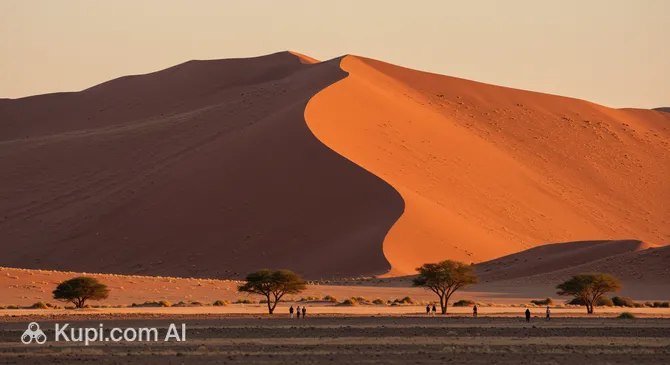
Sesriem is a unique place where the concepts of a "city park" or "museum" take on a completely different meaning. There are no usual paved paths, fenced gardens, or classic exhibition halls with paintings. The main exhibition curator and landscape designer in this region is nature itself, which over millions of years has created a grand open-air museum of geology, and the green zones here are rare and precious oases of life amidst endless sands.
Namib-Naukluft National Park is undoubtedly the main natural attraction surrounding the settlement. It is one of Africa's largest reserves, covering part of the world's oldest desert and the Naukluft mountain range. For the tourist, this "park" represents an infinite space for exploration: from high red dunes to stony plains. Here you can see how life adapts to extreme conditions: hardy camel thorn trees create the natural "architecture" of the desert, and rare shrubs serve as homes for many endemic insects and reptiles.
The second significant natural site, serving as a "city garden" for resting in the shade, is Sesriem Canyon itself. Unlike the windswept dunes, a special microclimate is maintained here. A walk along the canyon floor is like visiting a desert botanical garden: trees grow here that you won't find on the plateau surface, and life bustles in permanent pools of water. It is an ideal place for those who want to take a break from the scorching sun and enjoy the coolness of the stone walls while admiring the whimsically layered rock formations.
Speaking of museums, it is worth noting that there are no traditional galleries in Sesriem. However, the role of a cultural and educational center is played by the NWR Park Management Office at the entrance gates. Information stands are often placed here, explaining the region's geology, flora, and fauna of the Namib Desert. Tourists can learn about how the dunes were formed, which peoples inhabited these lands in antiquity, and how the fragile ecosystem dependent on Atlantic fogs works. This is a small but important educational point before diving into the wilderness.
A sort of "gallery of time" can be found at Deadvlei. Although it is a natural site, it is perceived as a surreal art installation. Frozen black trees against a backdrop of white clay and orange sands create a landscape that looks like an avant-garde artist's canvas. This place tells the story of climate change more vividly than any textbook, demonstrating a frozen moment that has lasted for centuries.
In terms of architecture, the interest lies not in historical buildings but in modern eco-lodges. Local hotels are built with deep respect for the landscape: many use natural stone, wood, and thatched roofs to visually blend with the desert. Some structures are styled as fortresses or traditional African huts, serving as an example of how humans can exist comfortably in harsh conditions without disturbing the harmony of the horizon.
Insider Tip: If you want to see something truly mysterious, look out for the so-called "Fairy Circles" in the grass on the outskirts of Sesriem. These are circular patches of bare earth surrounded by a ring of grass, the origin of which is still debated by scientists—from termite activity to the release of underground gases. And the best "museum" at night will be the sky: the region is one of the best places on the planet for astronomical observations, where the Milky Way is visible with startling clarity.