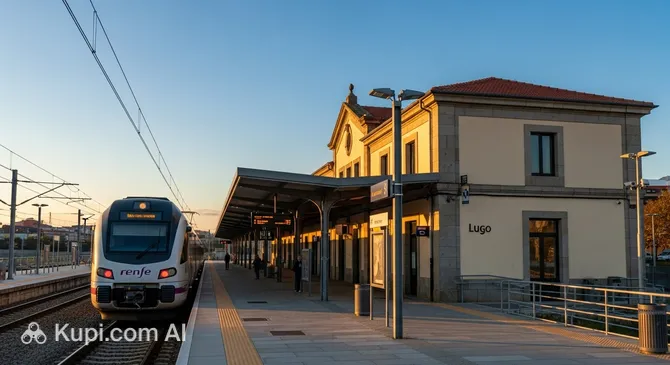
Lugo Railway Station (Estación de Lugo) serves as the main transport gateway to one of the oldest cities in Galicia. Combining historical charm with functionality, the station building serves long and medium-distance trains, connecting the city with Madrid, A Coruña, and other regions of Spain. It is a convenient starting point for travelers wishing to see the famous Roman walls, which are listed as a UNESCO World Heritage site.
It is important for passengers to know that the station is quite compact and simple to navigate. There are only a few tracks and platforms connected by safe crossings. Orienting yourself inside is very easy: from the main entrance, you immediately enter the ticket hall and waiting area, from where there is a direct and clear exit to the trains.
Contact Information
To plan your journey and contact the station administration, please use the following information:
Official Website: Current schedules and tickets are available on the Renfe and Adif portals.
Address: Praza do Conde de Fontao, 27003 Lugo, Spain.
Information Phone: (+34) 912 320 320 (Renfe general line).
Opening Hours: The station is open daily, approximately from 06:00 to 23:30 (times may vary depending on the schedule of the first and last train).
Accessibility: The station is adapted for passengers with reduced mobility, and the Atendo boarding assistance service is available (booking in advance is recommended).
How to Get There
You can reach Lugo station in several ways, as it is located relatively close to the historical centre, though in the lower part of the city.
On Foot: A walk from the famous Roman walls to the station will take about 10–15 minutes. Please note that the city is situated on an elevation, so the path from the station to the centre goes uphill, while the return journey is downhill.
Public Transport: City buses stop right next to the station building (at Conde de Fontao Square), connecting the station with various districts of the city.
Taxi: A taxi stand is located directly at the terminal exit. A trip to the centre will take 5–7 minutes and the fare is reasonably priced.
Services and Amenities
Despite its small size, the station in Lugo provides the necessary range of services for a comfortable wait for your train.
The terminal houses an indoor waiting hall with seating. For purchasing travel documents, there are ticket counters (please note they may close for breaks) and self-service machines. Restrooms are available on the premises.
Important: Zone-based Wi-Fi availability (Adif service) is implemented at the station. Luggage storage lockers at smaller stations may be absent or operate inconsistently, so it is recommended to clarify this issue in advance or not rely on long-term storage of belongings.
Where to Eat
A small cafeteria usually operates within the station grounds, where you can enjoy a coffee, order refreshments, or buy a sandwich while waiting for your train. This is a convenient option for a quick snack, and the average price here is quite affordable.
If you have more time to spare (from 40–50 minutes), it is better to head into the city. In the immediate vicinity of Conde de Fontao square, there are several local eateries and cafes where you can try Galician appetizers in a more atmospheric setting.
Station History
The history of railway communication in Lugo dates back to the second half of the 19th century. The station was inaugurated in 1875, when the first train arrived in the city from A Coruña. The arrival of the railway was a turning point for the region's economy, linking the interior of Galicia with the Atlantic coast.
The station building has retained features of the classical architecture of that time. Throughout its history, the station has undergone several stages of modernization regarding tracks and signaling systems. Today, Lugo station is an important link in plans for the development of the modern railway network in north-western Spain.
Passenger Tips
To ensure your journey is stress-free, please follow these tips:
Arrival: It is recommended to arrive at the station 20–30 minutes before departure. At Spanish stations, ticket checks and luggage scanning are often conducted before accessing the platform for long-distance trains (such as Alvia).
Tickets and Boarding: Keep your ticket (printed or on your smartphone) close at hand. For regional trains, it is usually sufficient to simply proceed to the platform, but inspectors may check tickets inside the carriage.
Safety and Waiting: During the night, when trains are not running, the station building closes. Do not plan to spend the night in the waiting hall.
Reached the bottom of the page?
Looks like you know this route inside out
Popular routes
Where travelers fly most — pick a route and check prices