Support

KabalegaFalls

About

Kabalega Falls (also known as Murchison Falls) is not just a geographical point, but a true gem of East Africa, located in the country's Northern Region. It is a place where the power of nature is felt in every drop of water and every sound of the savanna. Although administratively it is more of a natural site and a tourist hub than a traditional city, this is where travelers flock to see how beautiful and diverse Uganda really is.

The heart of this location is the waterfall itself, where the mighty White Nile, flowing from Lake Victoria, squeezes through a narrow gorge only 7 meters wide with incredible force and plunges down from a height of 43 meters. This spectacle creates a unique atmosphere filled with the roar of water and mist sparkling in the sun. To learn more about how this region was formed and how its names changed, explore the fascinating history of Kabalega Falls, full of discoveries and legends.
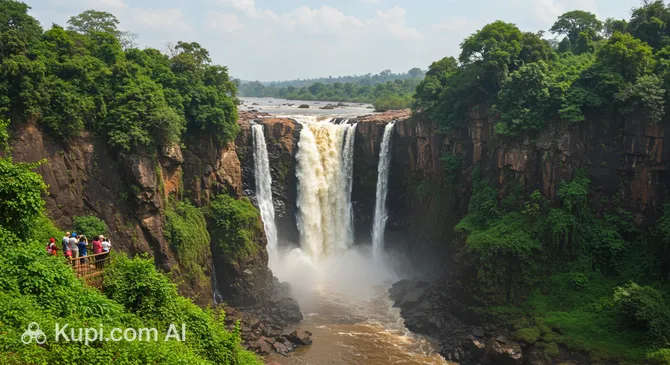
Kabalega Falls. Illustration.
Source: Kupi.com AI

The surroundings of the waterfall are an ideal destination for safari and wildlife enthusiasts. Here, amidst dense forests and vast savannas, you can encounter herds of elephants, graceful giraffes, and buffaloes. Birdwatchers and photographers will be particularly interested in the chance to see rare birds, including the grey crowned crane—the national symbol of the country. The tourist infrastructure is represented by cozy lodges and camps that allow for a comfortable rest after an eventful day.

A visit to Kabalega Falls is a must for those seeking true adventure. There is no urban hustle here; instead, there is the majesty of African nature, which leaves an indelible impression for a lifetime. This place is perfect for those who want to reset and feel the rhythm of wild Africa.
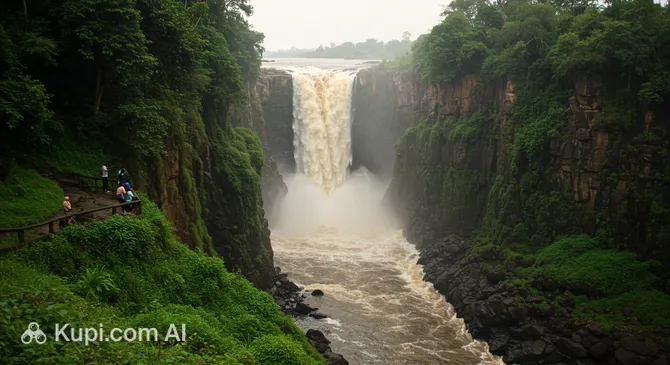
Weather Overview

The climate in the Kabalega Falls area can be described as tropical and hot, making this location accessible for visits year-round. The temperature regime here is remarkably stable: average figures stay in the range of 25°C to 29°C, while nights bring comfortable coolness as the air cools down to about 21°C.

The hottest and driest period occurs at the beginning of the year. In January and February, daytime temperatures often rise to 34–35°C, and precipitation is extremely rare—only 3 to 6 rainy days per month are recorded. This time is considered excellent for those who prefer clear weather, though one should be prepared for the heat.

With the arrival of March, the picture changes: a long wet season begins, lasting until November. During these months, the number of rainy days significantly increases, peaking in April, September, and October (up to 20–23 rainy days). Expect warm days with occasional refreshing showers during this period.

When planning a trip, it is important to consider these seasonal characteristics. Detailed weather at Kabalega Falls by month will help you choose the ideal dates for your journey and properly prepare for your encounter with Uganda's wildlife.

Average monthly temperature

Average monthly precipitation

Interesting Facts

In addition to breathtaking landscapes and the incredible power of the elements, Kabalega Falls holds many curious details and stories that make a visit to this place even more meaningful for travelers.

  • This landmark actually has two names, reflecting the complex history of the region. Although explorer Samuel Baker named Murchison Falls after the president of the Royal Geographical Society, the name Kabalega is officially used in modern Uganda. It is named after Omukama (King) Kabalega II, the ruler of the Bunyoro Kingdom, who is an important historical figure for the local people.

  • This place holds a unique hydrological record. An amazing natural phenomenon occurs here: a huge mass of water from the Victoria Nile, which is quite wide upstream, suddenly rushes into a narrow rocky gorge only 7 meters wide. Such colossal pressure turns the flow into one of the most powerful in the world.

  • The surrounding area is a true paradise for birdwatchers, home to more than 450 species of birds. This is where tourists have a high chance of seeing the rare and mysterious shoebill, which resembles a prehistoric creature, as well as meeting the grey crowned crane—a graceful bird that is the national symbol of the country.

  • Among indigenous peoples, there are beliefs that imbue the waterfall with mystical power. The roar of the falling water is often interpreted as the voice of ancestors, and a beautiful local legend says: if you sincerely make a wish while standing by the raging torrent, it will surely come true.

Murchison Falls. Illustration.
Source: Kupi.com AI

Traveler photos:

How to Get There

Planning a trip to this wonder of nature requires careful route selection, as the attraction is remote from major cities. You can find out more details on how to get to Kabalega Falls to create an optimal travel plan that considers your preferences for time and comfort.

The main way for international tourists to reach the region is by air followed by a transfer. The country's main gateway is Entebbe International Airport (IATA: EBB). It is important to note that it is not located right by the falls, but in the city of Entebbe, approximately 261 km away. This is the largest transport hub with a passenger flow of over 2 million people per year. A trip from here by taxi or tour bus to the park takes about 7 hours.

Another option, convenient for organizing charter flights by light aircraft, is Kajjansi Airport (IATA: KJJ). It is located in the town of Katwe, about 249 km from Kabalega Falls. Despite its modest passenger traffic, this airfield is popular among travelers heading on safari. Ground transfer from here takes approximately 6 hours and 30 minutes.

For clarity, here is a summary of the main airports through which you can plan your route:

AirportPassenger trafficDistance
Kajjansi25 000249 km
Entebbe International Airport2.2 mln261 km
Juba International Airport650 000287 km
Kasese Airport18 000291 km

Main Attractions

Visiting this region is an immersion into a world of wildlife where every location offers unique emotions. While the area itself is named after the famous cascade, the surroundings of the national park offer travelers a whole complex of breathtaking natural sites to include in their itinerary.

The absolute dominant feature and main magnet for tourists is Murchison Falls. This is the place where the calm and wide Nile turns into a roaring beast, squeezing through a narrow rocky gorge. Tourists are offered two main ways to experience it: an exciting boat cruise to the base, where you can feel the power of the water mist, or a hike to the \"Top of the Falls,\" which offers a dizzying panorama of the abyss and often features a bright rainbow.

Murchison Falls. Illustration.
Source: Kupi.com AI

Traveler photos:

South of the river lies the Budongo Forest—a true paradise for primate lovers. It is the largest mahogany forest in East Africa, famous for its chimpanzee population. Chimpanzee trekking here is considered one of the best in Uganda due to the high probability of meeting these intelligent animals. Additionally, the forest is well-known among birdwatchers for its \"Royal Mile\" stretch, where rarest species of forest birds can be observed.

Special attention should be given to the Victoria Nile Delta, where the river flows into Lake Albert. This is a marshy area best explored during a boat safari. This is where you have the highest chances of seeing the mysterious shoebill stork—a bird with a prehistoric appearance sought after by photographers from around the world. The delta landscapes, with papyrus thickets and calm water, create a striking contrast to the churning rapids of the falls.

Near the main flow lies the lesser-known but picturesque Uhuru Falls. It was formed in 1962 when heavy rains forced the river to break out of its main channel and create a second cascade. It is best viewed from the north bank or from the top of the main waterfall. Uhuru adds scale to the landscape, creating the feeling that water is bursting through the rocks everywhere.

Local Cuisine

The culinary scene in the Kabalega Falls area has its own unique characteristics. Since this attraction is located in the heart of a national park, you won't find the usual city restaurants or noisy street food markets here. The main culinary life is centered in safari lodges and camps, which offer guests a surprising mix of European service and authentic African flavors.

The main delicacy of the region is certainly fresh fish. The proximity of the great river dictates the menu: be sure to try the Nile perch or tilapia. Local lodges prepare fish masterfully—most often it is grilled whole or served as a fillet with spicy herbs and lime. This simple but incredibly tasty dish pairs perfectly with a river view at sunset.

Murchison Falls. Illustration.
Source: Kupi.com AI

Traveler photos:

If you want to get acquainted with traditional Ugandan cuisine, look for matooke on the menu. This is a mash made from unsweetened green bananas, which resembles potatoes in texture but has a more delicate taste. It is often served with a thick peanut sauce (G-nut sauce), which gives the dish a hearty and nutty aroma. Another gastronomic hit is luwombo. This is meat (usually chicken, beef, or goat) stewed with vegetables in a closed banana leaf envelope, which allows all the juices and aromas to be preserved inside.

As a quick snack often offered to tourists before a safari, there is the famous Ugandan \"rolex\". This is not a watch, but a rolled-up chapati flatbread with an omelet, tomatoes, and cabbage inside. This filling and inexpensive dish, which has become a true symbol of the country's street food, is available even in hotel restaurants.

The food culture here is inextricably linked with nature. Many lodges organize so-called \"bush breakfasts\" right in the middle of the savanna or candlelit dinners accompanied by the sounds of the wild. For day excursions when you head out to see Murchison Falls, you will likely be offered picnic lunch boxes to enjoy in designated areas with panoramic views.

As for drinks, look out for the local beer, whose name—Nile Special—is a perfect fit for the location. Fans of stronger drinks can try \"Waragi,\" a local gin often used in cocktails. And, of course, don't forget Ugandan tea and coffee, which are grown in this country and are known for their rich flavor.

Travel Tips

A journey to Kabalega Falls is a true expedition into the world of wildlife, requiring more thorough preparation than a standard city trip. To ensure your adventure in the heart of Africa is comfortable and safe, we have gathered a list of the most important recommendations to help you enjoy the majesty of the elements without being distracted by domestic inconveniences.

  1. Clothing and Gear. Since you are heading to the savanna, choose clothes made of natural breathable fabrics in neutral colors (khaki, beige, olive). Important: avoid dark blue and black colors—they attract tsetse flies, whose bites are quite painful. For the hike to the top of the falls, comfortable trekking shoes with non-slip soles are essential. Don't forget a hat, sunglasses, and a raincoat, as tropical downpours can start suddenly.

  2. Transport and Moving Around. There is no public transport, metro, or taxis in the traditional sense here. The only way to get around the national park is a reliable 4x4 vehicle. The best solution is to rent a car with an experienced driver-guide in Kampala or Entebbe. Self-driving is possible, but roads can be difficult, especially after rain.

  3. Finance and Cash. There are virtually no ATMs near the falls or inside the park, so stock up on cash in advance. The local currency is the Ugandan shilling, but US dollars (bills issued after 2009) are also widely accepted for park entry fees and excursions. Bank cards only work in expensive lodges, and the terminal connection is often unstable. It is customary to tip guides and rangers (about 5-10 dollars per day).

  4. Health and First Aid Kit. The nearest pharmacies are in the town of Masindi (about 85 km from the park), so bring a full personal first aid kit. Uganda is a malaria risk zone, so be sure to use strong repellents and consult a doctor about taking preventive medication before your trip. Never drink tap water; use only bottled water.

  5. Connectivity and Communication. The official language of the country is English, and staff in the tourist zone speak it excellently. Mobile connectivity and 3G/4G (MTN or Airtel operators) work reasonably well near the lodges but may disappear deep in the park. Wi-Fi is usually only available in hotel lobbies and can be slow, so be prepared for a digital detox. Download offline maps in advance.

  6. Park Rules. The main etiquette here concerns interacting with nature. Never leave your vehicle during a safari without the guide's permission. Speak quietly so as not to scare the animals. When meeting local staff, it is customary to greet them with a handshake and a smile—Ugandans are very friendly and welcoming people.

  7. What to Strictly Avoid. Under no circumstances should you feed wild animals, especially baboons, which can be aggressive and snatch food from your hands. It is also strictly forbidden to swim in the Nile—even if the water seems calm, it is home to crocodiles and hippos, which pose a deadly danger.

  8. Useful Life Hack. Bring a good pair of binoculars and a powerful power bank. Electricity in some eco-lodges is supplied on a schedule (from a generator or solar panels), and you may have limited time to charge all your gadgets. Binoculars will allow you to see rare birds and animals hiding far from the road.

Following these simple rules will make your trip to Kabalega Falls easy and carefree. Respect the wildlife, pay attention to details, and Africa will reveal its most amazing secrets to you, leaving you with nothing but thrilled memories!

Entertainment & Nightlife

Entertainment in this part of Uganda is far from the usual standards of city life. There are no noisy nightclubs or shopping malls here; the entire leisure industry is built around the unique opportunities offered by wildlife. Travelers are offered activities that allow them to feel the spirit of Africa and get a dose of adrenaline.

A special place on the entertainment list is occupied by sport fishing. This activity attracts enthusiasts from all over the world dreaming of catching the legendary Nile perch. Giant specimens, which can exceed 100 kilograms, live in the turbulent waters at the foot of Murchison Falls. Fishing requires prior booking and a license, and the process itself most often follows the \"catch-photograph-release\" principle, which helps preserve the population of these river giants.

For those who want to see the savanna from an unusual perspective, hot air balloon safaris are organized. A flight at dawn gives completely different emotions than a jeep trip: you float silently over the treetops, watching nature wake up. From above, a fantastic panorama of the winding Nile, Lake Albert, and herds of animals casting long shadows on the golden grass opens up. Such an adventure concludes with a traditional bush breakfast and a glass of champagne.

The evening program in the lodges often includes cultural performances. Local folklore groups, such as the Mubako group, put on vibrant performances by the campfire. To the rhythmic sounds of the adungu (a traditional stringed instrument), dancers tell stories from the lives of the Acholi and Bunyoro tribes. This is not just a show, but an opportunity to touch the rich heritage of the region and support local communities.

Parks & Museums

Kabalega Falls and its surrounding area is a unique space where the concept of an \"urban park\" takes on a completely different scale, transforming into the endless expanses of the wild savanna. You won't find the usual glass display cases of museums or neatly trimmed city squares here; instead, nature itself acts as a grand open-air exposition, and historical monuments are inextricably linked to the era of great geographical discoveries.

Murchison Falls National Park is, without a doubt, the main and most impressive \"green zone\" of the region. Being the oldest and largest reserve in the country, it is divided by the Nile River into two sectors. The northern sector is a classic African savanna with Borassus palms and acacias, where you can observe lions, elephants, and Rothschild's giraffes. This is where the famous Murchison Falls is located, whose power and beauty attract thousands of travelers. The southern sector is more forested, creating ideal conditions for primates and forest birds.

Murchison Falls. Illustration.
Source: Kupi.com AI

Traveler photos:

Another important natural area worth visiting on the way to or from the falls is the Ziwa Rhino Sanctuary. This is the only place in Uganda where you can see white rhinos in the wild. The sanctuary is a vast protected area where tourists, accompanied by rangers, go on walking tours to track these majestic giants. This is not a zoo, but a true natural reserve playing a key role in restoring the rhino population in the country.

Regarding cultural and historical heritage, iconic geographical points serve the role of museums. One of these is Baker’s Point. This is a historical site on the south bank of the Nile from where Sir Samuel Baker and his wife Florence first saw the waterfall in 1864. Standing here, you can not only enjoy the panoramic view but also mentally transport yourself back to the era of explorers, imagining how this landscape appeared to Europeans a century and a half ago.

History buffs will be interested in visiting the old railway locomotive installed near the Paraa crossing. This rusting but atmospheric monument serves as a reminder of colonial times when a railway through East Africa was planned. Although there is no museum building here, this object serves as an excellent photo spot and a silent witness to the industrial ambitions of the last century.

Insider Tip: If you are looking for solitude and want to see the park as it was before the arrival of mass tourism, ask your guide to take you to the \"Honeymoon Track\" in the southern sector of the park. This area is less visited by jeeps but incredibly picturesque, especially at sunset when the light falls softly on the dense vegetation, and the chances of meeting shy leopards here are sometimes even higher than on popular routes.

Getting Around

Since Kabalega Falls is located within a national park, the public transport system familiar to metropolitan areas is absent here. You won't find a metro, trams, or regular city buses with schedules. The region's transport infrastructure is entirely subject to wildlife conditions and tourist needs, so moving around has its own specifics.

The main means of communication between nearby settlements (e.g., Masindi) and the park boundaries are matatus. These are local minibuses that serve as the primary form of transport for the population. They do not have fixed stops and stop on request. Travel in them is cheap, but comfort is minimal: vehicles are often overcrowded and there is no air conditioning. Payment is made in cash to the conductor; there are no tickets as such.

For traveling short distances in the surrounding towns, boda-bodas (motorcycle taxis) are used everywhere. This is the fastest and most maneuverable way to reach your destination, though it is considered quite risky due to the driving style of local riders. Important: entering the safari zone directly on a motorcycle is strictly prohibited for safety reasons, as this is predator territory.

Directly inside the park and in the area of the falls, specialized safari jeeps and tour vans perform the function of \"public transport.\" Walking between locations is not permitted. If you haven't rented a car, organized transfers from lodges are the only alternative. Renting an SUV (there is no car-sharing here, only traditional rental) is the most practical solution for those who want freedom of movement.

A unique feature of the local transport system is water communication. Regular boat trips along the Nile from the Paraa jetty to the base of the falls and to the river delta are not just an excursion, but a fully-fledged way to move between key points in the park. Boat tickets are purchased at the national park office or through your lodge's administration.

The payment system everywhere is exclusively cash. There are no validators, transport cards, or mobile apps for paying fares in this region. Always carry small bills in the local currency, as matatu and boda-boda drivers often do not have change. The price of a motorcycle taxi ride must be agreed upon in advance, before boarding, and bargaining is quite appropriate here.

Accommodation

Accommodation in the Kabalega Falls area (Murchison Falls National Park) is not just a place to sleep, but an extension of your wildlife adventure. You won't find typical urban hotels or high-rise buildings here. Instead, tourists are offered atmospheric safari lodges, cozy tented camps, and campsites that are harmoniously integrated into the savanna landscape or hidden in the shade of riverine forests.

The choice of accommodation largely depends on which bank of the Nile you plan to stay on, as the river divides the park into two parts:

  • North Bank (Paraa): Most popular among fans of classic safaris, as this is where most of the wild animals live. Staying here saves time on morning ferry crossings and allows you to start your photo hunt with the first rays of the sun.
  • South Bank: This area is more forested and peaceful. It is ideal for those planning to trek to chimpanzees in the Budongo Forest or wishing to visit Murchison Falls from its upper viewpoint.
Murchison Falls. Illustration.
Source: Kupi.com AI

Traveler photos:

The range of accommodation options varies from budget campsites, where you can pitch your own tent or rent a simple hut (banda) with shared facilities, to luxury lodges of a 5-star level. In expensive options, guests can expect private bungalows with infinity pools, fine dining, and personal service. Many lodges are located right on the riverbank, allowing you to watch hippos and elephants coming to drink directly from your room's terrace.

Booking Tip: Since the number of places in the park is strictly limited to preserve the ecosystem, good lodges fill up very quickly. If your trip falls during the \"high season\" (December–February or June–September), it is necessary to book accommodation at least 3–5 months before arrival.

The pricing policy here is higher than the national average due to the remoteness of the location and the complexity of logistics. Budget accommodation will cost between 20 and 50 dollars per night, mid-range from 150 to 300 dollars, and the cost of a night in premium lodges can exceed 500 dollars. Most properties operate on a \"full board\" (all-inclusive) basis, as there are no alternative dining options in the savanna. It is most convenient to book accommodation through safari tour operators or directly through the official websites of the lodges.

Nearby Cities

For those who want to explore the surroundings, Kabalega Falls serves as an excellent starting point for day trips to several interesting nearby places. Although the waterfall itself is in the heart of the wild, there are towns within a comfortable driving distance that allow for a deeper dive into Ugandan culture and life.

One of the most convenient destinations is Masindi—the town closest to the park, often called the \"gateway\" to the falls. This is a colorful place with a relaxed atmosphere, where travelers can visit local markets, see colonial architecture, and restock supplies before a safari. A trip here is perfect for experiencing daily life in the Ugandan province without unnecessary hustle.

For history and ethnography lovers, Hoima is of interest. This city is the capital of the ancient Bunyoro-Kitara Kingdom. The palace of the Omukama (King) is located here, providing a unique opportunity to touch upon traditions and the monarchical way of life that still plays an important role in the local community.

If you are interested in a more dynamic urban environment, it is worth paying attention to Gulu—the largest economic and cultural center of the Northern Region. The city is famous for its craft shops, diverse cuisine, and lively atmosphere. A visit here will allow you to see the modern face of the country's north, which differs strikingly from the southern regions.

CityPopulationDistance
Pakuba25 km
Pakwach28 70029 km
Bulisa9 50035 km
Nwoya4 29553 km
Kiryandongo31 61062 km

These nearby destinations provide an insight into the diverse culture and landscapes of the region, harmoniously complementing the wildlife experience of the national park.

Shopping & Souvenirs

General Overview: Shopping in the Kabalega Falls area has its own unique characteristics. This is national park territory, so you won't find the usual malls, outlets, or designer boutiques here. Shopping in this location is more of a pleasant addition to a safari and an opportunity to purchase authentic souvenirs reminiscent of an encounter with Uganda's wildlife.

Main Shopping Points: Commercial activity is concentrated in a few key areas. Primarily, these are specialized gift shops at safari lodges, offering high-quality products, nature books, and maps. Small stalls can also be found at major tourist hubs, such as near the Paraa crossing or at the top of the cliff where Murchison Falls roars.

Lack of Supermarkets: It is important to understand that there are no grocery stores, pharmacies, or electronics shops within the reserve itself. If you need food, specific batteries, hygiene products, or medications, they must be purchased in advance in larger settlements along the way, such as Masindi or Kampala.

What to Buy: The range of souvenirs here vividly reflects the local flavor. Particularly popular are:

  • Woodwork: skillfully carved figurines of the \"Big Five\" animals and traditional masks.
  • Textiles: vibrant \"kitenge\" fabrics and clothing with African prints.
  • Woven products: handmade baskets and bowls with geometric patterns.
  • Gastronomy: Ugandan coffee (Arabica and Robusta) and tea from local plantations make excellent gifts.

Local Community Markets: The most interesting and inexpensive finds often await tourists in stalls located at the park gates. These outlets are often managed by women's cooperatives or local communities. By buying here, you directly support residents of villages bordering the reserve. Additionally, bargaining is customary here, turning a purchase into a lively interaction.

Payment and Opening Hours: Shops in lodges usually stay open late to accommodate guests, while street stalls close at sunset (around 6:00 PM – 7:00 PM). There are no ATMs in the park. While expensive hotels may accept cards, for souvenir purchases from artisans, cash (Ugandan shillings or small denomination US dollars) is absolutely necessary.

Nearby cities

Have you reached the end of the page?

So the route has been studied inside and out