Climbing Mount Rinjani, Lombok Island.
Our subscriber Nikita continues his story about his trip to Indonesia.
"Mount Rinjani is a place that, even from the planning stage, attracted me with its height and beauty. Moreover, it is the second highest peak in all of Indonesia. The volcano is located on Lombok Island - neighboring Bali. I arrived there with a pit stop on Gili Air island. From Gili Air, for 12000 rupiah, I took a boat to Lombok.
The boat has no schedule and departs as soon as enough people gather. It is mainly used by locals, as it's a budget option, so I was the only European on the boat. After 40 minutes, I was on Lombok and looking for a moped to get to the start of the Rinjani trek.
The port where boats from Gili arrive is a small town, and there are practically no rentals there. I was lucky, and for 50000 rupiah a day, I made a deal with a local who, in front of me, pushed his wife off her moped, told her she'd manage for a few days, and with a smile, handed it over to me. Happy, with Hello Kitty stickers on the moped, I drove to the starting point.
 You can ascend Rinjani from two villages - Senaru and Sembalun. Usually, everyone starts in Senaru, as there is a checkpoint, a local trekking center. Since I didn't want to be ripped off for "guide" services, I decided I would go from Sembalun (by the way, I never figured out if they allow people to go alone, or if they shout that it's impossible without a guide). I, of course, intended to go alone.
I had all my camping gear with me, and I really didn't want to pay 1.2 million rupiah for a guide (that's the lowest price I heard). Jumping ahead, I'll say that, as it seemed to me, it's better to start from Sembalun. Initially, the path goes through picturesque fields, and the incline is very gentle. After an hour and a half to two hours through the fields, the hard work begins, and it takes another 4-5 hours to reach the base camp on the rim of the volcano crater. My time can be considered very slow because I carried absolutely all my belongings that I had on the trip, plus a tent, sleeping bag, and stove.
You can ascend Rinjani from two villages - Senaru and Sembalun. Usually, everyone starts in Senaru, as there is a checkpoint, a local trekking center. Since I didn't want to be ripped off for "guide" services, I decided I would go from Sembalun (by the way, I never figured out if they allow people to go alone, or if they shout that it's impossible without a guide). I, of course, intended to go alone.
I had all my camping gear with me, and I really didn't want to pay 1.2 million rupiah for a guide (that's the lowest price I heard). Jumping ahead, I'll say that, as it seemed to me, it's better to start from Sembalun. Initially, the path goes through picturesque fields, and the incline is very gentle. After an hour and a half to two hours through the fields, the hard work begins, and it takes another 4-5 hours to reach the base camp on the rim of the volcano crater. My time can be considered very slow because I carried absolutely all my belongings that I had on the trip, plus a tent, sleeping bag, and stove.
 I was "lucky" and ascended on some national holiday, along with crowds of Indonesians. By the way, Indonesians themselves are very nice and friendly people. They treated me to something all the way, always offered help, never let me cook for myself, always fed me their trekking food, which was very tasty :)
Setting out on the trail at dawn, I reached the rim of the volcano around two in the afternoon. I tried to set up my tent and lie down to sleep as quickly as possible, because the ascent to the summit needs to start around midnight. Sleeping in the camp is quite difficult because Indonesians dance, sing, shout, and have fun. For many, the crater rim is the final goal.
I was "lucky" and ascended on some national holiday, along with crowds of Indonesians. By the way, Indonesians themselves are very nice and friendly people. They treated me to something all the way, always offered help, never let me cook for myself, always fed me their trekking food, which was very tasty :)
Setting out on the trail at dawn, I reached the rim of the volcano around two in the afternoon. I tried to set up my tent and lie down to sleep as quickly as possible, because the ascent to the summit needs to start around midnight. Sleeping in the camp is quite difficult because Indonesians dance, sing, shout, and have fun. For many, the crater rim is the final goal.
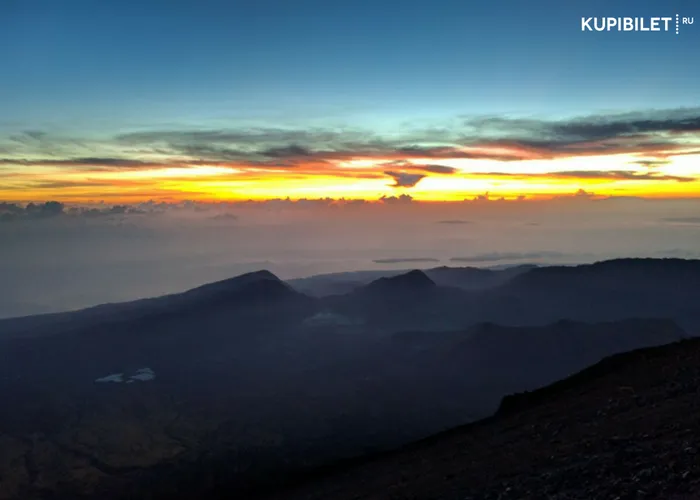
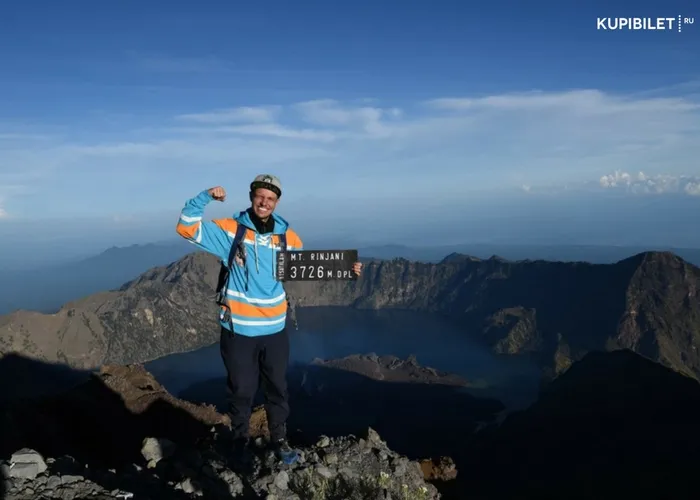
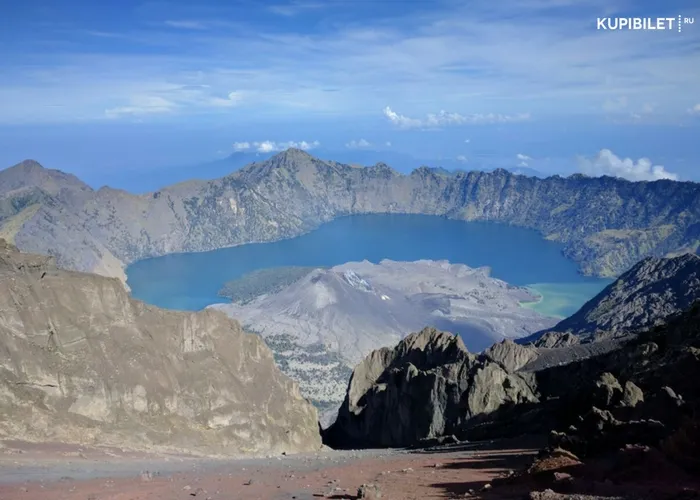 After somehow getting some sleep, I set out for the summit around midnight. The path to the highest point is very difficult. It's a mixture of sand, ash, and dust, about ankle-deep. The journey to the summit took me 6 hours; I could have gone faster, but the elevation gain in 1 day was from zero to 3726 meters, which significantly affected my well-being. Descending this sand is pure joy.
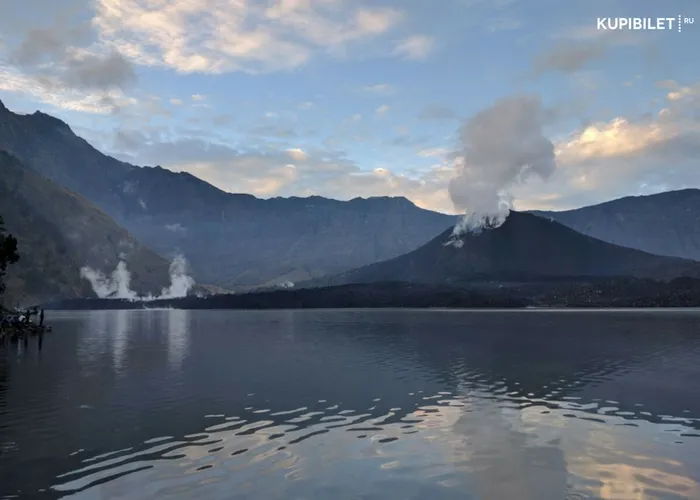
 I ran down and reached the base camp in just an hour and a half. After resting for a couple of hours, I continued my journey and descended to the camp by the lake in the center of the crater. This part of the path is not very difficult and takes 3-4 hours. At night, I woke up to very loud bangs, heard movement in other tents, and poked my head out to check what was happening. It turned out that the volcano in the center of the crater was erupting. There was no full eruption, but it smoked very actively for the first few hours. Locals told me that this is not a very frequent phenomenon and happens once a month, or even less often.
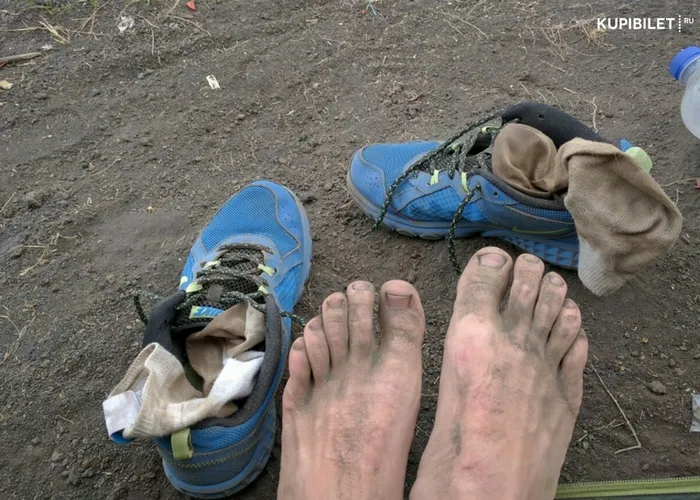
The path from the lake camp to Senaru is pain. First, you need to climb back up from the center of the crater to its rim, which takes about 3-4 hours. After that, there's a long and steep descent that I walked for about 7 hours. In general, I want to note that local tour companies clearly downplay the difficulty of this trek to attract more tourists, because, in reality, it's far from easy. Along the way, I saw many people turning back and heading down.
Probably, my experience wouldn't have been so tough if I had traveled light, with guides and porters, but since I was alone with two backpacks weighing 20+ kg, this ascent was very difficult for me. But it was definitely worth it! In my opinion, the easiest route is to ascend from Sembalun to the base camp on the crater rim, climb to the summit, and descend the same way. This can be done in 2 days, not easy, but realistic. And, as it seemed to me, it's better to ascend from Sembalun in any case, because the path is not as difficult as from Senaru, which allows you to save energy for the summit ascent, which needs to be done at night on the same day".
I ran down and reached the base camp in just an hour and a half. After resting for a couple of hours, I continued my journey and descended to the camp by the lake in the center of the crater. This part of the path is not very difficult and takes 3-4 hours. At night, I woke up to very loud bangs, heard movement in other tents, and poked my head out to check what was happening. It turned out that the volcano in the center of the crater was erupting. There was no full eruption, but it smoked very actively for the first few hours. Locals told me that this is not a very frequent phenomenon and happens once a month, or even less often.
The path from the lake camp to Senaru is pain. First, you need to climb back up from the center of the crater to its rim, which takes about 3-4 hours. After that, there's a long and steep descent that I walked for about 7 hours. In general, I want to note that local tour companies clearly downplay the difficulty of this trek to attract more tourists, because, in reality, it's far from easy. Along the way, I saw many people turning back and heading down.
Probably, my experience wouldn't have been so tough if I had traveled light, with guides and porters, but since I was alone with two backpacks weighing 20+ kg, this ascent was very difficult for me. But it was definitely worth it! In my opinion, the easiest route is to ascend from Sembalun to the base camp on the crater rim, climb to the summit, and descend the same way. This can be done in 2 days, not easy, but realistic. And, as it seemed to me, it's better to ascend from Sembalun in any case, because the path is not as difficult as from Senaru, which allows you to save energy for the summit ascent, which needs to be done at night on the same day".
 To be continued...
You can ascend Rinjani from two villages - Senaru and Sembalun. Usually, everyone starts in Senaru, as there is a checkpoint, a local trekking center. Since I didn't want to be ripped off for "guide" services, I decided I would go from Sembalun (by the way, I never figured out if they allow people to go alone, or if they shout that it's impossible without a guide). I, of course, intended to go alone.
I had all my camping gear with me, and I really didn't want to pay 1.2 million rupiah for a guide (that's the lowest price I heard). Jumping ahead, I'll say that, as it seemed to me, it's better to start from Sembalun. Initially, the path goes through picturesque fields, and the incline is very gentle. After an hour and a half to two hours through the fields, the hard work begins, and it takes another 4-5 hours to reach the base camp on the rim of the volcano crater. My time can be considered very slow because I carried absolutely all my belongings that I had on the trip, plus a tent, sleeping bag, and stove.
I was "lucky" and ascended on some national holiday, along with crowds of Indonesians. By the way, Indonesians themselves are very nice and friendly people. They treated me to something all the way, always offered help, never let me cook for myself, always fed me their trekking food, which was very tasty :)
Setting out on the trail at dawn, I reached the rim of the volcano around two in the afternoon. I tried to set up my tent and lie down to sleep as quickly as possible, because the ascent to the summit needs to start around midnight. Sleeping in the camp is quite difficult because Indonesians dance, sing, shout, and have fun. For many, the crater rim is the final goal.
After somehow getting some sleep, I set out for the summit around midnight. The path to the highest point is very difficult. It's a mixture of sand, ash, and dust, about ankle-deep. The journey to the summit took me 6 hours; I could have gone faster, but the elevation gain in 1 day was from zero to 3726 meters, which significantly affected my well-being. Descending this sand is pure joy.
I ran down and reached the base camp in just an hour and a half. After resting for a couple of hours, I continued my journey and descended to the camp by the lake in the center of the crater. This part of the path is not very difficult and takes 3-4 hours. At night, I woke up to very loud bangs, heard movement in other tents, and poked my head out to check what was happening. It turned out that the volcano in the center of the crater was erupting. There was no full eruption, but it smoked very actively for the first few hours. Locals told me that this is not a very frequent phenomenon and happens once a month, or even less often.
The path from the lake camp to Senaru is pain. First, you need to climb back up from the center of the crater to its rim, which takes about 3-4 hours. After that, there's a long and steep descent that I walked for about 7 hours. In general, I want to note that local tour companies clearly downplay the difficulty of this trek to attract more tourists, because, in reality, it's far from easy. Along the way, I saw many people turning back and heading down.
Probably, my experience wouldn't have been so tough if I had traveled light, with guides and porters, but since I was alone with two backpacks weighing 20+ kg, this ascent was very difficult for me. But it was definitely worth it! In my opinion, the easiest route is to ascend from Sembalun to the base camp on the crater rim, climb to the summit, and descend the same way. This can be done in 2 days, not easy, but realistic. And, as it seemed to me, it's better to ascend from Sembalun in any case, because the path is not as difficult as from Senaru, which allows you to save energy for the summit ascent, which needs to be done at night on the same day".
To be continued...