Pickpockets in Europe. Tips on how not to become a victim
When traveling in Europe, always be on the alert. Tourists are the favorite clients of petty thieves and pickpockets. In this article, we will tell you what tricks pickpockets in Europe most often use, where you might encounter them, and how not to become their victim.
 Most pickpockets operate in large cities popular with tourists:
 Why children? It's simple. Even if the police catch them, they won't be able to do much, other than perhaps scare them. They are minors, and it's unlikely they carry passports or other identification documents. They won't be able to hold them at the station for long and will release them anyway.
Another type of thief is well-dressed people, often elderly. They might not just be well-dressed, but very well-dressed, and, for example, holding a bag with the emblem of an expensive store. But the bag is just a prop to lull your vigilance. If it looks worn, crumpled, without a brand sticker on top (in expensive stores, bags are usually sealed with a sticker), then you should be wary; it might just be a prop.
Why children? It's simple. Even if the police catch them, they won't be able to do much, other than perhaps scare them. They are minors, and it's unlikely they carry passports or other identification documents. They won't be able to hold them at the station for long and will release them anyway.
Another type of thief is well-dressed people, often elderly. They might not just be well-dressed, but very well-dressed, and, for example, holding a bag with the emblem of an expensive store. But the bag is just a prop to lull your vigilance. If it looks worn, crumpled, without a brand sticker on top (in expensive stores, bags are usually sealed with a sticker), then you should be wary; it might just be a prop.
Most pickpockets operate in large cities popular with tourists:
- Barcelona
- Rome
- Paris
- Madrid
- Athens
- Prague
- Lisbon
- Florence
- London
- Amsterdam
Who are pickpockets?
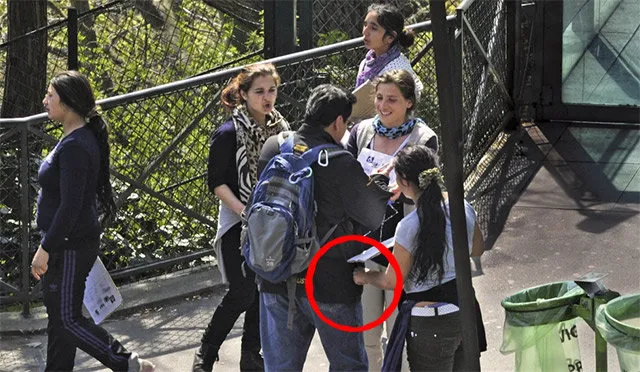
Unfortunately, pickpockets have no distinguishing features or characteristics. It can be very difficult to identify them, sometimes even in pairs. As a rule, pickpockets work in small groups of 2-3 people. In most cases, these are children or teenagers, and not necessarily dirty and in ragged clothes or Roma; they can be perfectly ordinary children, clean and well-dressed.
Why children? It's simple. Even if the police catch them, they won't be able to do much, other than perhaps scare them. They are minors, and it's unlikely they carry passports or other identification documents. They won't be able to hold them at the station for long and will release them anyway.
Another type of thief is well-dressed people, often elderly. They might not just be well-dressed, but very well-dressed, and, for example, holding a bag with the emblem of an expensive store. But the bag is just a prop to lull your vigilance. If it looks worn, crumpled, without a brand sticker on top (in expensive stores, bags are usually sealed with a sticker), then you should be wary; it might just be a prop.
Where are pickpockets most often encountered?
Public Transport
Metro, tram, bus... favorite places for thieves, especially during rush hour. But being vigilant only on transport is not enough; most thefts occur at the stop while waiting for transport or while you are going up or down an escalator. As a rule, they observe the victim for some time, watching where you put your phone or wallet. They rarely operate blindly.Attractions
Emptying your pockets while you enjoy the view of the Eiffel Tower is easy. In any place with a large crowd of tourists, you need to be extremely careful, because the main target of a thief is precisely a tourist.Museums
Don't relax in a museum either; even though the entrance ticket is paid, this doesn't stop thieves, who will easily recoup all their expenses from the very first client.Restaurants and Cafes
What do most of us do while waiting for an order in a restaurant? Most often, we fiddle with our phones, play games, like posts on Facebook or photos on Instagram... And what do we do when our order arrives? We put the phone on the table and enjoy the meal. This is the biggest mistake! Some scammers specialize precisely in this; they instantly rush past your table, grab your phone, and run away. Most often, visitors to summer terraces and outdoor tables become victims. If you like to combine your meal with your phone, then either choose a table further inside, not at the edge, or always put your phone in your bag. But your phone is not the only thing that can be stolen from you. The contents of a bag hanging on the back of a chair are also at risk, as are the pockets of a jacket or blazer that you have taken off and hung up.What techniques do pickpockets use?
Distraction
There are many ways to distract a victim. This includes asking for directions on a map, an "accidental" coffee spill, collecting signatures for charity.... We recently wrote a little more about this in the article "How tourists are scammed".Bumping
There can be two variations in this case. If the criminal works alone, they simply push or brush past you and, at that moment, take your phone or wallet from your pocket. Things are a bit more complicated if they work in pairs. In this case, an accomplice suddenly stops in front of you, and their partner, as if by accident, bumps into you and commits the theft. The second variation is often used on escalators. The person in front of you suddenly stops when exiting the escalator, you bump into them, and their accomplice, who was behind you, carefully empties your pockets or bag. As a rule, on escalators, they work not even in pairs, but in groups. One creates an unforeseen situation, the second cleans out pockets and passes their contents to the third.Crowding
This technique is used in crowded transport. One of the passengers presses tightly against you and, at that moment, takes your belongings from your bag or pocket. If it's not easy to spot a pickpocket during rush hour, as everyone is crowded, then at other times, if you see someone standing too close to you when there's plenty of free space, it's better to move away. Often, a thief resorts to a small disguise, for example, holding a coat and using it to cover their hand while rummaging through your bag or pocket. Another method widely used in transport is cutting your bag. For this, not only a knife or blade is used, but also a sharpened coin.How not to become a victim of a pickpocket?
There are several fairly simple rules that many people know but somehow always forget.- Never put things in your back pocket. Men are most often guilty of this. Remember, it's not for nothing they say: "a back pocket is someone else's pocket."
- In a crowd, hold your bag tightly in your hands, pressed against your chest.
- In a queue, on transport, or on an escalator, take off your backpack and hold it in front of you.
- Always zip up your briefcase or bag and turn the zipper towards yourself.
- Be careful with phones and bags if you are standing right by the door on public transport. A second before the door closes, a thief can snatch your phone or bag from your hands.
- Do not wear a camera around your neck; it's easy to cut it off in a crowd or by bumping into you.
- Do not put all your money and credit cards in one place. It's better to distribute them evenly in different places. Even if your bag is cleaned out, you will still have some money left.
- Do not carry a lot of money with you. It's better to distribute your expenses by day and take only as much as you plan to spend today.
- And, of course, do not carry money and valuables in outer pockets.