Can you take cosmetics in hand luggage
Yes, there's a certain romance in applying your favorite cream, reclining your seat, and relaxing during a flight. But can you really take a tube of face wash or a bottle of perfume with you into the airplane cabin?
Today, we'll figure out how to transport cosmetics on a plane so that no one confiscates your valuable jar from a luxury boutique. Let's go!

What cosmetics can be taken on a plane
When transporting cosmetic products in hand luggage, you should refer to the rules of the airline you are flying with. Usually, cosmetic products are allowed in the cabin in small quantities: no more than 100 ml per item. These can be, for example, mascara, lipstick, cream, deodorant.
We still recommend checking with each specific airline whether cosmetics can be taken in hand luggage, as rules may vary. In some cases, you may need additional screening at the airport.
Cosmetics of any quantity and volume can be checked in as luggage. However, remember that pressed products — such as compact powder or eyeshadow — can break. If luggage is dropped or handled carelessly, not only the cosmetic product itself but also its packaging will suffer. Therefore, it is best to carry cosmetics in hand luggage, especially when it comes to loose products. You can carry any amount of eyeshadow, powder, blush, and other pressed cosmetics in hand luggage: the 100 ml restriction applies only to liquids.
Liquids in containers no larger than 100 ml are allowed in hand luggage. Even if you are carrying 70 ml of sunscreen in a 250 ml jar, it will have to be checked in as luggage. The total volume of all liquids in hand luggage must not exceed one liter.
Brands have taken this safety requirement into account: shampoos, creams, balms, and other cosmetic products can be purchased in travel-sized versions (their volume typically does not exceed 50–70 ml). If there's no travel format in the product line, samples can help — ask for them from consultants at cosmetic stores. Samples of products in sachets with a standard volume of 0.5–10 ml are not considered liquids — you can stock up on them for the entire trip. Alternatively, buy special 100 ml travel containers into which you can decant products from their main packaging.
It should be noted that the 100 ml restriction does not apply to perfumes and other items purchased at Duty Free. Typically, Duty Free purchases are packed in special bags for hand luggage transport that comply with airline requirements. You can carry any quantity of liquids, aerosols, and gels, provided you have kept the receipt and are transporting the items in a sealed bag.
What is considered liquid cosmetics
Now let's talk about what airlines consider liquids. Because (spoiler alert) not all products on the list might seem like liquids to the average person at first glance. So, here's a detailed list:
- deodorant;
- perfume and eau de toilette;
- eyeliner;
- mascara;
- hair spray;
- face mask in a tube;
- serum;
- shampoo;
- cream;
- spray;
- gel;
- cream eyeshadows and blushes.
That is, in essence, airlines consider not only flowing substances but also creamy products as liquids.
What cannot be carried in hand luggage
Cosmetics in hand luggage on a plane must be safe. Some cosmetic products may be prohibited from carriage in hand luggage due to their chemical composition or packaging method. As a rule, the following products are prohibited in the cabin:
- aerosols, such as spray deodorants and high-pressure hairsprays;
- liquids and gels if there is a risk of leakage (in particular, nail polish remover with acetone);
- aggressive cosmetic products — chemical products such as acids or peels.
How to properly pack cosmetics for hand luggage
The first thing to check is that any tube is tightly closed. If you need to transport eyeshadows and powder, it's best to cushion the compacts with fabric to prevent breakage.
Liquid and gel products should be packed in a separate transparent bag to prevent leakage. Ideally, it should look something like this:
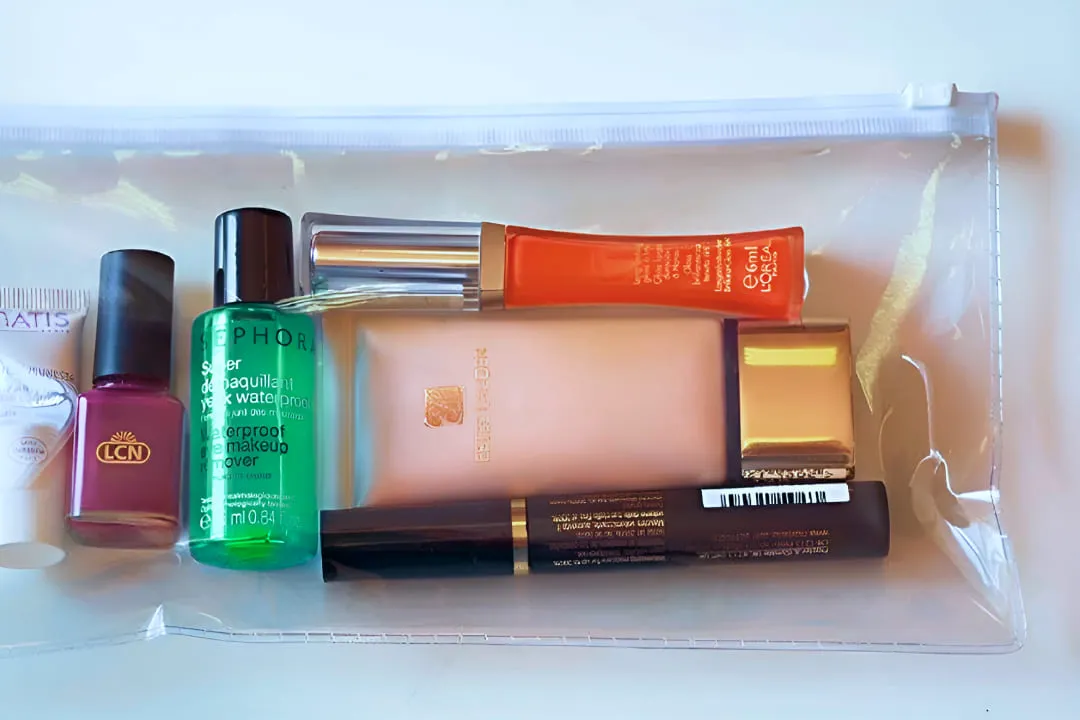
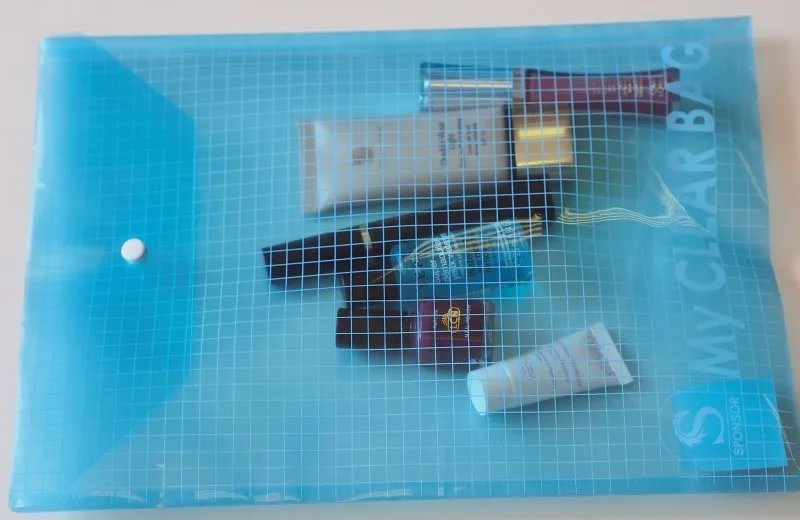
Such a bag can be bought at a stationery store. In general, any zip-lock bag will do, but you can also use this button-closure option, though it's preferable for it to be completely transparent:
What to do if a product is not allowed
If you are carrying a liquid exceeding 100 ml, you have three options:
- return to the check-in counter and register the bottle as checked luggage. If you went through pre-flight screening in advance, and not right before departure, you will have time to check in your favorite cream;
- send by mail. Many airports have a post office. If the item is valuable to you, and it's too late to check it in as luggage, you can send it home by mail;
- discard it. A harsh measure, but if there's no other way — it's unavoidable.
We hope your favorite jars travel with you all over the globe!