How to count Schengen stay days?
Since October 18, 2013, the procedure for calculating Schengen stay days for multiple-entry visas has changed. Today, we will look at how to count Schengen multiple-entry visa days according to the new rules. Officially, the rule states that you are entitled to stay in the Schengen area for 90 days within any 180-day period. However, the exact number of days always depends on your visa; it can be 30 or 45, not strictly 90. Let's consider an example (it's conditional, as this rule didn't exist in 2009 and 2010): 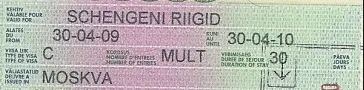 You were issued a visa from 30/04/2009 to 30/04/2010, i.e., for exactly 1 year Number of entries is indicated as MULT - multiple-entry visa. Duration of stay (duation of stay) - 30 Consequently, you can stay in the Schengen area for no more than 30 days in each half-year period. For the following visa:
 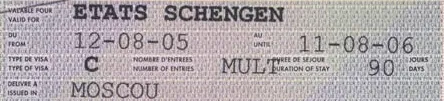 you can stay 90 days per half-year period. Note that the calculation is only for Category C visas; if you have a Category D visa, this rule does not apply to you. The calculation only includes visits to countries that are part of the Schengen Agreement. Trips to Bulgaria, Cyprus, the United Kingdom, Ireland, Romania, and Croatia are not counted. Be careful!
  It turns out that the sum of stay days should be counted from 20/05/2013. If you want to know if you will violate the rule with your planned trip, then count 180 days from the date of your intended departure. For counting, it is very convenient to use a special calculator from the European Commission website. However, it has one limitation: it only makes correct calculations when the number of stay days is 90; if you have 45 or 30, you will have to calculate it yourself. You can also do this in Excel: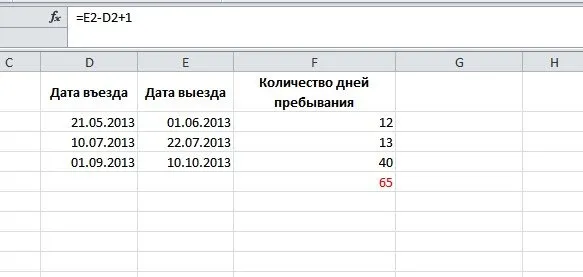
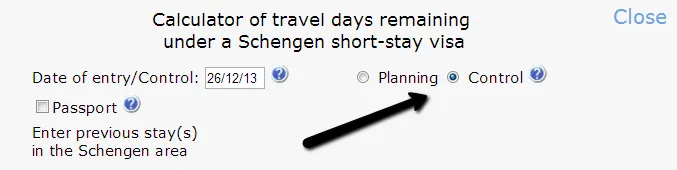 Pay attention to the line "Date of entry/Control:": the calculator automatically inserts today's date. If you want to check data from previous trips and/or find out how many more days you can spend in the Schengen area, set the date of your last departure or today's date. And if you want to check if you will violate the rule with your future trip, switch to "Planning" mode and set the date of your intended return. The calculator requires the dates of each entry and exit from Schengen countries for each trip, not necessarily in chronological order. If you have difficulty finding stamps with dates, check the box next to "Passport" and you can enter dates out of order; this is very convenient if you have many stamps and it's hard to sort them by trip.
 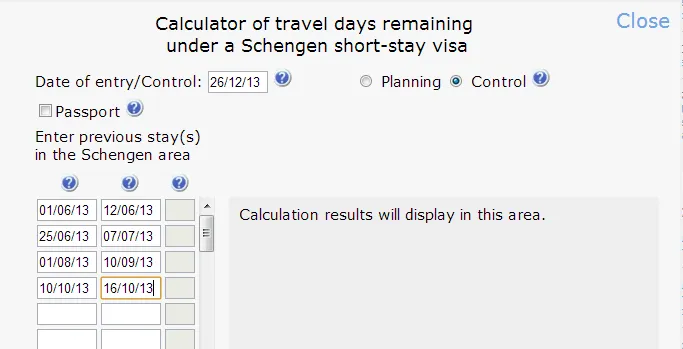 In total, we spent in Schengen: 12 + 14 + 40 + 7 = 73 days. This means we did not violate the rule.
 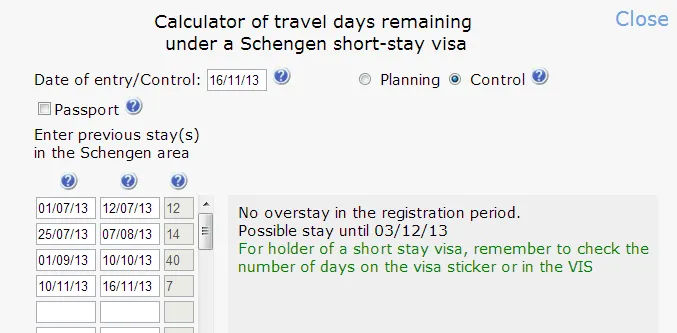 If you see the message "No overstay in registration period", then everything is in order; the line below will state until which date we can stay in the Schengen area. According to the calculator, we can stay in the Schengen area for another 17 days, until 03/12/2013. Example № 2 Trips on visa:
 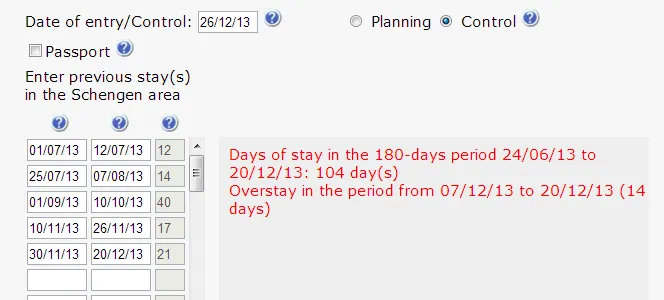 The red font color indicates that the rule has been violated. We stayed in the Schengen area 14 days longer than allowed and should have departed on 07/12/2013. The calculation for planned trips is done similarly.
You were issued a visa from 30/04/2009 to 30/04/2010, i.e., for exactly 1 year Number of entries is indicated as MULT - multiple-entry visa. Duration of stay (duation of stay) - 30 Consequently, you can stay in the Schengen area for no more than 30 days in each half-year period. For the following visa: you can stay 90 days per half-year period. Note that the calculation is only for Category C visas; if you have a Category D visa, this rule does not apply to you. The calculation only includes visits to countries that are part of the Schengen Agreement. Trips to Bulgaria, Cyprus, the United Kingdom, Ireland, Romania, and Croatia are not counted. Be careful! From what date does the 180-day count begin?
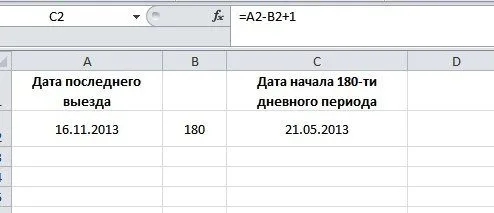
There are several options, depending on what information you want to obtain. If you want to check if you violated the rule with your previous trips, subtract 180 days from the date of your last departure from the Schengen area. For example, you left the Schengen area on 16/11/2013. Let's calculate when the 180-day period began: It's very convenient to do this in Excel: It turns out that the sum of stay days should be counted from 20/05/2013. If you want to know if you will violate the rule with your planned trip, then count 180 days from the date of your intended departure. For counting, it is very convenient to use a special calculator from the European Commission website. However, it has one limitation: it only makes correct calculations when the number of stay days is 90; if you have 45 or 30, you will have to calculate it yourself. You can also do this in Excel: How to use the Schengen day calculator?
The calculator works in two modes:- "Control" (Control) - checks your previous trips for any violation of the 90/180 rule.
- "Planning" (Planning) - will tell you how many days you can stay in the Schengen area without violating the rule.
Pay attention to the line "Date of entry/Control:": the calculator automatically inserts today's date. If you want to check data from previous trips and/or find out how many more days you can spend in the Schengen area, set the date of your last departure or today's date. And if you want to check if you will violate the rule with your future trip, switch to "Planning" mode and set the date of your intended return. The calculator requires the dates of each entry and exit from Schengen countries for each trip, not necessarily in chronological order. If you have difficulty finding stamps with dates, check the box next to "Passport" and you can enter dates out of order; this is very convenient if you have many stamps and it's hard to sort them by trip. The data entry format is regulated; dates must be written as dd/mm/yy - 01/12/13.
Dates must be entered into the table under the heading "Enter previous stay(s) in the Schengen area". Entry dates are entered in the leftmost column, exit dates in the central column, and the rightmost column shows the number of days, which is calculated automatically after clicking the "Calculate" button. After entering all data, click the "Calculate" button and view the results. To make it clearer, let's look at how the calculator works with examples. Example № 1: We want to check if we violated the 90/180 requirement, so we select "Control" mode. Trips over the last 180 days:- Germany from 01/07/13 to 12/07/13 - 12 days
- Czech Republic from 25/07/13 to 07/08/13 - 14 days
- Spain from 01/09/13 to 10/10/13 - 40 days
- Germany from 10/11/13 to 16/11/13 - 7 days
In total, we spent in Schengen: 12 + 14 + 40 + 7 = 73 days. This means we did not violate the rule. If you see the message "No overstay in registration period", then everything is in order; the line below will state until which date we can stay in the Schengen area. According to the calculator, we can stay in the Schengen area for another 17 days, until 03/12/2013. Example № 2 Trips on visa: - Germany from 01/07/13 to 12/07/13 - 12 days
- Czech Republic from 25/07/13 to 07/08/13 - 14 days
- Spain from 01/09/13 to 10/10/13 - 40 days
- Germany from 10/11/13 to 26/11/13 - 17 days
- Poland from 30/11/13 to 20/12/13 - 21 days
The red font color indicates that the rule has been violated. We stayed in the Schengen area 14 days longer than allowed and should have departed on 07/12/2013. The calculation for planned trips is done similarly.