How to transport a bicycle, moped, or kayak on a train
 Yasya
YasyaSummer is coming, vacation is coming, hiking, rafting, cycling, and all other active-tourism activities are coming soon. And newly-minted conquerors of rivers, rapids, and trails ask themselves: “How do I get my bicycle (kayak, catamaran, motorcycle – underline as appropriate) from point A to point B?” School taught us to calculate distance, time, and speed, but it didn't warn us that various rules would also be involved. Let's talk about them!
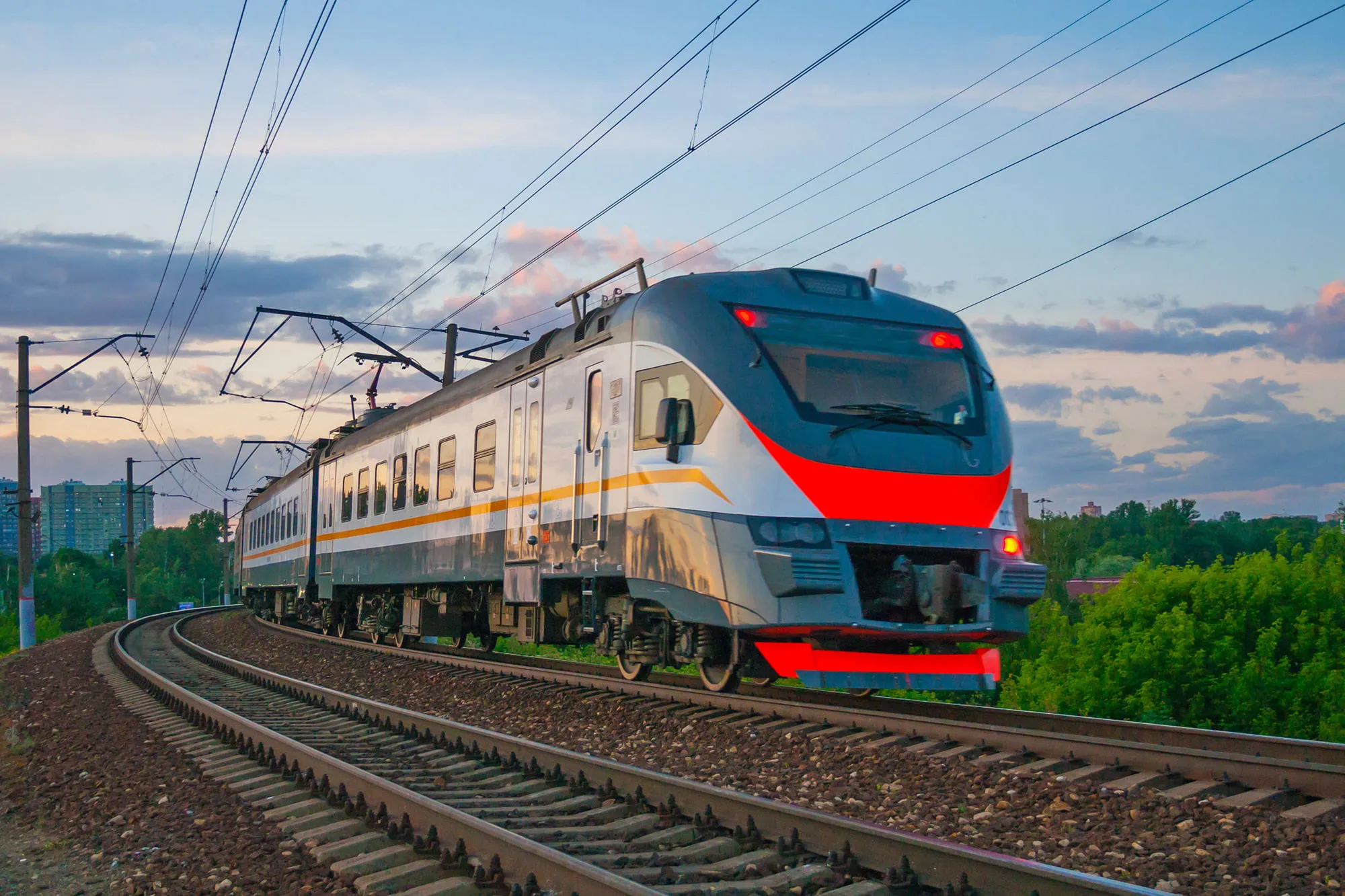
Why a train is convenient
Baggage allowance rules on an airplane include provisions for carrying oversized baggage, including skis, snowboards, bicycles, and so on. And an airplane remains the #1 choice for trips over 1,000 km. With a relatively similar ticket price, choosing a plane saves you a lot of time. But a train also has its advantages:
- Railway stations are present in a huge number of cities. Airports, however, are not built everywhere. And sometimes, after arriving in one city, you still have to travel to another by train.
- airports are located outside the city, while train stations are in the center. A simple example: the “Sapsan” to St. Petersburg takes an average of 4 hours. A plane flies there in about 1.5 hours. It would seem that time savings are obvious! But add to this the time to get to Sheremetyevo or Vnukovo, and then from Pulkovo to the city. And the time for check-in and baggage handling. The difference is almost erased.
- you can sleep on a train! On a plane, too, of course, but only sitting. And, possibly, with your neighbor's head on your shoulder.
- baggage on a plane will be loaded by airport staff, and it's unknown how a bicycle/other equipment will survive such an experience. Baggage on a train will always be under supervision. Your personal supervision.
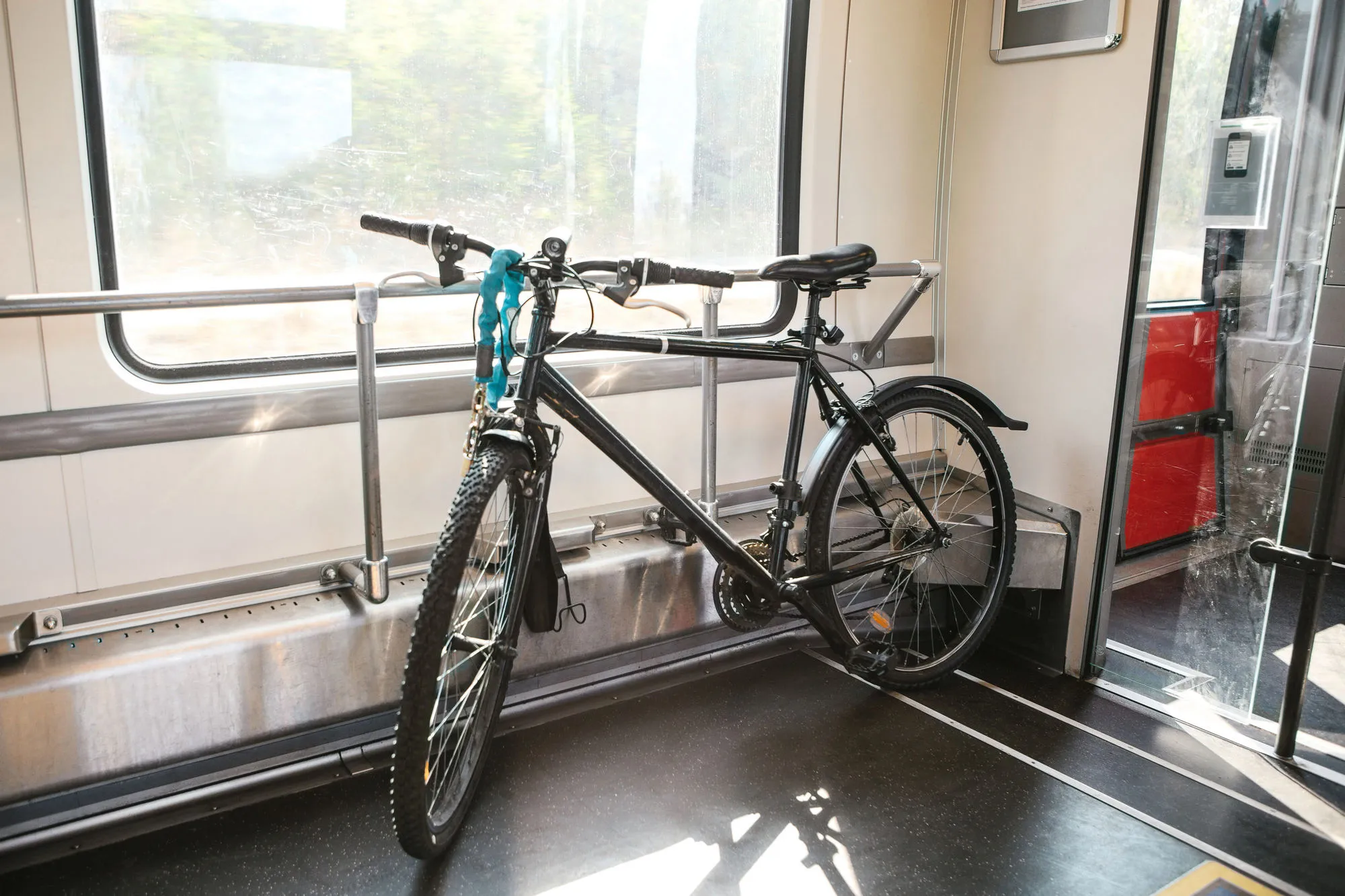
How to transport a bicycle on a train
The rules for transporting bicycles on trains depend on the length of the trip. For short-distance trips, suburban trains (aka elektrichki) are suitable. Transportation is handled by suburban passenger companies, of which there are many – ЦППК, МТППК, АО «Кубань Экспресс-Пригород», СевППК, and so on.
On a suburban train
There are two main ways to transport bicycles here. The first is for a fee, unassembled, in the vestibule. The rules state “no more than one bicycle”, although it is not clarified whether this means one bicycle per vestibule or one bicycle per passenger.
The second way is free, as hand luggage, in the carriage. For this, the bicycle will have to “shrink” to 180 cm in the sum of three dimensions (length+width+height). It's better to disassemble your two-wheeled friend at home beforehand and see how far you'll have to go with this deconstruction.
Additionally, daily from 11:00 to 16:00 and from 21:00 to 6:00, you can transport a bicycle for free on TsPPK suburban trains (all directions of the Moscow railway hub, except the Leningrad direction) and MTPPK (Leningrad direction). However, you will first need to obtain a free ticket at the ticket office or a vending machine.
For passengers who frequently travel with a bicycle, both companies offer a “Bike Option”. With it, you don't need to purchase single-use bicycle tickets, but it can only be added to season tickets for suburban passenger trains.
On long-distance trains
These include those that cover more than 150 km. If the ticket indicates JSC “FPK” (a subsidiary of Russian Railways), “DOSS” (high-speed trains), “Grand Service Express” (“Tavria” and “Grand Express” trains), or “Tverskoy Express” (“Megapolis” train), then these are long-distance trains.
If the bicycle fits the parameters for hand luggage, then it travels free of charge. For this, the dimensions must not exceed 180 cm in the sum of three measurements, and the weight must not reach 36 kg (in SV class, a bit more – 50 kg – is allowed). So, the bicycle will have to be: disassembled, packed, and placed in the hand luggage area in the passenger car.
For luggage (in our case – a bicycle) exceeding 180 cm, different rules apply. Bicycles, “both assembled and disassembled, both packed and unpacked, are transported with payment at the baggage transportation rate for a weight of 30 kg.” They must be placed in the hand luggage areas or in the carriage in such a way as not to obstruct other passengers, not to soil the carriage or other people's belongings, and to leave the passage to emergency exits clear. This category also includes scooters, electric bicycles, Segways (hoverboards), and unicycles.
A bicycle can be checked into the baggage car. Then it will travel under special conditions, as oversized luggage. The permissible weight is up to 75 kg.
How to transport a kayak on a train
Russian Railways rules also specifically mention equipment for rafting enthusiasts. For the transportation of a disassembled or non-disassembled kayak, kayak (together with paddles), catamaran, raft or other similar equipment, you must pay as for baggage weighing 30 kg.
How to transport a scooter on a train
With suburban trains, everything is clear: transportation of vehicles with internal combustion engines is not permitted.
On long-distance trains, special car-carrier wagons are provided, and a motorcycle (moped, scooter) will have to be sent in one of them. You also need to arrange transportation documents and transport it only from the initial to the final station, because nothing is unloaded en route. One such wagon can accommodate 3-4 passenger cars or 14 motorcycles. They are not available on every train, but, for example, a car-carrier wagon operates on the route Moscow – St. Petersburg or St. Petersburg – Anapa. To transport a motorcycle or other equipment, you need to submit an application (this can be done online) at least 5 days before the train's departure.
