Why and What For on Board an Airplane
Not all recommendations and procedures on board an airplane are clear to us. Many passengers disregard certain things, argue about others...
We decided to tell you about some points that every passenger is recommended to know.
Why is the cabin light turned off during takeoff and landing?
The light is turned off so that passengers' eyes can adapt to natural lighting. This way, in case of an emergency (fire, smoke, emergency landing, etc.), you can see where to safely evacuate and not lose time while your eyes adapt.
Why open window shades on an airplane?
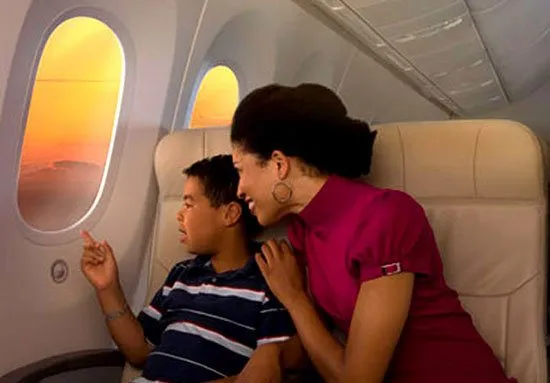 For the same purpose: so that passengers can see what is happening outside and the evacuation routes, and rescuers can assess the situation in the aircraft cabin.
Why do ears pop on an airplane?
Ears pop due to the difference in pressure between the human body and the external environment.
Normally, the air pressure in the ear (more precisely, in the tympanic cavity) should be equal to atmospheric pressure. If the pressure is not equal, one side pushes the eardrum inward, and we feel this as ear blockage.
When the plane gains altitude, atmospheric pressure decreases, and a pressure difference arises, which we feel as ear blockage. If you swallow or yawn at this moment, the inner opening of the Eustachian tube temporarily opens, air with higher pressure exits, and air with lower pressure fills the cavity, and the ear blockage disappears.
Read more about why ears pop on an airplane and how to deal with it>>
Why fasten your seatbelt on an airplane?
During landing, you need to fasten your seatbelt so that you don't fly out of your seat in case of a sudden stop of the aircraft. And during the flight, you are asked to fasten your seatbelt so that, when flying through turbulence, you again don't fall out of your seat or hit your head on the ceiling (this, by the way, is a common injury for stubborn passengers who refuse to fasten their seatbelts).
Many ask, why fasten your seatbelt during takeoff? Doesn't it just "press" a person into the seat? The thing is, during aircraft acceleration, unforeseen circumstances can also occur, and the pilot may be forced to abort takeoff. That's when the seatbelt will come in handy, holding you in place and helping to avoid serious injuries.
Why are you not allowed to listen to the radio with headphones during takeoff and landing?
This is so that you can hear the flight attendants' commands in case of an emergency.
Why turn off your phone on an airplane?
You are asked to turn off your phone so that its signal does not interfere with onboard communication and does not affect the operation of aircraft instruments. The influence of phones, laptops, and other electronic devices may not be too dangerous; debates on this issue are still ongoing. However, just in case, it is recommended to turn off phones and other devices.
The second reason they are asked to be turned off and stowed is that during sudden maneuvers of the aircraft, they can fly out of your hands and injure other passengers or damage the aircraft cabin.
Why are you asked to put seatbacks in an upright position during takeoff and landing?
This is done so that reclined seats do not hinder the quick evacuation of passengers in emergency situations. For the same reasons, you are asked to fold up tray tables.
In addition, seats in an upright position will better protect you and the passenger sitting behind you in case of an accident.
Have a good flight! And do not neglect aviation safety rules!
For the same purpose: so that passengers can see what is happening outside and the evacuation routes, and rescuers can assess the situation in the aircraft cabin.
Why do ears pop on an airplane?
Ears pop due to the difference in pressure between the human body and the external environment.
Normally, the air pressure in the ear (more precisely, in the tympanic cavity) should be equal to atmospheric pressure. If the pressure is not equal, one side pushes the eardrum inward, and we feel this as ear blockage.
When the plane gains altitude, atmospheric pressure decreases, and a pressure difference arises, which we feel as ear blockage. If you swallow or yawn at this moment, the inner opening of the Eustachian tube temporarily opens, air with higher pressure exits, and air with lower pressure fills the cavity, and the ear blockage disappears.
Read more about why ears pop on an airplane and how to deal with it>>
Why fasten your seatbelt on an airplane?
During landing, you need to fasten your seatbelt so that you don't fly out of your seat in case of a sudden stop of the aircraft. And during the flight, you are asked to fasten your seatbelt so that, when flying through turbulence, you again don't fall out of your seat or hit your head on the ceiling (this, by the way, is a common injury for stubborn passengers who refuse to fasten their seatbelts).
Many ask, why fasten your seatbelt during takeoff? Doesn't it just "press" a person into the seat? The thing is, during aircraft acceleration, unforeseen circumstances can also occur, and the pilot may be forced to abort takeoff. That's when the seatbelt will come in handy, holding you in place and helping to avoid serious injuries.
Why are you not allowed to listen to the radio with headphones during takeoff and landing?
This is so that you can hear the flight attendants' commands in case of an emergency.
Why turn off your phone on an airplane?
You are asked to turn off your phone so that its signal does not interfere with onboard communication and does not affect the operation of aircraft instruments. The influence of phones, laptops, and other electronic devices may not be too dangerous; debates on this issue are still ongoing. However, just in case, it is recommended to turn off phones and other devices.
The second reason they are asked to be turned off and stowed is that during sudden maneuvers of the aircraft, they can fly out of your hands and injure other passengers or damage the aircraft cabin.
Why are you asked to put seatbacks in an upright position during takeoff and landing?
This is done so that reclined seats do not hinder the quick evacuation of passengers in emergency situations. For the same reasons, you are asked to fold up tray tables.
In addition, seats in an upright position will better protect you and the passenger sitting behind you in case of an accident.
Have a good flight! And do not neglect aviation safety rules!
For the same purpose: so that passengers can see what is happening outside and the evacuation routes, and rescuers can assess the situation in the aircraft cabin.
Why do ears pop on an airplane?
Ears pop due to the difference in pressure between the human body and the external environment.
Normally, the air pressure in the ear (more precisely, in the tympanic cavity) should be equal to atmospheric pressure. If the pressure is not equal, one side pushes the eardrum inward, and we feel this as ear blockage.
When the plane gains altitude, atmospheric pressure decreases, and a pressure difference arises, which we feel as ear blockage. If you swallow or yawn at this moment, the inner opening of the Eustachian tube temporarily opens, air with higher pressure exits, and air with lower pressure fills the cavity, and the ear blockage disappears.
Read more about why ears pop on an airplane and how to deal with it>>
Why fasten your seatbelt on an airplane?
During landing, you need to fasten your seatbelt so that you don't fly out of your seat in case of a sudden stop of the aircraft. And during the flight, you are asked to fasten your seatbelt so that, when flying through turbulence, you again don't fall out of your seat or hit your head on the ceiling (this, by the way, is a common injury for stubborn passengers who refuse to fasten their seatbelts).
Many ask, why fasten your seatbelt during takeoff? Doesn't it just "press" a person into the seat? The thing is, during aircraft acceleration, unforeseen circumstances can also occur, and the pilot may be forced to abort takeoff. That's when the seatbelt will come in handy, holding you in place and helping to avoid serious injuries.
Why are you not allowed to listen to the radio with headphones during takeoff and landing?
This is so that you can hear the flight attendants' commands in case of an emergency.
Why turn off your phone on an airplane?
You are asked to turn off your phone so that its signal does not interfere with onboard communication and does not affect the operation of aircraft instruments. The influence of phones, laptops, and other electronic devices may not be too dangerous; debates on this issue are still ongoing. However, just in case, it is recommended to turn off phones and other devices.
The second reason they are asked to be turned off and stowed is that during sudden maneuvers of the aircraft, they can fly out of your hands and injure other passengers or damage the aircraft cabin.
Why are you asked to put seatbacks in an upright position during takeoff and landing?
This is done so that reclined seats do not hinder the quick evacuation of passengers in emergency situations. For the same reasons, you are asked to fold up tray tables.
In addition, seats in an upright position will better protect you and the passenger sitting behind you in case of an accident.
Have a good flight! And do not neglect aviation safety rules!