Support

Abu Simbel

About the Airport

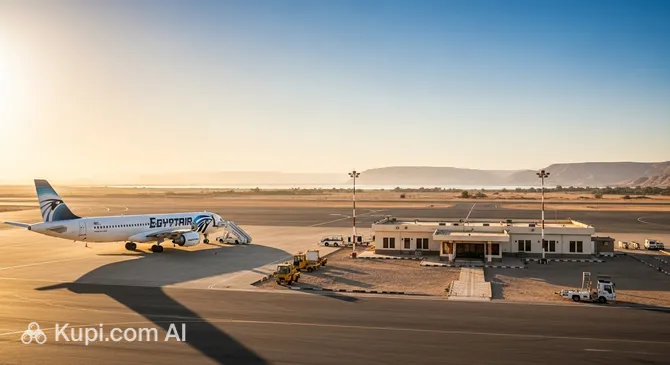
Abu Simbel. Illustration.
Source: Kupi.com AI

Abu Simbel Airport is not just a regional transport hub, but a true air gateway to the world of ancient Egyptian history, situated amidst the majestic desert. This air haven is unique because it exists for practically one sole purpose — to provide convenient access for travellers to the legendary temples of Ramses II and Nefertari. Your immersion into the atmosphere of the Pharaonic era begins here, while the terminal's compact size allows you to feel not like you are in a noisy metropolis, but on the threshold of a great discovery.

PropertyValue
IATA CodeABS
ICAO CodeHEBL
CityAbu Simbel
CountryEgypt
TimezoneAfrica/Cairo
Top AirlinesEgyptair, Air Cairo
ScheduleOnline Timetable

Features and Advantages of the Airport

The main advantage of the airport is its exceptional proximity to the main attraction. The transfer to the temple complex takes less than 10 minutes, making it an ideal arrival point for day trips from Cairo or Aswan. Many flights are specifically synchronised with the schedules of cruise liners and light shows at the temples, ensuring maximum logistical convenience for tourists.

Despite its modest size and simple architecture, the airport offers travellers stunning visual impressions even before landing. During the approach, a breathtaking panoramic view of the turquoise waters of Lake Nasser and the endless desert sands often opens up from the window. The terminal is distinguished by a calm atmosphere and a lack of queues, allowing you to complete all formalities in a matter of minutes and immediately set off to meet history.

Contact Information

There are several ways to contact representatives of Abu Simbel Airport (ABS). Given that this is a small regional airport primarily serving tourist charters and domestic flights, the most reliable method of communication is by phone.

  • Official Website: Abu Simbel Airport does not have its own separate website. Up-to-date information can be found on the airport's page on the Egyptian Airports Company (EAC) portal.
  • Information Desk Phone: +20 97 340 1147. When calling, be prepared that communication may be conducted in Arabic or English.
  • Airport Address: Abu Simbel Airport (ABS), Abu Simbel, Aswan Governorate, Egypt. The airport is located just a few kilometres from the famous Abu Simbel temples.
  • Email: An official email address for passenger communication is not published. It is recommended to use the phone to resolve issues.
  • Social Media: The airport does not maintain official pages on social networks.
  • Lost Luggage Information: For all questions related to lost or damaged luggage, you must contact the representative office of the airline you flew with directly.
  • Passenger Support Contacts: For assistance or consultation on-site, please approach the information desk in the terminal or use the information service phone number.

How to Get to the Airport

Abu Simbel Airport (ABS) is located in the immediate vicinity of the small town of the same name and the famous temples of Egypt. Getting to it from the tourist zone, where hotels and main attractions are located, is very simple and does not take much time. The distance from the city centre to the terminal is only a few kilometres.

Taxis and Hotel Transfers. This is the most popular and convenient way to get to Abu Simbel Airport. A taxi ride from any hotel in the city will take no more than 5-10 minutes. The cost of the trip is low, but it is always better to agree on it with the driver in advance. Most hotels also offer transfer services for their guests — this is a reliable option that can be booked at the reception.

Car Rental and Parking. If you are travelling around Egypt in a rented car, for example, arriving from Aswan, you will easily reach the airport via a well-marked road. The airport has a small parking area where you can leave your car. However, renting a car solely to get from the hotel to the airport is not practical due to the short distance.

Public Transport. It is worth noting that public transport in the usual sense (city buses, metro, or trains) does not run between the city and the airport. This is due to the compact size of the city itself, which is entirely oriented towards serving tourists arriving at the temples.

Features and Alternatives. Many tourists do not fly directly to Abu Simbel, but to the larger airport in Aswan (ASW), located approximately 215 km away. From there, you can reach Abu Simbel by tourist bus (as part of an organised convoy) or by taxi. This allows you to combine visiting the sights of both cities. Another major transport hub in the region is Luxor International Airport (LXR), but it is located significantly further away.

Terminals and Map

Abu Simbel Airport (ABS) is a small and very compact aviation hub, created primarily to serve tourists arriving at the famous temples. Its structure is extremely simple and intuitive, making navigation easy even for those visiting for the first time.

The airport consists of one small terminal, which serves both domestic and charter flights. Due to its compact size, there are no complex passageways, multi-level maps, or need for shuttles between terminals — everything is located within a single building. The arrival and departure zones are located next to each other, and finding the right sector will not be difficult.

The terminal layout is very simple: after entering, you immediately find yourself in the general area where several check-in counters are located. After completing check-in and dropping off luggage, passengers proceed to a single security checkpoint, followed by a small departure waiting lounge. The arrival zone is equally straightforward: after disembarking from the plane, passengers walk to the terminal building, where they collect their luggage in a small hall.

Thanks to the small size and low passenger traffic, all pre-flight formalities, including check-in and security screening, are completed very quickly — usually taking no more than 20-30 minutes. Nevertheless, it is recommended to arrive at the airport with a standard margin of time. The main advice on navigation is simple: getting lost in Abu Simbel Airport is practically impossible. Follow the few signs, and you will easily find everything you need.

Airport History

The history of Abu Simbel Airport (IATA: ABS) is inextricably linked with one of the most ambitious engineering and archaeological projects of the 20th century. The airport was built in the 1960s with one main goal — to ensure access to the famous temples of Ramses II and Nefertari during and after their relocation. The construction of the Aswan High Dam threatened to flood this ancient complex, and UNESCO organised an international campaign to save it. The airport became a key transport hub for delivering specialists, equipment, and ultimately, tourists to the new location of the temples.

Officially, the airport began fully functioning around 1968, just in time for the completion of the grand project to move the temples. Since then, its primary function has not changed. It is not a major transport hub, but rather a specialised air haven working in tandem with the greatest attraction of southern Egypt. Most flights are morning arrivals from Aswan and Cairo and afternoon departures, allowing travellers to visit the temple complex as part of a one-day excursion.

Over the course of its existence, the airport has undergone necessary upgrades to meet modern safety and passenger service standards, but its scale remains modest, which highlights its unique purpose. The main achievement of Abu Simbel Airport is not passenger traffic records, but its indispensable role in making one of the most remote and impressive wonders of the Ancient World accessible to people from all over the planet. This is a rare example of infrastructure created and existing for the sake of a single cultural monument.

Services and Amenities

Abu Simbel Airport (ABS) is a small regional airport, the main task of which is serving tourists arriving to view the famous temples. In this regard, the set of services here is oriented towards the basic needs of passengers before a short flight, and its infrastructure is more modest compared to the large international hubs of Egypt.

In the terminal, you will find a small waiting lounge with seats, several souvenir shops where you can buy memorable gifts, and a small café or refreshment area offering drinks and light snacks. The choice of catering establishments and shops is limited. As for modern amenities, free Wi-Fi may be unavailable or work intermittently, so it is better to rely on mobile data. Places to charge electronic devices may also be in short supply.

Specialised services at Abu Simbel Airport are present in minimal volume. There are no full-fledged bank branches here, but an ATM or a small currency exchange point may be present, although it is recommended to take care of cash in advance. For emergencies, a basic medical point is provided. There are no VIP halls or business lounges at the airport.

For passengers with special needs, including travellers with children and people with disabilities, the main service consists of assistance from airport and airline staff. There are no specialised playrooms for children. Passengers requiring a wheelchair or other assistance should notify their airline in advance to organise help upon arrival and departure.

On the territory of the airport itself, there are no hotels, conference halls, or business centres. The nearest accommodation options are located in the small town of Abu Simbel, situated a few kilometres from the terminal. Transfers to hotels are usually organised by travel companies or can be booked on the spot.

Where to Eat

Abu Simbel Airport (ABS) is a small regional airport that mainly serves tourists arriving at the famous temples. Consequently, the choice of dining establishments here is quite modest and designed so that passengers can have a quick snack before departure. Do not expect the variety inherent in large international airports, but basic options are available.

In the airport's single terminal, you will find a small café or several snack kiosks. Typically, one establishment is located in the public area before security control, and another in the small departure lounge. The assortment mainly consists of packaged sandwiches, pastries, crisps, chocolate, and other snacks. Drinks on offer include coffee, tea, bottled water, and carbonated beverages. All this is suitable for a quick snack, but not for a full meal.

You are unlikely to be able to try local cuisine dishes here, although sometimes traditional Egyptian sweets can be found on sale. Regarding special dietary needs, finding specific vegetarian or gluten-free options will be extremely difficult. Passengers with strict dietary restrictions are strongly recommended to take food with them.

Cafés and kiosks at Abu Simbel Airport operate in accordance with the flight schedule — they open a few hours before the arrival or departure of flights and close shortly after them. Food and drink prices, as in most airports around the world, are higher here than the city average. Given the limited choice, plan your meals in advance, especially if you are travelling with children or adhering to a specific diet.

Travel Tips

The airport in Abu Simbel is small and serves mainly domestic flights, so processes here proceed quite quickly. Nevertheless, it is recommended to arrive 1.5–2 hours before departure. This time will be sufficient to complete check-in and security control without rushing. Ensure your passport and e-ticket are at hand to speed up the process.

At check-in, if possible, ask for a window seat. During take-off or landing, stunning views of Lake Nasser and the Abu Simbel temples themselves open up from the aircraft — this is a unique opportunity to take unforgettable photos. Regarding hand luggage, standard international rules apply: liquids in containers no larger than 100 ml, and no sharp objects. Be sure to take all valuables, documents, medicines, and portable chargers (power banks) with you into the cabin.

One of the key features of customs control in Egypt, which is worth remembering upon departure, is the strict ban on exporting antiques and artefacts without special permission. This does not apply to ordinary souvenirs you buy in tourist shops. However, if you have purchased something that looks like a genuine artefact, be prepared for questions from the customs service.

Abu Simbel Airport is rarely used for transit. If you have a transfer planned in another city, for example, in Cairo or Aswan, check in advance whether you will need to collect and re-check your luggage. In case of a flight delay, bear in mind that opportunities for waiting at this airport are limited. There are few shops and cafés here, so it is better to have a book, a charged phone, and a small supply of water and snacks with you.

To save time and money, check in for your flight online if your airline provides such a service. Try to book plane tickets well in advance — this increases the chances of finding favourable fares. Travelling light, with only hand luggage, will also save you time at the arrival airport, as you will not have to wait for luggage.

Reached the end of the page?

That means the route is fully explored