Support

Heliopolis Obelisk

About

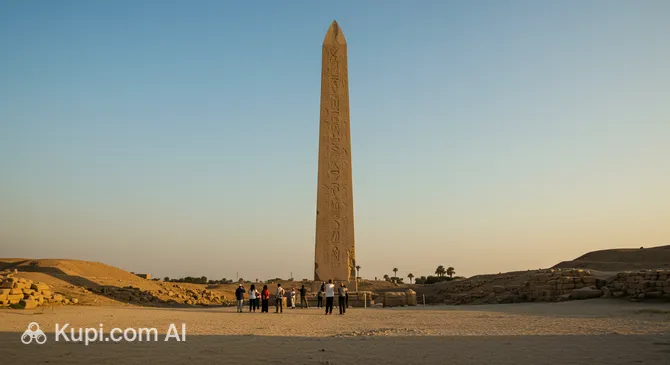
The Heliopolis Obelisk is a unique historical monument, recognized as the oldest surviving obelisk in the world. Erected by Pharaoh Senusret I during the Middle Kingdom, this red granite colossus stands 21 meters tall. Located in the Shubra El Kheima district, it is the sole surviving witness to the former grandeur of Heliopolis — the sacred "City of the Sun," which served as the primary theological center of ancient Egypt for centuries.
\n\n
Heliopolis Obelisk. Illustration.
Source: Kupi.com AI

Traveler photos:

\n\n

The significance of this site cannot be overstated: it stands on the very spot where, according to ancient myths, the creator gods emerged from primordial chaos. Weighing approximately 120 tons, the obelisk is adorned with clear hieroglyphic inscriptions praising the Pharaoh's connection to divine light. Despite the dense modern urban development surrounding it, the monument maintains an atmosphere of eternity and the steadfastness of an ancient civilization.

\n\n

Today, the Heliopolis Obelisk is a must-see for those wishing to experience authentic Egypt off the beaten path. Surrounded by the remains of ancient temple complexes and a necropolis, it serves as a powerful reminder of the spiritual and engineering mastery of ancestors who created a timeless masterpiece.

Contacts

When planning a visit to the Heliopolis Obelisk, located in the Shubra El Kheima area, we recommend checking for the latest information regarding access in advance. As this is an open-air archaeological site, visits may be subject to change due to restoration work or current regulations set by the Egypt Ministry of Tourism.

How to contactContact
Address119 Taha Hussein, Ein Shams Al Gharbeyah, El Matareya, Cairo Governorate 4532522, Египет
Websitewww.obelisks.org

What to Do

Visiting this site offers a rare opportunity to touch history almost at arm's length. The main highlight here is studying the masterfully carved hieroglyphs on the faces of the obelisk. The inscriptions commemorate the jubilee of Senusret I's reign and his offerings to the Sun gods. Don't forget your camera: the contrast between the ancient pink granite and the modern urban landscape of the El Matareya district creates unique shots that emphasize the monument's scale.

\n\n

A walk through the archaeological zone will allow you to see the results of recent excavations. In recent years, fragments of statues of great pharaohs, such as Psamtik I and Ramses II, have been discovered here. The area is filled with a silence that contrasts sharply with the noise of Cairo, making it perfect for quiet contemplation. Experts recommend visiting closer to sunset, when the rays of the fading sun turn the granite to gold, recreating the mystical connection with Ra for which the obelisk was originally built.

Getting There

The Heliopolis Obelisk is located at: 119 Taha Hussein, Ein Shams Al Gharbeyah, El Matareya. The most convenient way to get there from central Cairo is by metro. Take Line 3 to the Ain Shams station. From the metro, the monument is a 10–15 minute walk, or you can take a taxi or a local tuk-tuk.

\n\n

For a more comfortable trip, using apps like Uber or Careem directly to the El Matareya district is the best option. A ride from Cairo International Airport takes about 20–30 minutes, depending on traffic. For those driving, use the coordinates 31.3075858, 30.1294018, but be prepared for heavy traffic in this densely populated area.

Nearest city: Shubra El Kheima

History & Facts

This majestic monument was erected by Pharaoh Senusret I over 4,000 years ago, around 1971–1926 BC. The obelisk was part of the colossal Temple of Ra-Atum in Heliopolis, the "City of the Sun." At that time, Heliopolis was considered a sacred site where, according to ancient Egyptian beliefs, life itself began, and dozens of such obelisks once graced its horizon.

\n\n

For millennia, the city remained an intellectual and religious hub. Great rulers like Ramses II and Akhenaten built shrines here. Even ancient Greek scholars, including the astronomer Eudoxus, came here in search of knowledge. Notably, the Sun Temple functioned continuously for over 2,400 years, an absolute record for religious structures of antiquity.

\n\n

By the beginning of the common era, Heliopolis began to decline; many monuments were moved to Rome or Alexandria, or disappeared beneath the silt of the Nile. However, the obelisk of Senusret I remained in its original location. In modern history, during the 1970s, a complex engineering operation was required: German specialists raised the 120-ton block onto a new pedestal to save the base from the destructive effects of groundwater.

Time Needed

About 1–2 hours is usually sufficient for a full tour of the Heliopolis Obelisk and its surrounding area. This allows enough time to examine the hieroglyphs on the red granite in detail, take impressive photos from various angles, and walk among the ruins of the ancient necropolis.

\n\n

If you are an archaeology enthusiast and plan to hire a professional guide for an in-depth history of Heliopolis and the cult of the god Ra, we recommend allocating up to 3 hours for your visit. Also, factor in travel time, as the El Matareya district is located away from Cairo's main tourist routes.

Working Hours

The Heliopolis Obelisk is open to visitors daily. According to the established schedule for archaeological sites in this region, it is open from 07:00 to 17:00, including weekends and holidays. It is recommended to plan your visit for the first half of the day to view the monument in good natural light and avoid the afternoon heat.

07:00–17:00

Nearby

Exploring the area around the Heliopolis Obelisk allows for a deeper dive into the contrasts of modern Egypt. Just a few kilometers from the ancient monument lies the majestic Koubbeh Palace, an official residence surrounded by magnificent gardens. For those traveling with children, a visit to the Children's Museum is an excellent addition, offering interactive ways for young guests to learn about the country's culture and nature.

NameDistance
Hyper Al Sharkia3.9 km
Hossam the Englishman4.5 km
Abu El Hana Restaurant6.3 km
Mamluk Square6.6 km
Happy Land6.9 km
Koshari El Rahmany7.2 km
Rod El Farag Axis Bridge (Tahya Misr Bridge)7.4 km

Reached the end of the page?

That means the route is fully explored