Support

Chuuk International Airport

About the Airport

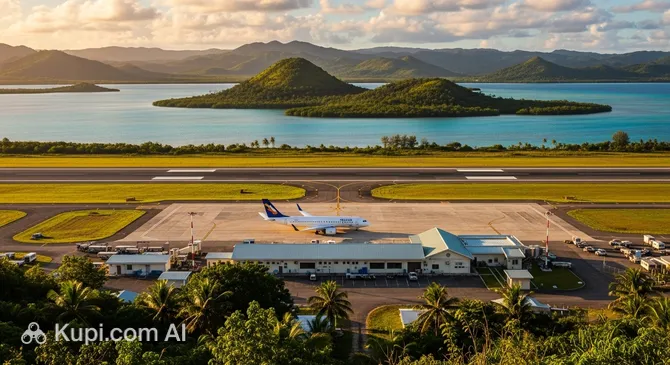
Chuuk International Airport. Source: Kupi.com Binoculars

Chuuk International Airport is not merely a runway on a remote island, but a true aerial gateway to one of the most mysterious and captivating corners of the world. Located on the main island of Weno in Chuuk State, this airport welcomes travellers eager for adventure and discovery. It is from here that the immersion into the amazing world of sunken World War II ships begins, making Chuuk Lagoon a global hub for divers from all over the planet. The airport serves as a key transport node connecting Micronesia with the rest of the world.

IATA Code TKK
ICAO Code PTKK
City Chuuk
Distance to Centre Located on Weno Island, a few kilometres from the administrative centre
Status International
Annual Passengers Data unavailable
Popular Airlines United Airlines, Air Niugini
Schedule "Chuuk International Airport" online flight schedule

The main feature of Chuuk Airport is its strategic location for diving enthusiasts. It serves as the starting point for exploring the famous "Underwater Museum" — the world's largest graveyard of sunken ships. Despite its modest size, the airport effectively handles its tasks, offering passengers all the essentials. Its compactness is arguably an advantage: it is impossible to get lost here, and check-in and control procedures are swift and fuss-free. In addition to international flights, the airport also services local charter flights, ensuring connections with other islands of the atoll, making it indispensable for logistics and tourism in the region.

Contact Information

Finding precise and centralised contact information for Chuuk International Airport (TKK) can be challenging due to its remote location. It is recommended to resolve most queries through your airline. Below are the most current details from open sources:

  • Official Website: Currently, Chuuk Airport does not have a dedicated official website for passengers. It is best to check primary flight information on the website of the airline you are flying with.
  • Help Desk Phone: There is no single enquiry number. For urgent matters related to airport operations, the administration number is sometimes listed as: +691 330 2598, though its availability and relevance are not guaranteed.
  • Airport Address: Weno Island, Chuuk State, Federated States of Micronesia.
  • Email: An official email address for general passenger enquiries is not published.
  • Social Media: The airport does not maintain official pages on social networks.
  • Lost Baggage Information: For all issues related to lost or damaged baggage, you must apply directly to your airline's representative at TKK airport.
  • Passenger Support Contacts: Support regarding booking, ticket changes, special services, and flight schedules is provided by the operating airline.

How to Get to the Airport

Getting to Chuuk International Airport (TKK) from anywhere on Weno Island, where it is located, is quite simple due to the short distances. The primary and most reliable mode of transport here is by taxi. A car can be found in the main town area or ordered through your hotel. The journey from most hotels to the airport takes just 10-20 minutes. An important tip: since taximeters are rarely used, always agree on the fare with the driver in advance to avoid misunderstandings.

Many hotels in Chuuk offer their guests an airport transfer service. This is perhaps the most convenient and hassle-free option, which is worth booking well in advance. Regarding public transport, there are no conventional city buses with strict schedules, metro, or trains on the island. Unofficial minibuses exist, but they run irregularly, and relying on them for a flight is not recommended.

For those who prefer maximum freedom of movement, car rental is available. Several local rental agencies, as well as some hotels, provide this service. By renting a car, you can not only reach the airport on time but also explore the island at your own pace. There is parking near the airport terminal where you can leave your vehicle while waiting for a flight or for a longer period.

To summarise, for a trip to the airport in Chuuk, it is best to choose a taxi or a pre-arranged hotel transfer. This guarantees that you will arrive on time and without unnecessary stress. Despite the short travel time, always leave with time to spare, as required before any flight, to calmly pass through check-in and pre-flight screening in this unique corner of Micronesia.

Terminals and Map

The International Airport in Chuuk (TKK) is distinguished by its compactness and simple structure. The airport consists of one small terminal, which serves both domestic flights across the islands of Micronesia and infrequent international routes. Such an organisation makes it very convenient for passengers, eliminating the need for long walks and complex navigation.

The terminal layout is extremely simple and intuitive. Essentially, it is a single-storey building where all key zones are within walking distance of each other. Immediately upon entry, you will see the check-in counters, followed by the security screening area and a small waiting hall. It is practically impossible to get lost here, as all functional areas are in plain sight.

Arrival and departure zones are located in the same building but are functionally separated. After landing, passengers proceed to the passport control and baggage claim section, which is situated next to the main hall. Check-in and screening procedures usually proceed quite quickly due to the low passenger flow. Nevertheless, it is recommended to arrive at the airport 2-3 hours before an international flight to complete all formalities without rushing.

Since there is only one terminal and it is very compact, transitions between zones take mere minutes. The main advice for travellers is not to worry about navigation. The entire airport infrastructure is aimed at fast and efficient flight processing. Simply follow the few signs, and you will easily find your boarding gate or baggage claim area.

Airport History

The history of the International Airport in Chuuk (TKK) is inextricably linked to the dramatic events of the 20th century. It is not just a transport hub, but a place with a rich and complex past that continues to attract researchers and travellers from around the world.

The airfield was built in the early 1940s, during World War II, by Japanese military forces on Moen Island (now Weno). It served as one of the key airbases within the vast Japanese naval complex in Truk Lagoon, which was often called the "Gibraltar of the Pacific" for its heavy fortifications and strategic importance.

A turning point in the airport's history was Operation Hailstone in February 1944. During this massive two-day air raid, the US Navy dealt a crushing blow to the Japanese base. The airfield was one of the primary targets: its runways, hangars, and aircraft were subjected to intense bombardment. This operation effectively neutralised the military power of the Truk base and turned the lagoon into a vast underwater graveyard of ships and planes.

After the war ended, the damaged airfield was restored and converted for civil purposes. It became the main aerial gateway for Chuuk State within the Trust Territory of the Pacific Islands, and later the independent Federated States of Micronesia. The airport underwent several stages of modernisation to accommodate modern aircraft, such as the Boeing 737, ensuring vital connections with Guam, Pohnpei, and other islands in the region.

Today, Chuuk International Airport is a modest but critically important facility. Its history remains its main "attraction": it is thanks to this history that Chuuk State has become a world-renowned centre for diving. Thousands of tourists fly here to explore the sunken ships and aircraft from the World War II era. Thus, the airport's past directly shapes its present, making arrival in Chuuk the beginning of not just a simple holiday, but a true historical adventure.

Services and Amenities

The International Airport in Chuuk (TKK) serves as the main aerial gateway to the state of the same name in the Federated States of Micronesia. Given its modest size and remote location, the range of services here is basic and corresponds to the needs of a small passenger flow. Travellers should prepare in advance for the fact that amenities in the terminal will be minimal.

Dining and Shopping: In the airport, you will find a small snack bar or café where you can buy light snacks, sandwiches, and beverages. The selection is limited, so for a full meal, it is better to eat before arriving at the airport. There are also kiosks selling souvenirs and essential items.

Waiting Areas and Wi-Fi: There are no specialised VIP halls or business lounges at the airport. A general waiting hall is available for all passengers. Access to Wi-Fi may be limited or unavailable, and the number of power outlets for charging devices is small. It is recommended to carry a portable charger (power bank) with you.

Financial and Other Services: A currency exchange point or ATM may operate in the terminal, but their presence and functionality are not guaranteed. It is better to exchange money in advance. Specialised business centres and conference rooms are absent. Medical assistance is limited to a first aid station.

Services for Passengers with Special Needs: The airport is equipped with basic facilities for passengers with reduced mobility, but to receive special assistance (such as a wheelchair), you must contact your airline in advance. There are no designated play areas or mother-and-child rooms for passengers with children; only basic amenities, such as restrooms, are available.

Accommodation: There are no hotels directly on the premises of Chuuk Airport. The nearest hotels and guesthouses are located in the town of Weno, a few minutes' drive from the airport. To travel there, you will need to use a taxi or a transfer, which is often provided by the hotels themselves.

Where to Eat

When planning a flight from the International Airport in Chuuk (TKK), it is important to consider that this is a small regional airport with a limited range of services. Dining options here are quite modest and correspond to the size and traffic of the air terminal, which mainly serves flights within Micronesia and a few international routes.

Typically, in the main and only terminal of the airport, in the area before security control (landside), there is a small café or snack bar. Here you can purchase basic items for a quick bite before departure: sandwiches, pastries, crisps, as well as soft drinks, water, and coffee. This is a good option if you need to pass the time while waiting for a flight and have a light refreshment.

Do not count on full-service restaurants with hot meals or a wide assortment of local cuisine. The selection here is oriented towards simple and quick solutions. Regarding specialised diets, finding vegetarian, vegan, gluten-free, or Halal dishes is practically impossible. If you have strict dietary requirements, it is strongly recommended to bring food with you.

Establishments in the airport usually operate in accordance with the flight schedule, opening a few hours before departure and closing after the last aircraft departs. Prices may be slightly higher than in the town. For a full lunch or dinner, it is better to choose one of the establishments in Weno town before travelling to the airport.

Traveller Tips

Travelling through Chuuk International Airport (TKK) is your first step towards adventures in one of the most picturesque corners of Micronesia. To ensure your experience is as comfortable as possible, make use of these tips.

Arrival Time at the Airport. TKK is a small airport, and there are no queues like in major hubs. Nevertheless, it is recommended to arrive 2–3 hours before an international flight and 1.5–2 hours before a domestic one. This will give you enough time to complete all formalities without rushing, especially if you are travelling with baggage.

Check-in and Security Control. Procedures at the airport in Chuuk are fairly standard but can be leisurely. Keep your passport, tickets, and other documents ready. Security control follows international rules, so be prepared to present electronics and liquids separately.

Choosing a Seat on the Plane. If you want to enjoy stunning views of the atolls and the ocean during take-off or landing, choose a window seat. Given that some flights between islands are operated on small aircraft, be prepared that your seat might be changed for the correct balancing of the aircraft.

Hand Luggage Rules. Standard restrictions on carrying liquids (up to 100 ml in one container) and the ban on sharp objects apply here too. Be sure to pack a portable charger in your hand luggage, as charging opportunities in the terminal are limited. It is also worth taking sunscreen, insect repellent, and a hat with you.

Connecting Passengers. The airport is not a major transit hub, and facilities for long waits are minimal here. If you have a connection, clarify with the airline in advance whether you need to collect and re-check your luggage. Plan sufficient time between flights in case of potential delays.

Customs Control. Micronesia has strict rules regarding the importation of food products, plants, and goods of animal origin. Be sure to declare everything you are carrying to avoid fines. Be prepared that your luggage may be searched manually.

Saving Time and Money. To save time, complete online check-in if your airline provides this option. Prices for food and drinks at the airport can be high, so bring a light snack and an empty water bottle, which can be filled after passing control (if such a facility is available).

In Case of Flight Delay. Delays, especially due to weather conditions, are not uncommon on the islands. The main thing is to remain calm. Ensure you have travel insurance that covers such instances. Have a book with you or download films onto your devices. The airline representative will be your main source of information, so maintain contact with them.

Reached the end of the page?

That means the route is fully explored