Support

Timaru Airport

About the Airport

Timaru Airport, officially known as Richard Pearse Airport, is not merely a runway but a welcoming air gateway into the heart of the South Canterbury region in New Zealand. Unlike bustling international hubs, a calm and friendly atmosphere reigns here, where flight check-in and baggage claim take just a few minutes. This compact airport serves as the ideal starting point for discovering the picturesque city of Timaru and its surroundings, offering travellers a quick and convenient way to reach this charming corner of the South Island.
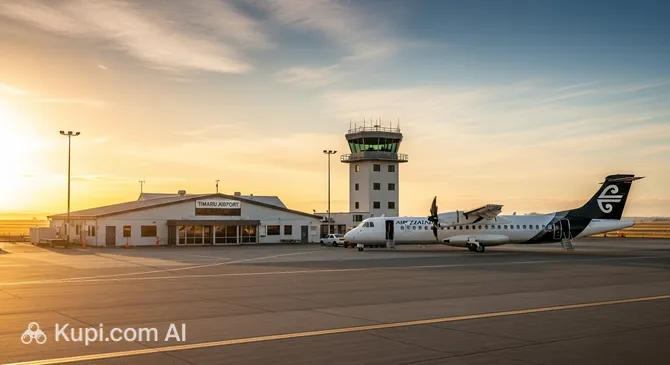
Timaru Airport. Source: Kupi.com Binoculars
IATA Code TIU
ICAO Code NZTU
City Timaru
Distance to Centre Approx. 11 km
Status Domestic
Annual Passengers Over 40,000
Popular Airlines Air New Zealand

The main advantage of Timaru Airport is its compactness and efficiency. There are no long queues or tiring transfers between terminals here, making the travel process as comfortable and swift as possible. The airport handles regular flights to Wellington, ensuring convenient connections to the capital and onward flights across the country and the world. For the convenience of passengers, the terminal features a small café, free Wi-Fi, as well as car rental desks, allowing you to set off to explore the region's beauties immediately upon arrival. This is the ideal choice for those who value their time and prefer to begin their journey without unnecessary hassle.

Contact Information

Below you will find contact information for the administration of Timaru Airport (TIU), also known as Richard Pearse Airport. As the air harbour is managed by the District Council, many contacts lead to its resources. We recommend checking the data for accuracy on official websites before your trip.

  • Official Website: Current information about the airport is available on the Timaru District Council website: timaru.govt.nz.
  • Information Desk Phone: For general and administrative enquiries regarding airport operations, you may contact the District Council at: +64 3 687 7200. For questions regarding flights, tickets, and check-in, please contact your airline directly.
  • Airport Address: Levels Highway, Washdyke, Timaru 7974, New Zealand.
  • Email: For written enquiries, you may use the general email of the Council managing the airport: enquiry@timdc.govt.nz.
  • Social Media: The airport does not have separate official social media pages. News and updates may be published on the Timaru District Council pages.
  • Lost Luggage Information: Matters regarding tracing lost or damaged luggage are handled exclusively by airline representatives. Please contact your carrier's support service.
  • Passenger Support Contacts: For general questions related to airport infrastructure, use the contacts listed above. Assistance in specific situations (ticket changes, special services on board) is provided only by airline representatives.

How to Get to the Airport

Getting to Timaru Airport (TIU), also known as Richard Pearse Airport, from the city centre of Timaru is quite simple, as it is located just 11 kilometres to the north. The journey usually takes no more than 15-20 minutes. Although there are no direct public transport routes to the terminal, several convenient alternatives are available to travellers.

Taxis and Shuttle Services are the most popular and reliable way to get to the airport. Several local taxi companies and shuttle services operate in the city, offering both private and group transfers. A taxi ride will cost approximately 40-50 New Zealand Dollars (NZD) and is the fastest option. A shuttle can be a more economical solution, especially for one or two travellers, costing around 25-35 NZD per seat. It is strongly recommended to book your transfer in advance, especially if you have an early morning or late evening flight, to guarantee vehicle availability.

Car Rental is an ideal option for those planning to explore the picturesque Canterbury region in New Zealand. Desks for several rental companies can be found within the airport terminal or nearby. By booking a car in advance, you can pick it up immediately upon arrival or return it right before departure, ensuring maximum flexibility in planning your route.

If you are driving to the airport in a private vehicle, a convenient car park is available in the immediate vicinity of the terminal building. Zones for both short-term and long-term parking are provided here. Given the small size of the airport, you will not have to spend much time walking from the car park to the check-in counters.

It is important to note that regular public bus services between Timaru centre and the airport are non-existent. Therefore, one should not rely on this mode of transport. It is better to plan your trip in advance by choosing one of the more reliable options — taxi, shuttle, or car rental.

Terminals and Map

Timaru Airport (TIU), also known as Richard Pearse Airport, is a small and cosy regional aviation hub in New Zealand. Its structure is extremely simple and focused on maximum passenger convenience: there is only one terminal operating here, which handles all domestic flights — both arrivals and departures.

The terminal layout is intuitively clear. It is a compact single-storey building where all key zones are within walking distance of each other. Immediately at the entrance are the check-in counters, followed by the security screening area. Since there is only one terminal, there is no need to worry about transfers between buildings — everything happens in a single space. The departure area consists of a small waiting lounge, while the arrivals area with the baggage claim belt is located near the main exit.

Thanks to the airport's modest size and low passenger traffic, check-in and security procedures take minimal time. Usually, all formalities take no more than 15–20 minutes. Nevertheless, the standard recommendation is to arrive at the airport approximately 60 minutes before your flight departure to check in your luggage and pass through screening without rushing.

The main advice for navigation at Timaru Airport is simply to follow the signs; while few in number, they are extremely clear. Getting lost in this terminal is practically impossible, making it ideal for travellers who value peace of mind and dislike the hustle and bustle of major aviation hubs.

Airport History

The history of Timaru Airport, officially known as Richard Pearse Airport, is closely intertwined with the history of aviation in New Zealand. The airport was officially opened in 1953 and initially had only grass runways. It received its name in honour of the local farmer and inventor Richard Pearse, who, according to some historians, achieved one of the world's first controlled flights in a heavier-than-air machine back in 1903, slightly ahead of the Wright brothers. This fact gives the airport special historical significance.

The first scheduled flights were commenced by the National Airways Corporation (NAC) using Douglas DC-3 aircraft. An important stage of development was the construction of a sealed runway in the 1960s, which allowed for the accommodation of more modern turboprop aircraft, such as the Fokker F27 Friendship. This significantly improved the connection of the South Canterbury region with the rest of the country and contributed to its economic growth.

Perhaps the most ambitious period in the airport's history was the 1980s. During this time, the runway was significantly lengthened and strengthened to accommodate Boeing 737 jet liners. This was the peak of the airport's development, competing on equal terms with larger regional centres. However, over time, the economic viability of jet flights decreased, and air services reverted to more economical turboprop aircraft.

In recent decades, the airport has undergone several stages of modernisation, including terminal updates to enhance passenger comfort. Today, Timaru Airport remains a key transport hub for the region. It does not break records for passenger numbers, but its main achievement is the stable and reliable provision of air connectivity for the residents and businesses of South Canterbury, maintaining links with Wellington and other important centres of the country.

An interesting fact: a full-scale replica of Richard Pearse's aircraft is installed in the airport terminal. This exhibit serves as a constant reminder of the bold inventor and aviation pioneer whose name the air harbour of Timaru proudly bears. Thus, every arriving or departing traveller unwittingly comes into contact with one of the most intriguing pages of world aviation history.

Services and Amenities

Timaru Airport (TIU), also known as Richard Pearse Airport, is a compact regional hub providing passengers with all essential amenities for a comfortable start or end to their journey. While there isn't a vast variety of services as found in major international hubs, everything necessary for waiting for a flight is available.

A cosy café operates within the terminal building, where one can order hot and cold beverages as well as light snacks. It is an excellent place to pass the time before departure. Shopping opportunities here are limited, so it is better to take care of purchasing souvenirs and other goods in advance. For passenger convenience, free Wi-Fi is available throughout the airport, along with power outlets for charging mobile phones and laptops.

Specialised VIP halls and business lounges are absent at the airport; however, the general waiting area is sufficiently spacious. It is important to note that there are no bank branches or currency exchange bureaus in the terminal, so it is recommended to settle all financial matters in the city of Timaru. For travellers with small children, baby care rooms are provided. An accessible environment is available for passengers with disabilities, but to arrange special assistance, it is recommended to contact your airline in advance.

The airport does not have its own hotels or business centres for meetings. The nearest accommodation options are located in the city of Timaru, which can be quickly reached by taxi. Despite the modest set of services, the airport effectively fulfils its main task — ensuring convenient and quick regional flights.

Where to Eat

When planning a flight through Timaru Airport (TIU), it is important to remember that this is a small regional aviation hub in New Zealand, and the choice of dining establishments here corresponds to its compact size. Nevertheless, passengers can count on a cosy atmosphere and the opportunity to have a snack before departure.

The main and, as a rule, the only place to eat at the airport is the café located in the main terminal building. It is situated in the general area, before security control (landside), making it accessible to both departing passengers and those seeing them off. There is no division into numerous restaurants or lounges here; all services are concentrated in one convenient location.

The café menu is focused on quick and quality snacks. For those in a hurry, sandwiches, pastries, muffins, and, of course, excellent coffee are offered. If you wish to try something local, consider ordering a classic New Zealand meat pie — this is a hearty and authentic option for a full lunch. The selection for vegetarians or passengers on a gluten-free diet is usually limited, but it is worth checking with the staff for suitable options.

Prices in the café can be described as moderate, typical for small airports in the country. The establishment's opening hours are directly tied to the flight schedule: it opens before the first departure and closes shortly after the last plane leaves. This guarantees that you will always have the opportunity to drink a cup of coffee or refresh yourself while waiting for your flight.

Tips for Travellers

To ensure your journey through the airport of Timaru city is as comfortable and hassle-free as possible, make use of our tips. This small regional airport is easy to navigate, and knowing a few nuances will make your experience even more pleasant.

Arrival Time at the Airport. Since Timaru Airport handles domestic flights, there are no long queues here. We recommend arriving 1-1.5 hours before departure. This time will be quite sufficient to check in luggage, pass through control, and reach the boarding gate without rushing. However, always check the recommendations of your airline.

Check-in and Security. To save time, use online check-in if your airline provides such an option. This will allow you to head straight to baggage drop or, if travelling light, to the security screening point. Security control here is standard and usually proceeds very quickly.

Seat Selection on the Plane. Flights from/to Timaru pass over the picturesque landscapes of New Zealand. If you wish to enjoy views of the Canterbury Plains, choose a window seat. For those who value comfort and the freedom to stand up, an aisle seat is more suitable.

Hand Luggage. Carefully review your airline's hand luggage rules, especially regarding weight and dimensions. General security rules are standard: liquids in containers no larger than 100 ml, packed in a transparent bag, and no sharp objects.

Passengers with Connections. Timaru Airport operates flights mainly to Wellington. If you have a further connection planned, especially to an international flight, ensure you have allowed sufficient time at the transit airport. As a rule, a comfortable transfer requires at least 2-3 hours.

Customs Control. It is important to remember that Timaru Airport services only domestic flights. There is no customs or immigration control here. You will complete all international formalities at your first airport of arrival in the country (for example, in Auckland, Christchurch, or Wellington).

Saving Time and Money. Book flight tickets in advance to get the best price. Travel with hand luggage to avoid paying for baggage. To avoid spending extra at the airport, you can take an empty water bottle with you and fill it after passing through security.

Flight Delays. In the event of a flight delay or cancellation, contact your airline's counter. Keep an eye on information on the departure boards and in the carrier's mobile app. Ensure your hand luggage contains a portable charger, a book, or other items to help pass the waiting time.

Reached the end of the page?

That means the route is fully explored