Support

Harran

About

Harran is a true treasury of antiquity, nestled in southeastern Turkey, just 44 kilometers from the city of Şanlıurfa. This small town, with a population of about 9,600, lies on a fertile plain irrigated by tributaries of the legendary Euphrates and possesses a unique historical and cultural heritage that can be felt in its distinctive atmosphere.

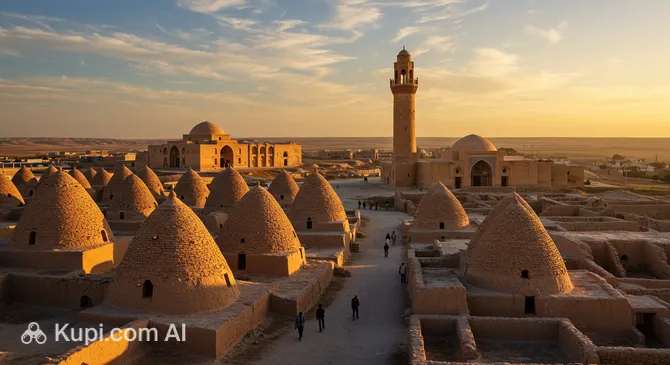
Harran. Illustration.
Source: Kupi.com AI

Today, Harran appears to travelers as a colorful settlement where ancient ruins harmoniously coexist with traditional village buildings. The town is particularly famous for its unusual mud-brick beehive houses, which seem to transport you to another era. Strolling through the narrow streets, inhaling the aromas of spices, and observing the leisurely life of the locals, you will immerse yourself in the unique atmosphere of Oriental hospitality.

In addition to the unique beehive houses, Harran attracts visitors with the ruins of an ancient university, one of the oldest in the world, and the remains of the Grand Mosque. This town is the perfect place for those seeking authentic experiences away from noisy tourist routes. A visit to Harran allows you not only to touch thousands of years of history but also to see how ancient traditions continue to live in the modern world, leaving an unforgettable impression.

More interesting facts can be found on the history of Harran page.

Weather Overview

The weather in Harran is characterized by hot, dry summers and cool, wetter winters. Summer months, especially July and August, can be very sweltering, with average temperatures exceeding 30°C and almost a total lack of precipitation. In winter, from December to February, average temperatures hover around 7-9°C, and rain is possible. Spring and autumn offer more moderate temperatures, making these seasons comfortable for visiting.

Expect very hot and dry summers with temperatures often reaching 40°C, and cool winters with average temperatures around 3-14°C and a small amount of precipitation. You can find more details about the weather on the Harran Climate page.

Average monthly temperature

Average monthly precipitation

Interesting Facts

In addition to its famous ruins and unique beehive houses, ancient Harran holds many amazing stories and little-known details that make it even more alluring for curious travelers. Here are just a few of them:

  • Harran is considered one of the oldest continuously inhabited cities in the world, with its history rooted in the 3rd millennium BC. Furthermore, it is mentioned in the Old Testament as the place where Terah, the father of the prophet Abraham, lived, which gives the city special significance for pilgrims and researchers of biblical texts.

  • In antiquity, Harran was not only a major trade center at the crossroads between Mesopotamia and Anatolia but also home to one of the world's first universities. Scientific and philosophical works were actively translated here from Greek into Arabic, and important astronomical observations were conducted, making it a center of knowledge in the ancient world.

  • The famous beehive houses of Harran, built of clay and brick, are unique not only for their conical shape but also because they were constructed without the use of wood or nails. This ingenious design provided natural coolness during the sweltering summer months and retained heat in winter, which was vital in the local climate.

  • According to legends and historical records, significant events of antiquity took place in the vicinity of Harran. For example, stories are told of a "treaty between the Sun and Moon gods" being concluded here. It is also believed that near the city in 53 BC, Parthian troops won a crushing victory over the Roman army under the command of Marcus Licinius Crassus, which became one of the turning points in history.

How to Get There

The most convenient way to reach the ancient city of Harran, located in the Şanlıurfa province, is by air, using one of the regional airports. Although Harran itself does not have its own airport, the nearest air harbors offer several options for travelers planning to visit this historical site.

The main and most closely located option is Şanlıurfa GAP Airport (IATA: GNY). It is located in the town of Karaköprü, approximately 65.5 km north of Harran. This is a modern regional airport serving a significant number of passengers. A trip from the airport to Harran by taxi or rental car will take about 1 hour 45 minutes – 2 hours.

Another major transport hub to consider is Gaziantep Airport (IATA: GZT), located in the city of Gaziantep. The distance from there to Harran is about 138 km. Gaziantep is a large airport that often serves international flights and has a high passenger flow, which may mean more flight options. The drive to Harran from here takes approximately 3 hours 30 minutes – 4 hours by car.

It is also worth mentioning Diyarbakır Airport (IATA: DIY), located in the city of Diyarbakır. It is approximately 155 km from Harran and is also a fairly large airport. A car journey from there to Harran will take about 4 hours – 4 hours 30 minutes.

From the cities where these airports are located (Şanlıurfa/Karaköprü, Gaziantep, Diyarbakır), you can reach Harran by taxi, rental car, or potentially by intercity buses (dolmush) running towards Şanlıurfa, from where it is easier to find transport to Harran itself. Renting a car provides the greatest flexibility for exploring the region. It is recommended to check current schedules and transfer options in advance, especially if you are traveling independently.

For convenience, here is a summary of the main airports used to reach Harran:

AirportPassenger trafficDistance
Sanliurfa GAP Airport882 98766 km
Adiyaman Airport366 424108 km
Gaziantep Airport3.0 mln138 km
Mardin Airport728 812148 km
Diyarbakir Airport2.3 mln155 km

Main Attractions

Harran is not just a town, but a real journey through time, where every stone breathes history. Located in southeastern Turkey in the province of Şanlıurfa, this ancient settlement bears the traces of many civilizations and offers tourists unique attractions that immerse them in the atmosphere of ancient Mesopotamia.

One of the most striking and memorable features of Harran is its famous beehive houses. These traditional mud-brick dwellings with conical roofs, built without the use of wood, are perfectly adapted to the hot and dry climate of the region. Their unique architecture is not only photogenic but also keeps the interior cool even on the hottest days. Visiting these houses, you can imagine how people lived in this area for centuries and take amazing photographs.

Harran is also known as the site of one of the oldest universities in the world. Although mostly ruins remain, they are impressive in scale and serve as a reminder of Harran's former greatness as a major educational and scientific center in the early Islamic world, starting from the 8th century. Astronomy, medicine, philosophy, and theology were studied here. A walk among these ancient walls allows you to touch the rich intellectual heritage of humanity.

The impressive ruins of Harran Castle (Harran Kalesi) also draw the attention of travelers. This citadel, with roots dating back to the 2nd millennium BC and rebuilt many times—including by the Crusaders and Ayyubids—bears witness to the strategic importance of Harran. Its surviving walls and towers offer panoramic views of the surrounding plain and the ancient town, allowing you to appreciate the scale of this historical site.

One cannot overlook the ruins of the Grand Mosque of Harran (Ulu Cami). It is believed to be one of the oldest mosques built in Anatolia, founded in the 8th century by the Umayyad caliph Marwan II. Its partially preserved minaret, astronomical tower, and the remains of walls with arcades provide an idea of the monumentality of this structure, which was once an important religious and cultural center. This site is particularly interesting for those fascinated by the history of Islamic architecture.

Local Cuisine

The gastronomy of Harran is a true immersion into the world of authentic Oriental flavors, where ancient culinary traditions are harmoniously combined with the influence of neighboring regions. The main highlight of the local cuisine lies in its simplicity and the use of exceptionally fresh, seasonal products grown on the fertile lands of this historical area. The dishes here are particularly rich and aromatic, reflecting the generosity of the local nature.

You should definitely start your acquaintance with the local cuisine with lamb kebab, masterfully prepared over an open fire with a bouquet of local spices. No less famous is the local bread – hot, fluffy lavash, baked in traditional tandoor ovens and served with every meal. In Harran, hearty and healthy dishes made from lentils and bulgur, often complemented by fresh vegetables, are also highly valued. Do not miss the chance to try thick local yogurt and various homemade cheeses made according to old recipes.

Traditional drinks in Harran are, first and foremost, fragrant Turkish tea and strong coffee. They are served in small glass cups, and the process of drinking tea or coffee often becomes a reason for leisurely conversation and enjoying the moment. This is not just quenching thirst, but an important part of local hospitality and the culture of communication.

You can discover the gastronomic diversity of Harran not only in restaurants. Visit the local markets, where you will be greeted by rows of the freshest vegetables and fruits, fragrant spices, homemade honey, and olive oil. Street food also deserves attention: try the appetizing samsa with meat or vegetables and traditional Oriental sweets made from dates and sesame. A meal in Harran is always more than just food; it is a real ritual that allows you to feel the spirit of the ancient city and its famous hospitality.

Travel Tips

Welcome to Harran, one of the oldest continuously inhabited settlements in the world! To make your journey to these unique historical sites as comfortable and memorable as possible, we have prepared some practical tips. They will help you better navigate and enjoy every moment in this amazing corner of Turkey.

  1. Clothing and essentials: Harran is located in a region with a hot and dry climate, especially in summer. Choose light, breathable clothing made from natural fabrics that covers the shoulders and knees, which is especially important when visiting historical sites and out of respect for local traditions. Be sure to bring comfortable shoes for walking on the uneven terrain of archaeological excavations. Don't forget a hat, sunglasses, and high-SPF sunscreen. For electronics, you will need a Type F adapter (European socket).

  2. Transport: Harran is more like a large village and archaeological complex than a city with a developed public transport system. It is most convenient to get here by dolmush (shared taxi) or a regular taxi from Şanlıurfa, the nearest major city. Once in Harran, it is best to get around on foot to fully feel the atmosphere of antiquity. Renting a car may be worthwhile if you plan to explore the surroundings.

  3. Finances: The official currency is the Turkish Lira (TRY). It is recommended to have a sufficient amount of cash with you, as not all local shops or small guest houses may accept bank cards. ATMs will likely be available in Şanlıurfa; there may not be any in Harran itself. International cards are accepted in large hotels and shops in Turkey's tourist centers, but in Harran, it's better not to count on it. Tips are welcome in cafes and restaurants (usually 10% of the bill) if you liked the service.

  4. Health and Safety: Harran is considered a fairly safe place for tourists. However, always observe basic precautions: keep an eye on your belongings and drink bottled water. The nearest pharmacies (eczane) and large medical facilities are located in Şanlıurfa. Take a small first-aid kit with the most necessary medications. Be sure to protect yourself from the sun, especially in the summer months, to avoid heatstroke.

  5. Communication: The main language of communication is Turkish. Kurdish may also be used in this region. English is not widely spoken, mainly among tourism industry workers in larger cities. Learn a few basic phrases in Turkish, such as "Merhaba" (Hello), "Teşekkür ederim" (Thank you), "Lütfen" (Please)—this will help a lot in communication. It is better to purchase a local SIM card for mobile internet in Şanlıurfa. Wi-Fi access may be limited and provided mainly in hotels or some cafes.

  6. Local Etiquette: Turks, especially in rural areas, are very hospitable. Show respect for local customs and traditions. Greet people with a smile and the word "Merhaba." If you are invited for tea, it is a sign of hospitality—try not to refuse if possible. Always ask permission before photographing local residents, especially women and children.

  7. What to avoid: Try not to wear overly revealing or provocative clothing outside the hotel to avoid offending local residents. Also, avoid photographing people without their explicit consent. Do not litter at archaeological sites—treat ancient ruins with respect.

  8. Additional advice: Harran is famous for its unique mud-brick beehive houses. Try to visit them at sunrise or sunset—the lighting at this time beautifully emphasizes their unusual architecture. Be open to communication: local residents can be very friendly and hospitable, and interacting with them will give you unforgettable impressions.

We hope these tips make your journey to Harran even more pleasant and fulfilling. We wish you amazing discoveries in this ancient city!

Entertainment & Nightlife

Harran, known for its ancient history and unique "beehive" houses, offers a very quiet and authentic atmosphere for evening leisure, which differs significantly from the noisy nightlife of large metropolises. Instead of neon-lit clubs and bars, here you will find more traditional ways to spend the evening, immersing yourself in the local culture.

Evening in Harran is an opportunity to enjoy a leisurely pace of life. The main entertainment centers around dinner in small family restaurants where you can taste regional cuisine. Some local cafes may stay open late, offering guests fragrant Turkish tea, coffee, and traditional sweets. This is also a wonderful time for slow strolls through the streets of the historical part of town once the daytime heat subsides, and for stargazing, as light pollution in this area is minimal.

The evening atmosphere in Harran is very peaceful and conducive to relaxed rest. The crowd mainly consists of locals and tourists interested in the city's rich historical heritage. There is usually no specific dress code for evening outings; however, to show respect for local traditions, modest clothing is recommended. Local establishments generally operate until late evening, but do not expect the 24-hour entertainment venues typical of major tourist centers.

If you are looking for lively nightclubs, trendy bars, or specialized nightlife districts, Harran will likely offer a different experience. Due to its historical status, small size (population around 9,653), and traditional way of life, the town does not have such establishments. Evening leisure here revolves around quieter activities: dining at local restaurants, socializing in teahouses, or simply enjoying the silence of the ancient city under the starry sky.

When planning an evening in Harran, keep in mind that public transport at night may be limited or unavailable. Moving around the compact city center is most convenient on foot. If you need a taxi, it is better to arrange a ride in advance through your hotel or a local agency. Prices in local restaurants and cafes are generally quite moderate. The best time for evening walks and dinner is after sunset when it becomes cooler.

Harran is considered a fairly safe place for tourists. However, as with any other trip, it is worth observing basic precautions, especially if you decide to walk late at night away from the main lit streets. It is important to remember that tourist infrastructure for night activities here may not be as developed as in large cities.

During the day, Harran offers a rich program for curious travelers. You should definitely visit the famous mud-brick "beehive" houses (Harran Evleri), which are the city's trademark. The ruins of Harran Castle and the remains of one of the world's oldest Islamic universities are also worth seeing, testifying to the rich past of this unique place. These attractions will allow you to gain a deeper understanding of Harran's millennial history.

Parks & Museums

Harran, an ancient city with a rich history in Turkey, offers travelers a unique immersion into the past. Here, you won't find traditional city parks with attractions or modern museum complexes in the usual sense. Instead, Harran itself and its surroundings represent a vast historical landscape and an open-air museum, where every corner breathes millennia of history.

When speaking of Harran's "green zones," the first thing to mention is the Harran Archaeological Complex itself. This is not a park in the classic sense, but an extensive area of the ancient city where you can walk for hours among the ruins, imagining the life that bustled here thousands of years ago. This is a unique opportunity for leisurely strolls and photo sessions against the backdrop of impressive remains from ancient civilizations. The plains surrounding the town, though predominantly agricultural land, provide an idea of the natural context in which this ancient Mesopotamian center existed and may be of interest to those wanting to feel the atmosphere of this historical region.

Harran's cultural heritage is represented by its outstanding historical sites, each of which can be considered a separate "exhibit" of this grand open-air museum:

One of the main symbols and most significant "museum" objects are the famous traditional beehive houses (Konik Kubbeli Evler). Their unique conical roof shape, created from clay bricks, is an ingenious architectural solution for the hot climate. Some of these houses are open to the public, allowing a glimpse inside to imagine the daily life of local residents over the centuries. This is living history and a wonderful place for understanding local culture and architectural traditions.

The heart of the ancient city was the ruins of the Grand Mosque of Harran (Ulu Cami). It is believed to be one of the oldest mosques built in Anatolia and is also known as the site of the first Islamic university and astronomical observatory. Exploring its remains, including the impressive minaret and arches, allows you to touch the scientific and spiritual past of Harran. This site will be of particular interest to those fascinated by the history of Islamic architecture and science.

The monumental ruins of Harran Castle (Harran Kalesi) testify to the strategic importance of the city over many centuries. Although the castle is heavily ruined, its walls and towers still make a strong impression. Exploring the castle provides insight into the military history of the region and offers panoramic views of the surrounding area and ancient ruins.

One must also mention the ruins of the ancient Harran University. Although little remains of it, the realization that one of the world's leading centers of knowledge, where philosophy, astronomy, and medicine flourished, was once located here commands deep respect. This is a place of power for everyone who values the history of education and science.

Traveler's Tip: To fully experience the magic of Harran, try to visit the main ruins, such as the Grand Mosque or the castle, at sunrise or sunset. The play of light on the ancient stones creates a truly unforgettable atmosphere. Also, don't miss the chance to peek into one of the traditional beehive houses—it's a unique experience that will help you better understand the local way of life.

Getting Around

When planning your travel around Harran and its surroundings, it's worth considering that this is a small historical town. The public transport system here is quite simple and adapted to the size and needs of the local population and tourists coming to see the ancient ruins.

The main form of public transport in Harran and for connections with nearby settlements, primarily with Şanlıurfa, is the dolmush. These are shared taxis or minibuses that run along specific routes. Dolmush often do not have a strict schedule; they depart as they fill up. Stops may also not always be strictly fixed—sometimes you can ask the driver to stop at a desired location along the route.

In addition to the dolmush, there may be local bus routes connecting Harran with larger cities in the region. Information about their schedules is best clarified on-site, for example, at a small bus station if one exists, or from local residents.

The fare payment system in dolmush and local buses is usually very simple: payment is made in cash directly to the driver upon entry. It is recommended to have small Turkish Lira bills. The fare is usually low, especially for short distances. Complex travel card systems or mobile apps for fare payment are unlikely in Harran.

Practical tips for tourists:

  • Tickets for the dolmush or local bus are purchased from the driver.
  • Special ticket validation is usually not required, as payment is made on the spot.
  • Public transport operating hours may be limited, especially in the evenings and on weekends. Plan your trips in advance, especially if you intend to return late.
  • Don't hesitate to ask drivers or locals about routes and the necessary stops.

Alternative ways to get around:

  • Taxi: Taxis can be found in Harran. This is a more expensive but more comfortable way to travel, especially if you are in a group or have luggage. It's better to agree on the fare with the driver in advance or ensure the meter is turned on (if there is one).
  • Walking: Ancient Harran itself is compact, and its main archaeological zones and attractions are most conveniently explored on foot.
  • Car Rental: For more freedom to move around the Şanlıurfa region, you might consider renting a car in a larger city. This will allow you to explore the surroundings of Harran at your own pace. Bicycle rentals or car-sharing in Harran itself are unlikely to be widespread.

In Harran, you won't find metros, trams, or trolleybuses. The transport system is focused on basic needs for connecting with the outside world and traveling short distances.

Accommodation

When planning a trip to Harran, you will find that accommodation options here reflect the unique historical character of the place. The town is dominated by small, authentic lodging options rather than large hotel chains. Tourists can expect guest houses decorated in a traditional style and small family-run hotels that offer a closer look at the local culture. For a wider selection, including mid-range and high-end hotels, some travelers also consider options in the larger nearby city of Şanlıurfa, from which Harran is easily accessible.

Given the compact size of Harran, most lodging options are located in close proximity to the main historical attractions, such as the famous mud-brick beehive houses, the ruins of the ancient university, and the fortress. The choice of where to stay here depends more on the desired level of immersion in the ancient city's atmosphere than on transport logistics within Harran itself.

In Harran, you are unlikely to find large international hotel chains. The main focus here is on providing a unique experience staying in places with local color. These might be small pensions or guest houses managed by local families, where you can experience genuine Turkish hospitality. Such options often offer more personalized service and the opportunity to get better acquainted with the region's way of life.

To ensure the best accommodation option, especially if your trip falls during the peak tourist season or local holidays, it is recommended to book in advance. Prices for accommodation in Harran generally range from budget to moderate. You can use popular online platforms for searching and booking or, in some cases, contact the guest houses directly if they have that option. This will allow you to compare options and choose what best suits your expectations and budget.

Nearby Cities

For those who want to explore the surroundings, Harran serves as an excellent starting point for day trips to several interesting nearby locations. For example, Şanlıurfa, located only 39 km away, is known as the "City of the Prophets" and attracts visitors with its rich history, the sacred Balıklıgöl complex, and its proximity to the famous archaeological site of Göbeklitepe. A bit further, Adıyaman (about 120 km) is the gateway to the majestic Mount Nemrut (Nemrut Dağ) with its giant statues, listed as a UNESCO World Heritage site. These and other destinations offer unique experiences and are easily accessible for short visits.

CityPopulationDistance
Akcakale113 19418 km
Tall Abyad14 82520 km
Sanliurfa1 985 75339 km
Karaköprü195 55255 km
Suruc104 30255 km

These nearby destinations allow for a more complete understanding of the diverse culture, history, and landscapes of the Southeastern Anatolia region.

Shopping & Souvenirs

Shopping in Harran is more about immersion in local color and searching for authentic souvenirs than hunting for brands in large shopping centers. The town is famous for its ancient history, and this is reflected in the goods that can be purchased here. Primary attention should be paid to handmade products and items related to the region's unique culture.

There are no major shopping streets or districts with modern shops in Harran as such. Most commercial activity is concentrated around the main tourist attractions, such as the famous mud-brick beehive houses and the ruins of the ancient university. Here you will find small shops and stalls offering souvenirs and products from local artisans. Some goods can also be found in small shops in the central part of the settlement, serving mainly local residents.

You will not find large, modern shopping malls in Harran. This ancient town preserves its historical atmosphere, and shopping here has a more traditional character.

There are no large organized markets in Harran like in the big cities of Turkey. However, you may encounter small bazaars or individual stalls, especially on days when tourists arrive. Here you can find fresh local produce, spices, and souvenir products. This is a great place to observe daily life and perhaps find something interesting and authentic.

Souvenirs reflecting Harran's uniqueness are worth bringing back. Popular items include miniature copies of the famous beehive houses, local ceramic products, and textiles with traditional patterns. You can also look for copperware, handmade jewelry, and perhaps local sweets or spices characteristic of the Şanlıurfa region. Occasionally, handmade carpets and kilims can be found.

Shops and souvenir stalls in Harran usually operate during daylight hours. Opening hours can be flexible, as many are family-run businesses. During the tourist season, they may stay open longer. The main method of payment in small shops is cash (Turkish Lira). In some larger souvenir shops or hotels, bank cards may be accepted, but it is always better to have cash on hand.

Tourists in Turkey can use the Tax Free system for purchases exceeding a certain amount. If you make a large purchase in a store with the appropriate sign, ask the seller about the possibility of issuing documents for a VAT refund. However, given the nature of shopping in Harran, which focuses mainly on small souvenirs, this option may be less relevant.

Reached the end of the page?

That means the route is fully explored