Support

Ontario Municipal Airport

About the Airport

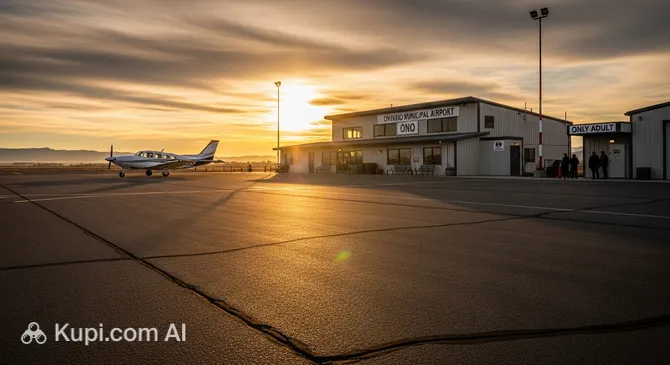
Ontario Municipal Airport. Source: Kupi.com Binoculars

Ontario Municipal Airport (IATA: ONO, ICAO: KONO) is not merely a runway, but a key air transport hub for the Treasure Valley region on the border of Oregon and Idaho. Located in the city of Ontario, it serves as a gateway for business and private aviation, providing vital connections for commerce, agriculture, and tourism. Despite the absence of scheduled passenger flights, the airport plays a significant role in the local economy by supporting cargo transport and providing a base for general aviation.

IATA Code ONO
ICAO Code KONO
City Ontario, United States
Distance to Centre about 5 km
Status General Aviation
Annual Passengers The airport does not serve scheduled commercial passenger flights. In 2019, approximately 12,930 takeoff and landing operations were recorded.
Popular Airlines The airport is used for private, corporate, charter, and training flights, as well as for gliding. It is not served by regular commercial airlines.
Schedule Ontario Municipal Airport online board

Features and Advantages

Ontario Municipal Airport is classified as a regional general aviation airport and covers an area of 194 hectares. It is equipped with one asphalt runway measuring 1,526 by 30 metres and features modern navigation systems, including GPS and LPV. The airport offers 24-hour self-service fuelling with 100LL and Jet-A, as well as maintenance services for aircraft and helicopters. A notable feature is its active use for agricultural purposes and gliding, alongside a strong Experimental Aircraft Association (EAA) community. Its convenient location just a few kilometres west of downtown Ontario and close to the Idaho border makes it a strategically important facility for the entire region.

Contact Information

  • Official Website: www.ontariooregon.org/departments/airport/
  • Information Desk Phone: +1 541-889-9135
  • Airport Address: 1816 SW 4th Ave, Ontario, OR 97914, USA
  • Email: For general enquiries, it is recommended to use the contact form on the official website or call the listed phone number, as a specific email for passengers is not published.
  • Social Media: Currently, the airport does not maintain official pages on social media platforms.
  • Lost Luggage Information: If your luggage has been lost or damaged, you should contact the airline you flew with directly. For items left behind in the terminal building, please contact the airport administration by phone.
  • Passenger Support Contacts: For all questions related to booking, flight schedules, and carriage regulations, please contact your airline. The airport administration advises on general matters regarding terminal operations.

How to Get to the Airport

Getting to Ontario Municipal Airport from Caldwell is quite straightforward, although transport options are typical for small regional airports in the United States. The airport is located in close proximity to the city, and a trip from the centre will take an average of 15–20 minutes depending on traffic conditions. The most convenient and common methods are taxis and car rentals.

Taxis and Rideshare Services, such as Uber and Lyft, are the fastest and most comfortable way to reach the terminal. The trip from downtown Caldwell will be short and relatively inexpensive. It is recommended to book a car in advance, especially if you have an early morning or late-night flight, to ensure driver availability. The cost of the trip usually varies but remains within reasonable limits for such a distance.

Car Rental is an ideal option for those planning to move actively around the region. You can rent a car from one of the rental agencies and drive comfortably to the airport, then return it there. If you are driving your own vehicle, parking is provided at Ontario Municipal Airport. Typically, small airports offer convenient and affordable options for both short-term and long-term parking.

Regarding Public Transport, options may be limited. Direct bus routes to small municipal airports are rare. Although transport companies operate in the region, it is strongly recommended to check their schedules and routes on official websites in advance. However, for timely arrival for your flight, taxis or personal vehicles remain the more reliable options.

For travellers requiring a greater number of flights and destinations, it is worth considering alternative air hubs. The main transport hub of the region is Boise Airport (Gowen Field) (BOI), located approximately an hour's drive away. Other options located at a greater distance include Friedman Memorial Airport (SUN) and Eastern Oregon Regional Airport (PDT).

Terminals and Map

Ontario Municipal Airport (ONO) is a small regional airport primarily serving private and business aviation, as well as charter flights. Its structure is extremely simple and intuitive for any traveller.

The airport consists of one main terminal that handles all flights—both departures and arrivals. Due to its compact size, getting lost here is practically impossible. All infrastructure, including waiting areas and check-in counters (if used for your flight), is located in a single building. Departure and arrival zones are situated in close proximity to each other, making movement through the terminal quick and convenient. Transfers between terminals are not required, as there is only one.

Check-in and security procedures, if applicable to your flight, are significantly faster than at major airports. Generally, all formalities take minimal time. It is recommended to arrive at the airport approximately 45-60 minutes before departure to pass through all necessary stages without haste.

A key tip for navigation: do not expect the scale and services of a major international hub here. This is a very compact and easy-to-navigate airport. Important note: ensure you are flying from Ontario Municipal Airport (ONO) in Oregon, and do not confuse it with the much larger Ontario International Airport (ONT) in California.

Airport History

The history of Ontario Municipal Airport (ONO) dates back to World War II. The airport was founded in 1942 as a military airbase named Ontario Army Air Field. Its main task was training crews for heavy B-24 Liberator bombers. For several years, the airfield was a vital training centre for the United States Air Force, preparing thousands of pilots and crew members for service.

After the war ended, in 1946, the military facility was transferred to the city of Ontario for civilian use, marking the beginning of its modern history as a municipal airport. This transition was a key stage in the development of the entire region's infrastructure. Military buildings were gradually adapted for civil aviation needs, and the airport began accepting private and commercial flights, contributing to economic growth.

In subsequent decades, the airport underwent multiple modernisations. Significant work was carried out to reconstruct the runway, update navigation systems, and improve terminal infrastructure to meet modern safety and comfort standards. At various times in its history, the airport served scheduled passenger services operated by regional airlines, connecting it to major hub airports.

Interesting fact: some original hangars and structures from the World War II era still remain on the airport grounds, serving as a living reminder of its military past. Today, Ontario Municipal Airport is an important centre for business, private, and cargo aviation, serving the vast agricultural region on the border of Oregon and Idaho, including cities such as Caldwell.

Services and Amenities

Ontario Municipal Airport (ONO) is a compact regional airport, so the range of passenger services in its terminal is basic. Travellers should plan their journey keeping in mind that many amenities typical of large aviation hubs are absent here.

Dining and Shopping: There are no restaurants, cafés, or retail outlets within the terminal building. It is recommended to arrange for food and purchases in the city of Ontario beforehand. Vending machines with snacks and beverages may be available inside, but their selection is limited.

Lounges and Terminal Facilities: A main waiting area is provided for passengers. Specialised VIP zones or business lounges are not available at the airport. Passengers may have access to basic Wi-Fi, but one should not rely on a large number of power outlets for charging gadgets. It is best to carry a portable power bank.

Financial and Medical Services: There are no bank branches, ATMs, or currency exchange points at the airport. All financial matters must be settled in the city. A medical centre is also absent; in emergencies, city rescue services are called to the site.

Services for Passengers with Children and Special Needs: The terminal meets basic accessibility requirements and is equipped for passengers with reduced mobility. However, specific mother-and-child rooms or children's play areas are not provided here.

Hotels and Business Services: There are no hotels on the airport grounds, but the city of Ontario, located just a few minutes' drive away, offers numerous hotels and motels to suit any budget. Conference room rentals or business centre services are not provided at the airport.

Where to Eat

When planning a trip through Ontario Municipal Airport (ONO), it is important to consider its specific nature. It is a small airport that mainly serves private and general aviation, and its infrastructure differs significantly from large commercial hubs. There are no restaurants, cafés, or dining outlets for passengers within the airport grounds. There are no food service zones either before or after security control.

If you need to have a meal before or after your flight, the best solution is to head into the city of Ontario itself, located in the immediate vicinity of the airport. In the city, you will find a variety of options to suit every taste and budget: from familiar fast-food chains, ideal for those in a hurry, to cosy local cafés and restaurants where you can enjoy a full lunch or dinner in a relaxed atmosphere. American and international cuisines are well represented here.

Therefore, travellers using Ontario Municipal Airport are advised to take care of their meals in advance. Plan to eat before leaving for the airport or be prepared to look for a café in the city upon arrival. This approach will help avoid inconvenience and make your journey more comfortable.

Travel Tips

Flying through Ontario Municipal Airport, which serves general aviation, is a completely different experience compared to large commercial hubs. To ensure your journey on a private or charter flight is as comfortable as possible, use our tips adapted to the specifics of this airport.

The main advantage of private aviation is saving time. It is recommended to arrive at the airport 45–60 minutes before the scheduled departure. This time is more than sufficient, as there are no long queues for check-in and security. All pre-flight procedures are conducted quickly and in a calm environment.

The check-in and security process at a general aviation airport is significantly simplified. Instead of airline counters, you will likely be met by a representative of your charter company or a Fixed Base Operator (FBO) staff member. They will assist with luggage and escort you to the aircraft. Security checks are conducted, but they are much faster and less formal than at large airports.

On board a small aircraft, seat selection is often more flexible. Nevertheless, general principles remain: window seats offer the best views during the flight, while aisle seats provide more convenience for moving around the cabin. Sometimes the crew may ask you to occupy specific seats for the correct centering of the aircraft.

Although baggage rules in private aviation can be more flexible, the basic safety requirements of the United States remain in force. It is prohibited to bring weapons, flammable items, and explosives on board. We recommend clarifying specific weight and size limits for baggage and rules regarding liquids with your charter operator in advance.

Ontario Municipal Airport mainly serves domestic flights, so there are no standard procedures for transit passengers or regular customs control. If your route involves an international flight or a transfer to another private aircraft, all details will be agreed upon and organised by your aviation broker or operator in advance.

To make your journey even smoother, book a transfer to Caldwell or another destination in advance. Taxi stands are not always available at general aviation airports. You can also ask the FBO operator to arrange catering on board—including Halal options if required—or other necessary services.

Delays in private aviation are most often related to weather conditions or technical reasons. In such a situation, your main source of information is the pilot or the charter company representative. Communication with them is direct and prompt. You can spend the waiting time comfortably in the FBO lounge, which usually has everything necessary for rest and work.

Reached the end of the page?

That means the route is fully explored