Support

Victoria Regional Airport

About the Airport

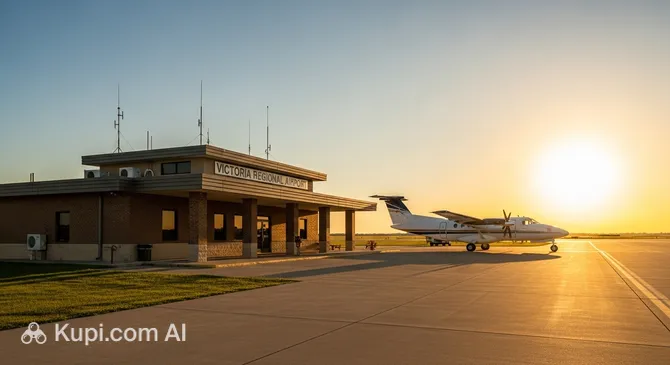
Victoria Regional Airport. Source: Kupi.com Binoculars

Victoria Regional Airport (VCT) is more than just a transport hub; it is an aerial gateway with a rich history that today serves as a vital link for residents and visitors of South Texas. A former World War II military airbase, the airport today combines heritage with modern functions. It ensures a comfortable and quick start to your journey thanks to its compact size and convenient infrastructure, connecting the region with major aviation hubs.

IATA Code VCT
ICAO Code KVCT
City Victoria, Texas
Distance to Centre approx. 9 km
Status Domestic
Annual Passengers approx. 3,100 (based on 2017 data)
Popular Airlines United Airlines
Schedule Victoria Regional Airport Online Schedule

The main feature of Victoria Airport is its participation in the federal Essential Air Service programme, which ensures stable air connectivity for smaller communities. Thanks to this, passengers have regular flights to one of the world's largest airports — George Bush Intercontinental Airport (IAH) in Houston, opening access to a global route network. The airport is distinguished by its simplicity and lack of queues, making the check-in and security process quick and carefree. Despite its modest size, it is well-equipped and constantly modernised to enhance traveller comfort and safety.

Contact Information

Below you will find contact information for Victoria Regional Airport (VCT), which will help you plan your trip and resolve any queries.

  • Official Website: flyvictoria.com
  • Information Desk Phone: +1 (361) 578-2704
  • Airport Address: 202 Foster Field Dr, Victoria, TX 77904, USA
  • Email: A direct email address is not published. It is recommended to use the contact form on the official website for communication.
  • Social Media: You can follow airport news on their official page on Facebook.
  • Lost Luggage Information: If you have lost items within the airport terminal, please contact the administration at +1 (361) 578-2704. For luggage lost during a flight or on board the aircraft, you should contact your airline directly.
  • Passenger Support Contacts: For general questions and assistance, you can contact the airport information desk at +1 (361) 578-2704.

How to Get to the Airport

Getting to Victoria Regional Airport (VCT) from the city of Port Lavaca, located in the USA, is most convenient by car, as there is no direct public transport connection. The airport is located approximately 50 kilometres northwest of the city, and the journey usually takes about 40-50 minutes depending on traffic conditions.

Taxi, Transfers, and Ride-Sharing

The simplest, though not the most budget-friendly method, is to order a taxi or use ride-hailing apps such as Uber or Lyft. A one-way trip will cost approximately $60-90. It is recommended to book a car in advance, especially if you have an early morning or late-night flight, as the number of available drivers in a small city may be limited. You may also consider booking a private transfer, which ensures a car is provided at the required time.

Car Rental and Parking

Renting a car is the most practical and recommended option. It gives full freedom of movement not only for the trip to the airport but also for travelling around the region. You can rent a car at one of the agencies in Port Lavaca. Victoria Regional Airport offers convenient and affordable parking. There are both short-term and long-term parking lots located in immediate proximity to the terminal, making the parking process quick and hassle-free.

Public Transport

Unfortunately, direct public transport routes, such as buses or trains, between Port Lavaca and Victoria Regional Airport are unavailable. Attempting to get there using public routes would require multiple transfers and is not a reliable way to catch a flight on time. Therefore, this option should not be considered for travel to the airport.

Alternative Airports

Although Victoria Regional Airport is the nearest, it serves a limited number of destinations. For a wider choice of flights, travellers often consider larger aviation hubs. Among them are Corpus Christi International Airport (approximately 133 km), Austin-Bergstrom International Airport (166 km), and San Antonio International Airport (169 km). Please note that the journey to these airports will take significantly longer — from two to three hours by car.

Terminals and Map

Victoria Regional Airport (VCT) is a compact and convenient aviation hub distinguished by a simple and clear structure. Travellers need not worry about complex navigation, as the airport consists of one passenger terminal serving all flights — both departures and arrivals.

The terminal layout is intuitively clear. Immediately upon entry, you find yourself in the general area where airline check-in counters are located. After receiving a boarding pass and checking in luggage, passengers proceed to the single security checkpoint. Since there is only one terminal, there is no need to transfer between buildings — everything is within walking distance.

Departure and arrival zones are clearly separated but located in the same building. After passing security control, you will find yourself in a small waiting area with boarding gates. The arrival zone is located on the ground floor and includes a baggage claim belt. Thanks to the airport's modest size, the path from the aircraft to the terminal exit takes just a few minutes.

The main feature of the VCT terminal is its tranquil atmosphere and lack of the hustle characteristic of large airports. Check-in and security procedures generally proceed very quickly. It is recommended to arrive at the airport approximately 60-90 minutes before departure to complete all formalities without rushing. Navigation through the terminal is extremely simple: follow the signs, but most likely, you will easily orient yourself without them, as all key zones are in plain sight.

Airport History

The history of Victoria Regional Airport (VCT) is closely tied to significant events of the 20th century. Its story begins not with civil aviation, but with the military. The airport was founded in 1941 as a US Army Air Forces military airfield named Foster Field. Its primary mission was training fighter pilots during the Second World War.

During wartime, Foster Field was one of the largest and most important training bases in the USA. Here, thousands of young pilots honed their skills before being deployed to the front. After the war ended, the need for such a large number of military bases diminished, and in 1946 the facility was transferred to civil authorities. This event became a key stage in the airport's development, opening a new chapter in its history as a civil transport hub for the city of Victoria and its surroundings.

With the transition to civil use, the airport received a new name and began serving commercial flights. Over the decades, it has cooperated with various regional carriers, ensuring air connectivity with major cities in Texas and other states. The airport infrastructure, including the passenger terminal, has undergone modernisation multiple times to meet modern safety and passenger comfort requirements.

An interesting fact from the airport's history is connected to its original name. Foster Field was named in honour of Lieutenant Arthur L. Foster, an instructor pilot who tragically died during a training flight back in 1925. Today's runways, originally built to accommodate heavy military aircraft, stand as a silent testament to the airport's rich past and its contribution to both the military and civil history of the region.

Services and Amenities

Victoria Regional Airport (VCT) offers passengers all necessary services for a comfortable wait for their flight. Despite its compact size, the airport is designed to ensure convenience for all categories of travellers departing from Port Lavaca and its surroundings.

Before departure, you can have a snack at the café or restaurant located within the terminal, as well as purchase drinks and light snacks. The airport has shops where you can find travel essentials and souvenirs. Comfortable waiting lounges are provided for passengers awaiting their flights. It is recommended to check information regarding the availability and access conditions of VIP lounges in advance, as their availability may be limited.

Throughout the terminal, free Wi-Fi is available for passengers, allowing you to stay connected or work while waiting for boarding. Special zones and outlets for charging electronic devices are also provided. ATMs are installed in the terminal building for cash withdrawals; however, currency exchange points may be absent, so it is worth attending to this beforehand.

The airport is equipped for the needs of passengers with children — there are mother and child rooms. For travellers with reduced mobility, a barrier-free environment has been created, including ramps and specially equipped restrooms. Passengers can request assistance services by contacting airline representatives or the airport information desk. In case of necessity, basic medical assistance can be obtained at the airport.

Although hotels are not located directly within the terminal building, several hotels are situated in immediate proximity to the airport, offering convenient options for overnight stays. The possibilities for holding business meetings or the availability of conference rooms should be checked with the airport administration, as such services are not always provided in regional airports.

Where to Eat

Victoria Regional Airport (VCT) is a compact terminal serving a small number of flights, so the choice of dining establishments corresponds to its size and focuses on basic passenger needs. Options for gourmets or a full restaurant dinner are absent, but having a snack before departure is certainly possible.

The main and, typically, the only place to buy food and drinks at the airport is a small snack bar or café located in the main terminal building, in the public area (landside), i.e., before passing security control. This makes it convenient for both departing passengers and those meeting them. Its operating hours are usually tied to the flight schedule and may be limited.

The assortment here is focused on quick bites. You will be able to find:

  • Hot and cold drinks: coffee, tea, sparkling water, juices.
  • Ready-made snacks: sandwiches, pastries, crisps, chocolate bars.
  • Sometimes simple salads or individually packaged fruits are on sale.
This option is ideal if you need to quickly drink a coffee and eat a sandwich before your flight.

Unfortunately, at Victoria Airport, you will not find restaurants offering hot meals from a menu or establishments with a wide selection of local cuisine. Specialised options, such as vegan, gluten-free, or Halal dishes, are also not available here. Passengers with strict dietary requirements are strongly advised to bring food with them. For those wishing to have a full lunch, the best solution would be to visit one of the cafés or restaurants in the city of Victoria before travelling to the airport.

Additionally, vending machines are installed in the terminal, where drinks and light snacks can be purchased around the clock. This can be a convenient alternative if the café is closed or you need something at the last minute.

Tips for Travellers

To ensure your journey through Victoria Regional Airport proceeds as comfortably as possible, please make use of our tips. The airport serves the city of Port Lavaca and its surroundings, and proper preparation will help avoid unnecessary stress. For domestic flights within the USA, it is recommended to arrive at the airport at least 1.5-2 hours before departure. This time is sufficient to calmly check in luggage, pass security control, and reach the boarding gate.

To save time, use online check-in for your flight, which usually opens 24 hours before departure. This allows you to select a seat and receive a boarding pass in advance. At the airport, you will only need to drop off luggage if you have any. Security checkpoints at regional airports are usually less busy, but the rules are standard. If you travel frequently, consider participating in the TSA PreCheck programme, which allows you to pass screening via an expedited procedure.

When choosing a seat on the plane, consider your preferences. Window seats offer beautiful views during take-off and landing, while aisle seats allow you to stand up freely without disturbing neighbours. If you value quiet, try to avoid rows near toilets and the galley area. Seats in the front part of the cabin usually allow for a quicker exit from the aircraft upon arrival.

Pay careful attention to packing your hand luggage. All liquids, gels, and aerosols must be in containers of no more than 100 ml (3.4 oz) and packed in a single transparent resealable bag with a volume of up to 1 litre. Laptops and other large electronics must be removed from your bag for separate scanning. It is prohibited to carry weapons, explosives, and sharp objects in hand luggage.

If you have a connecting flight, study the map of the transfer airport in advance. Ensure you have enough time between flights — for domestic transfers, it is recommended to allow at least 60-90 minutes. Keep boarding passes for both flights at hand to avoid wasting time searching for them.

Customs and border control at Victoria Regional Airport are only undergone by passengers arriving on international flights (if such are operated). If you are flying on a domestic flight, you do not need to go through these procedures. For international flights, have your passport, visa, and completed customs declaration ready to speed up the process.

You can save money by booking tickets and airport parking in advance. Bring an empty reusable water bottle to fill after passing security control, and light snacks, as prices at the airport are always higher. Using public transport or shuttles instead of taxis will also help reduce expenses.

In case of a flight delay, first contact your airline representative for the latest information. Remain calm and clarify your rights: in some cases, airlines are obliged to provide meals or hotel accommodation during long delays. Find out the reason for the delay — this may affect eligibility for compensation. It is useful to carry a portable charger to stay connected.
Reached the end of the page?

That means the route is fully explored