Pamukkale, Turkey: what to see, how to get there
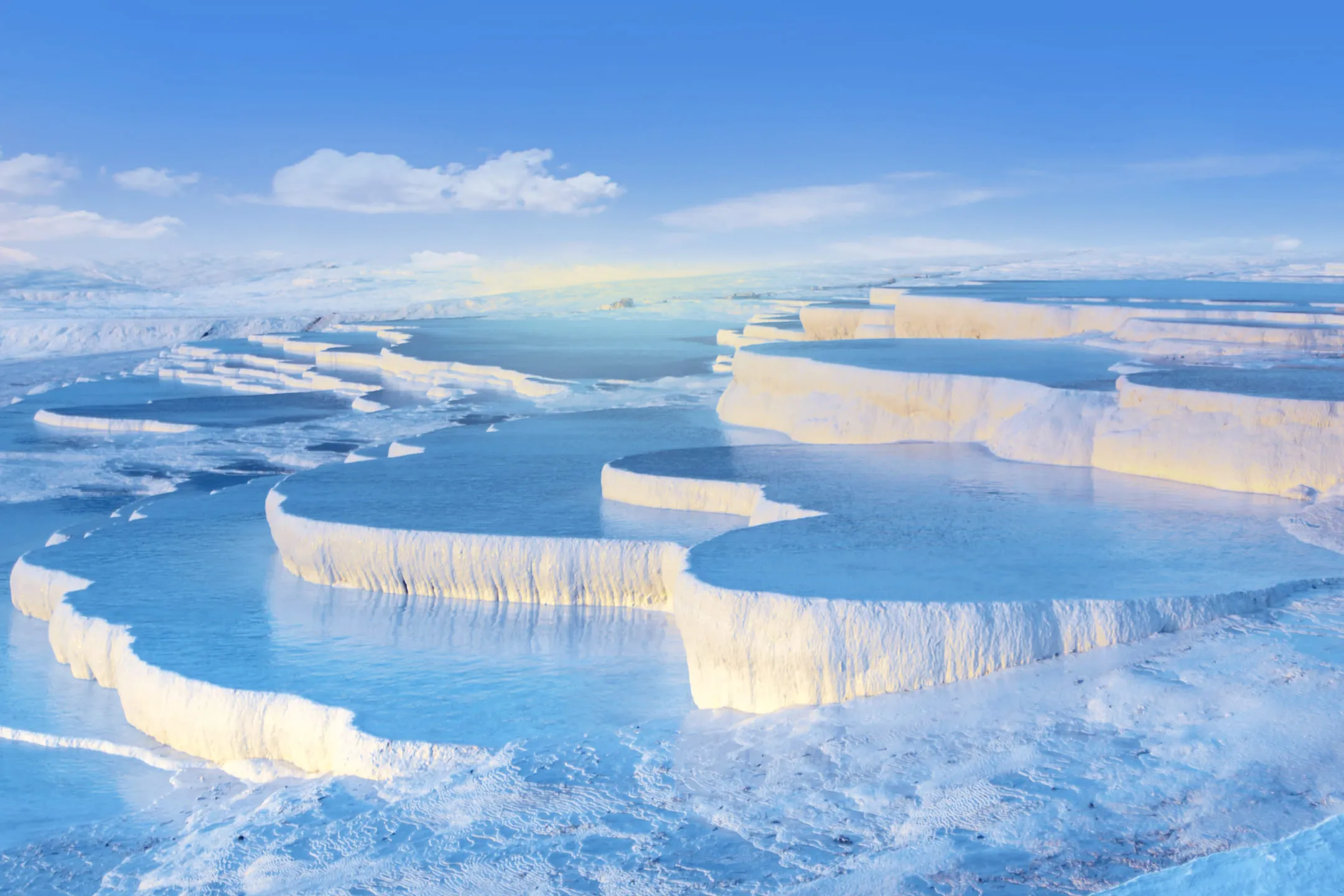
We tell you about a unique location for a wellness holiday in Turkey. The water temperature here averages +36 degrees Celsius, and the landscape resembles a snow-white cotton mountain.
In this article, we’ll tell you where this unusual resort is located, how to get there, and what else is interesting nearby. Let’s go!
How to get to Pamukkale
Many have at least heard of the Pamukkale resort, but have no idea how to get there. There are no direct international flights to Denizli, the town closest to this unusual area.
In this case, a flight to Istanbul saves the day. And from Istanbul, local Pegasus and Turkish Airlines fly directly to Denizli. Shuttles and taxis run from Denizli to Pamukkale.
You can also fly to Izmir, and then find fellow travelers by car or take a bus ticket to Pamukkale. The location is super popular, so there are always plenty of other travelers on the same route.
Geography and Climate
The closest coastal cities to Pamukkale are Aegean Sea cities like Marmaris. The climate here also corresponds to the coastal region: subtropical continental — with very hot summers and moderately cool winters. But due to the hilly terrain, it can be drier in elevated areas, and foggy during the off-season.
The hottest months are from June to September: the average air temperature stays at +30 degrees Celsius, and there is almost no precipitation. But people also come to Pamukkale for holidays during the cooler months — generally, it rarely drops below +10 degrees Celsius here.
It’s best to visit in late spring or early autumn: at this time, it’s already warm and comfortable, but without the scorching summer sun. The peak of tourist crowds is usually during the day, so we recommend choosing morning or evening for your visit.
History
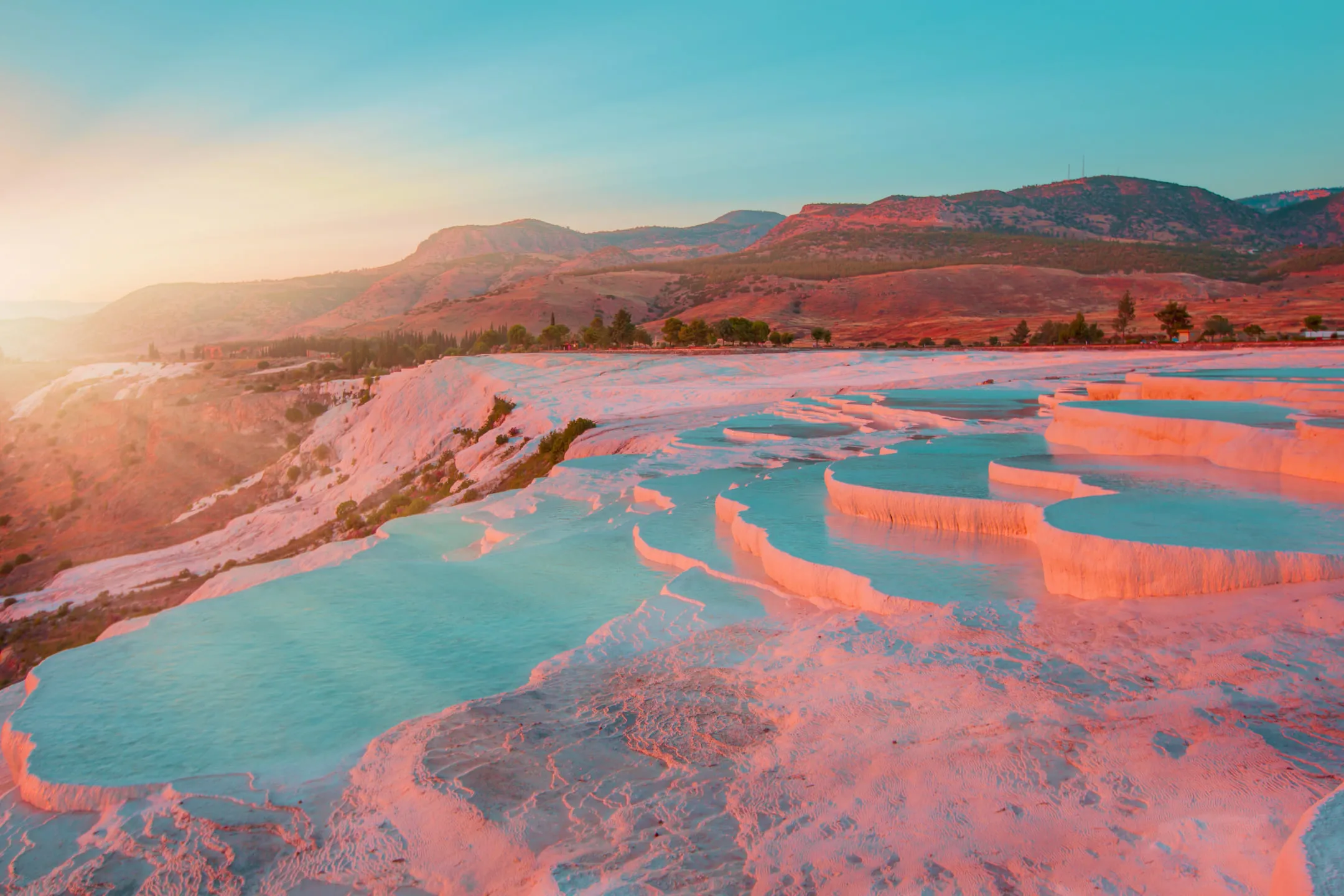
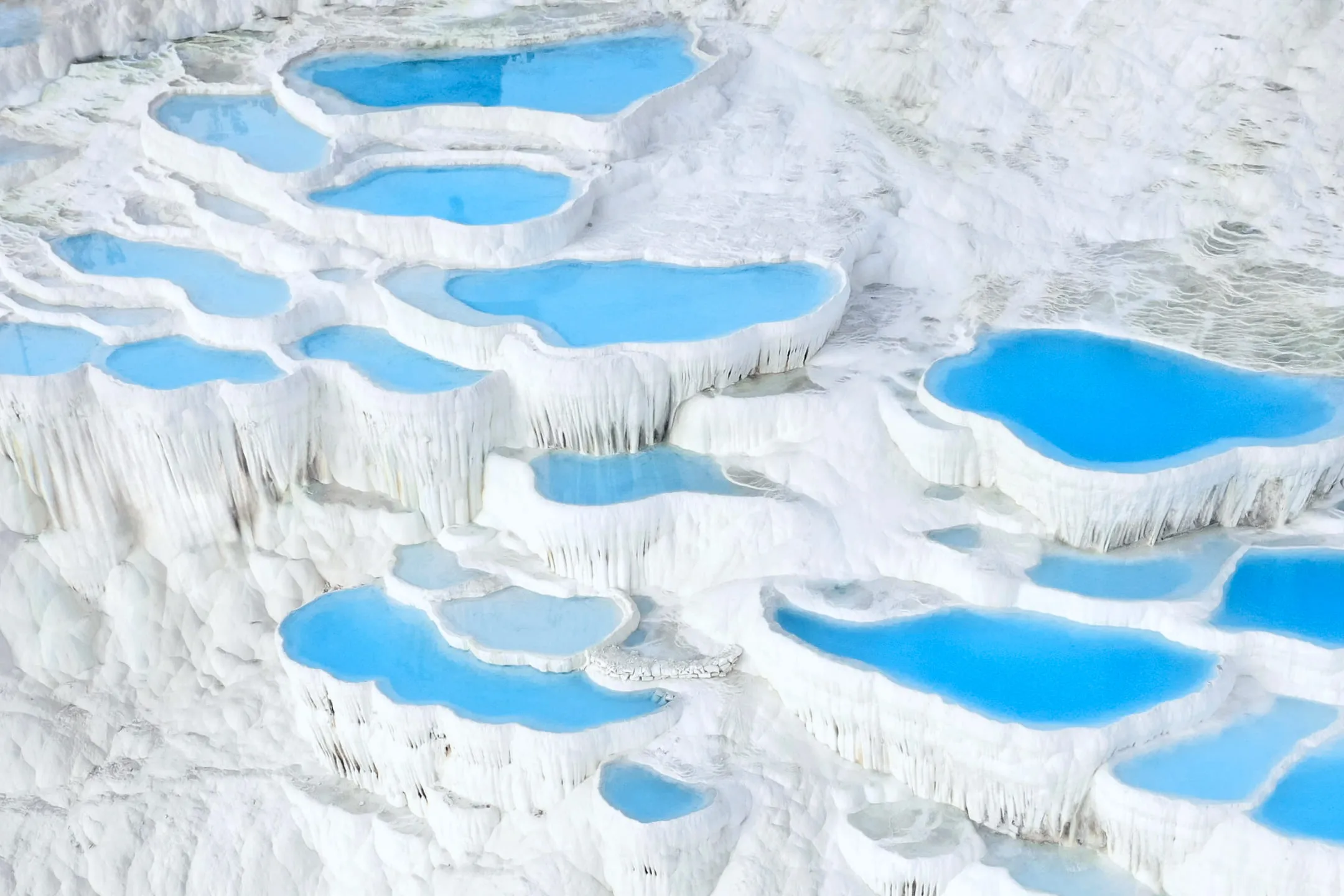
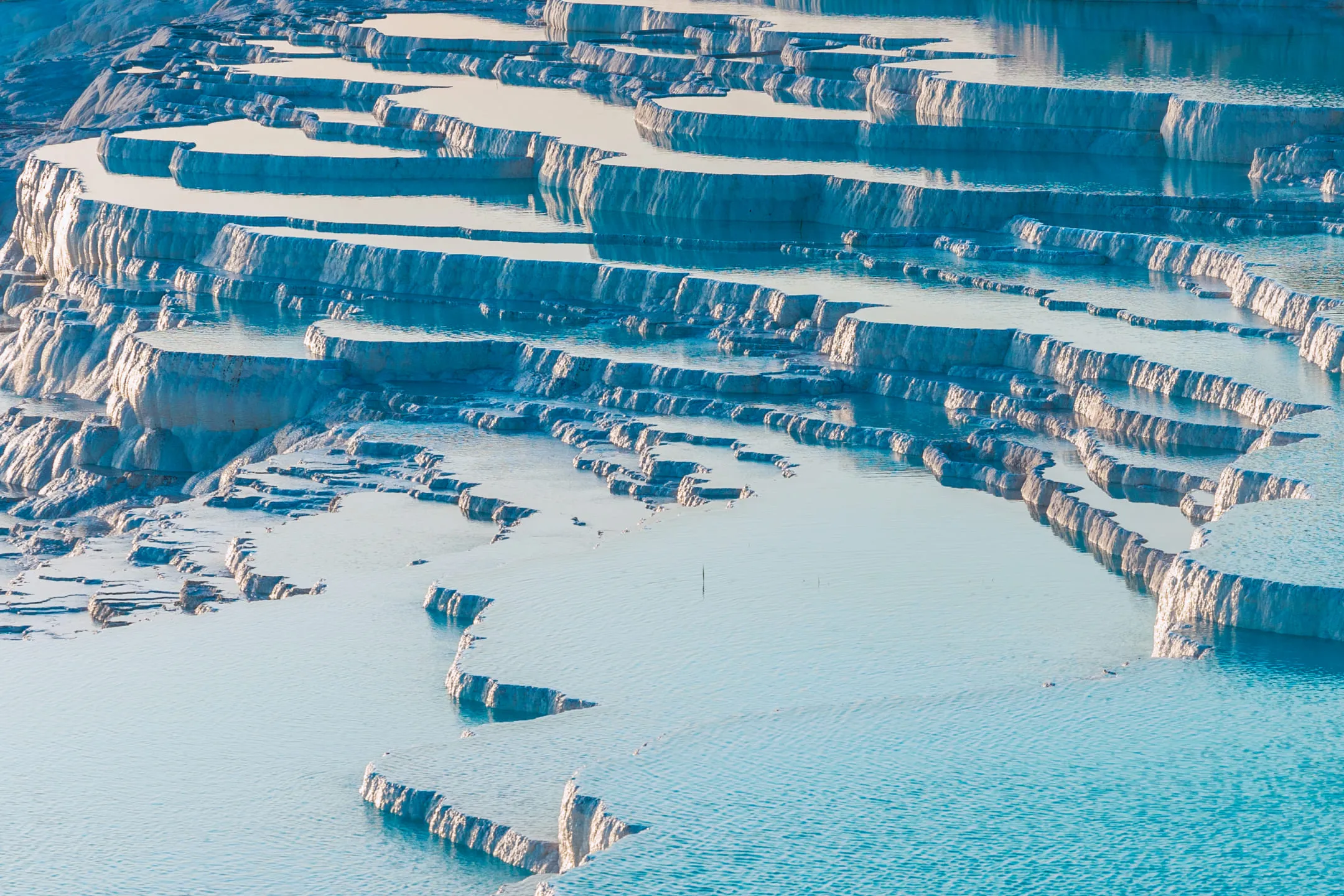
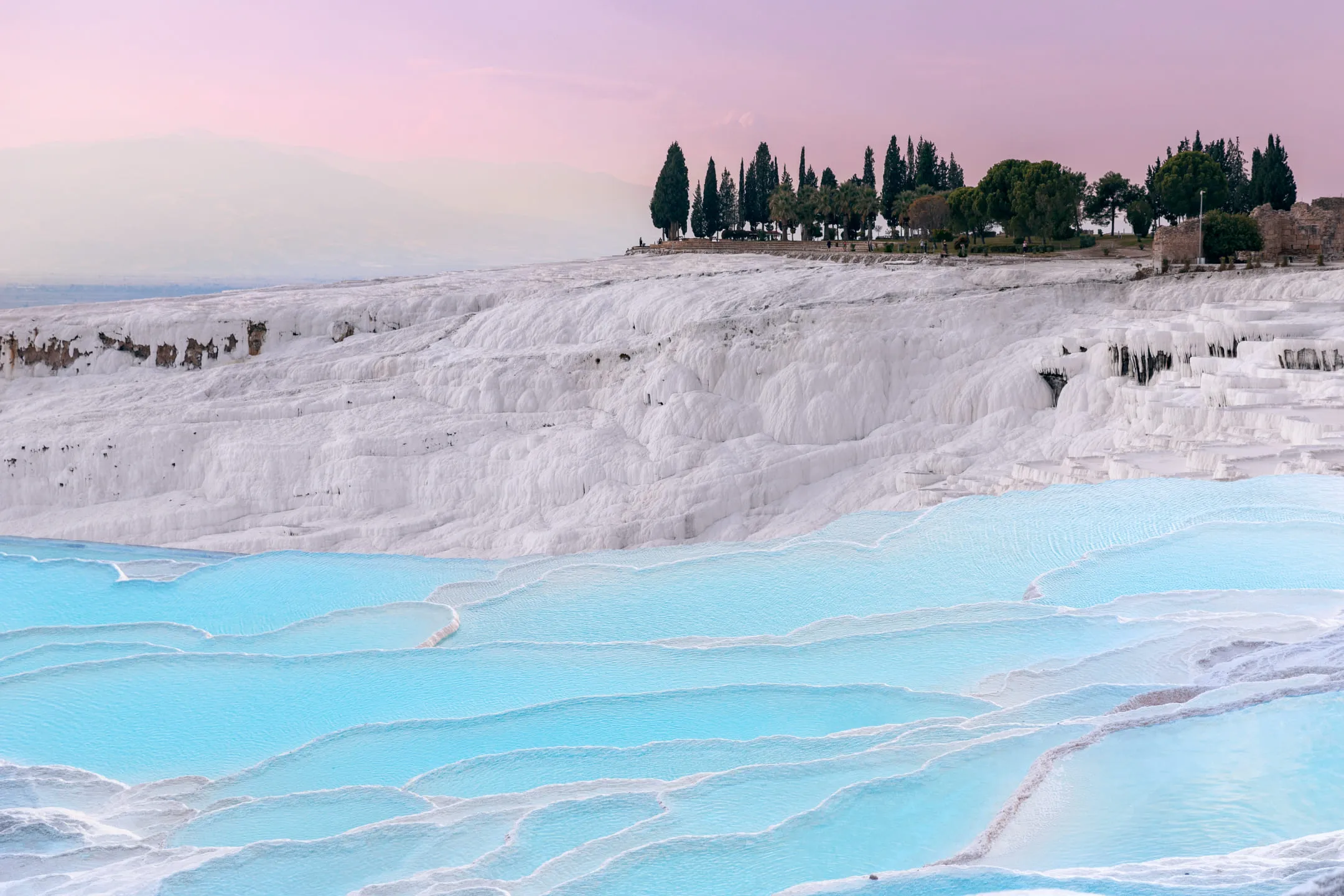
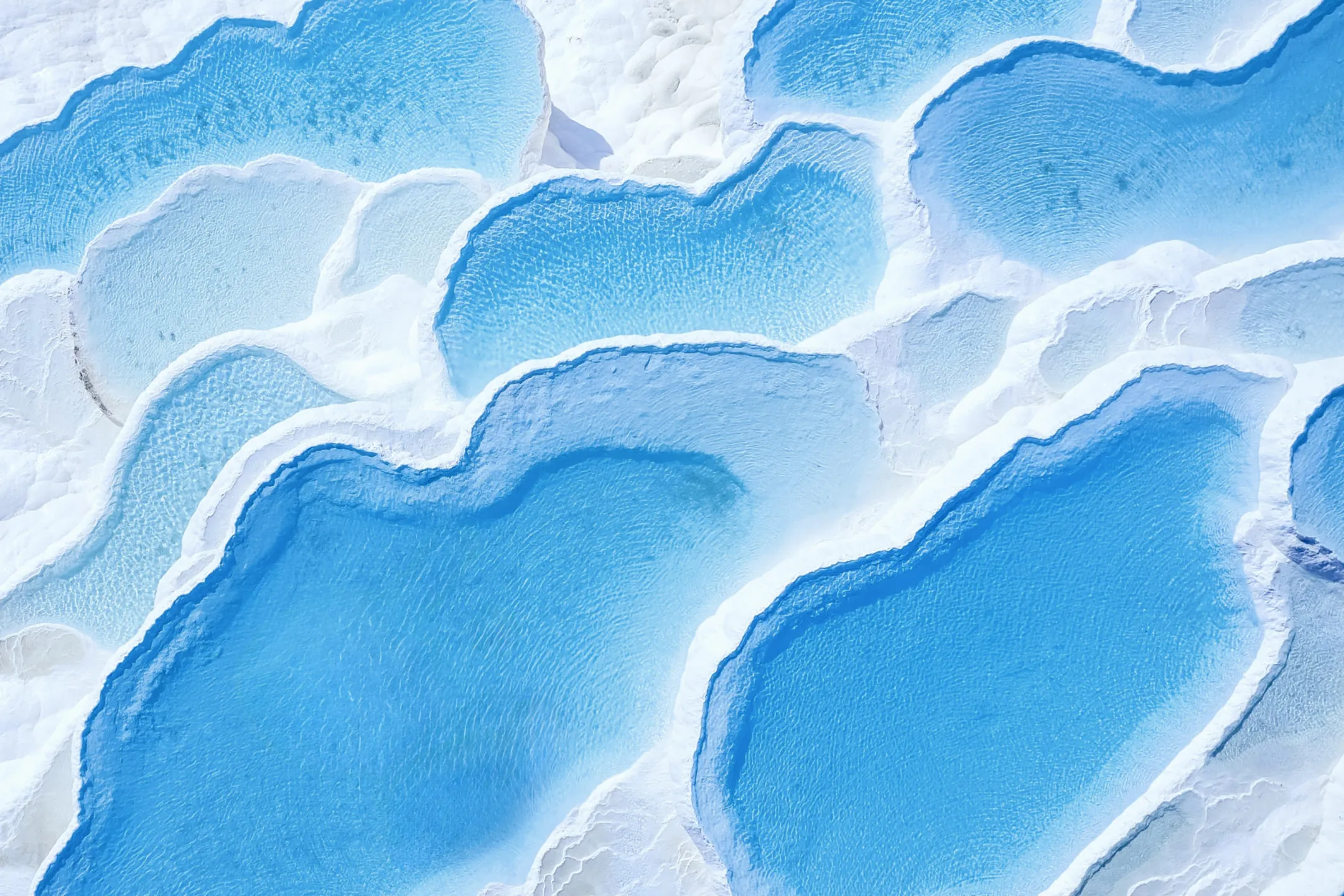
The word ‘Pamukkale’ itself literally translates to ‘cotton castle’. The local landscape of travertine hills indeed resembles cotton. Travertine is a rock formed here due to the emergence of calcium-rich waters. Once, an earthquake occurred in the area, creating cracks in the earth’s crust through which underground springs broke through. Gradually, flowing down the slopes, they formed terraced pools of whimsical shapes. Today, Pamukkale has 17 active thermal springs up to a meter deep.
Attractions
Travertines
Travertines are arguably the most iconic attraction in Pamukkale. These limestone deposits are very fragile themselves, so you can only walk barefoot in the area.
You also can’t just climb in and swim. Most bathing pools are closed to visitors — the Turkish government strives to preserve this unique site, so usually, only the open spring in the city of Hierapolis is accessible. However, you can admire the snow-white slopes from afar — the views of the cascades are truly mesmerizing.
Cleopatra’s Pool
The only place where tourists are allowed to swim is the legendary Cleopatra’s Pool, where, according to local beliefs, the Egyptian queen bathed. The water in it stays at +36 degrees Celsius, and at the bottom lie the remains of marble columns, which adds a special atmosphere to swimming: as if you are truly diving into the past.
There are many rumors surrounding the pool: the thermal baths are considered almost miraculous and not only heal but also bestow youth and beauty. In reality, the local springs are rich in iron, zinc, nickel, and salts of calcium, sodium, and magnesium. The thermal water has a beneficial effect on the treatment of cardiovascular diseases, skin and eye conditions, and is even taken internally for stomach pains. As for Cleopatra, according to legend, her wrinkles smoothed out thanks to taking these local baths.
Hierapolis
History enthusiasts and people for whom religion holds a significant place in their hearts should visit Hierapolis — an ancient city near Pamukkale. The place is considered holy: one of the twelve apostles of Jesus Christ, Saint Philip, who once preached Christianity in the city, was crucified here.
Hierapolis was destroyed several times by earthquakes and rebuilt, so mostly ruins remain here. In the city, you can see the remains of the martyrium — a structure at the site of Apostle Philip’s death, a necropolis, the Temple of Apollo, and the Sanctuary of Pluto. The ancient theater, founded in 62 BC, is relatively well-preserved.
What to see in the surroundings
Red Spring
Continuing the topic of thermal waters: seven kilometers from Pamukkale, there is a spring with a high iron content. It is this metal that gives it a red hue. This place is not as well-known to foreign tourists, but it is popular among locals: Turks even believe that the Red Spring is more beneficial than others.
Denizli
The journey for tourists to Pamukkale usually begins in the town of Denizli. There aren’t many unique sites or historical attractions within it, but there’s a good selection of cafes and a cozy park. Overall, use this location to eat well and relax after active walks around the travertines.
Laodicea
Laodicea is a historical attraction with ruins similar to Hierapolis, 13 km from Pamukkale. You can visit it to see all that remains of the temples, theaters, stadium, and baths.
Aphrodisias
The city of Aphrodisias is named after the goddess of love Aphrodite and is located 97 km from Pamukkale. This is relatively far, but if you happen to rent a car, Aphrodisias is definitely a must-visit.
Once, the city was a center for the cult of the goddess: 14 columns from the Temple of Aphrodite remain here in good condition. The stadium, which could accommodate up to 30,000 spectators, is also well-preserved — come here to witness history firsthand.
Kaklik Cave
The name Kaklik Cave translates to ‘stinky’: the springs here are rich in hydrogen sulfide, hence the corresponding smell. The place is called ‘underground Pamukkale’ — inside there is an unusual relief and blue water, which also has healing properties.
Pamukkale Hotels
Turkish resorts vary greatly in terms of hotel standards and atmosphere: some offer generous family all-inclusive packages, while others provide five-star accommodation for adults without children. The same applies to Pamukkale: it’s a popular place, so hotels here cater to every taste and budget.
It’s naturally better to book a room in advance. We advise checking if the hotel has a mineral water pool and if wellness treatments are included in the accommodation booking price. Such a program is not uncommon when staying in Pamukkale, and the hotel’s star rating does not affect its availability. For example, both the three-star Pamuksu Boutique Hotel and the four-star Tripolis Hotel have their own thermal pools.
Where to eat
If you know what street food in Istanbul is like, it’s better not to have high expectations for its quality and variety in Pamukkale. Near the main attractions, cafes are only available by Cleopatra’s Pool — keep this in mind when going on an excursion. In short, prepare a couple of sandwiches and stock up on water.
Service and food are better in restaurants — further away from the main tourist spots and at hotels. The dishes here are classic Turkish: lamb in the form of cutlets and kebabs, baklava, and doners.
Tips
- If your goal is to visit Pamukkale, it’s easiest to do so from cities on the Aegean Sea — Marmaris or Izmir. But generally, excursions depart from all resorts: Belek, Antalya, Kemer, Alanya, Bodrum, Fethiye.
- The most comfortable time to visit is spring or autumn (morning or evening). In summer, the sun is scorching, and there can be a great many tourists during the day.
- It’s best to enter Pamukkale park from the eastern main entrance: this way you’ll immediately reach the travertine hill. Avoid the southern entrance — otherwise, you’ll have to walk another 20 minutes to the main attraction, strictly barefoot or in socks, because the path goes over calcium deposits.
- Among the options for what to bring from Pamukkale, the most popular is a bottle of thermal water. You should not break off and try to take a piece of travertine with you. Firstly, it is forbidden, and secondly, it is generally prohibited to export stones from Turkey.
- To save money on food, we recommend visiting a ‘lokanta’ — that’s what canteens are called in Turkey. Lunch will be twice cheaper compared to restaurants.
- Pamukkale is a fairly popular place among travelers from all over the world, so the staff is trained and speaks at least English. But if you suddenly decide to explore the small towns in the vicinity, be prepared for a language barrier. Just in case, check out the Turkish phrasebook for tourists and learn at least a couple of phrases.
Now you know how to enjoy your time in Pamukkale and what to do besides water treatments. We recently talked about what to see in Fethiye — on the azure coast just 190 km from Pamukkale.
We wish you great experiences!