Transporting Fragile Baggage on a Plane
We are regularly asked how to transport fragile baggage on a plane: dinnerware, jars of homemade preserves, electronic equipment, etc. There are several methods, each with its pros and cons; which one to choose depends on the specific item and your preferences.
Transporting Fragile Items in Hand Luggage
If your fragile baggage complies with the hand luggage regulations of the airline you are flying with, then take it with you into the aircraft cabin. The dimensions of the box or bag must not exceed 55×40×20 cm or 115 cm in the sum of three dimensions (length + width + height). Most airlines do not accept items longer than 60 cm in hand luggage (except for tubes). The weight should be up to 5–7 kg; some carriers allow up to 10 kg in hand luggage. An undeniable advantage of this method is that you will have complete control over the safety of your baggage. Among the disadvantages is that not every item will be accepted as hand luggage. This primarily concerns liquids. You can take a container with liquid of no more than 100 ml into the aircraft cabin; the total volume of all liquids must not exceed 1 liter per passenger. This means if you are carrying wine or homemade preserves, you won’t be able to take them as hand luggage.
Purchasing a Separate Seat for Hand Luggage
Some oversized items that exceed 115 cm in the sum of three dimensions can be transported in the cabin by purchasing a separate seat for them. This is not a cheap pleasure. While you, as a passenger, might buy a ticket on Kupi.com with a promotion or discount, for fragile baggage, you will have to purchase a ticket at tariff Y — full economy. This is often the most expensive economy class fare. This is how expensive electronics and musical instruments are transported.
Checking in Baggage with a "Fragile" Tag
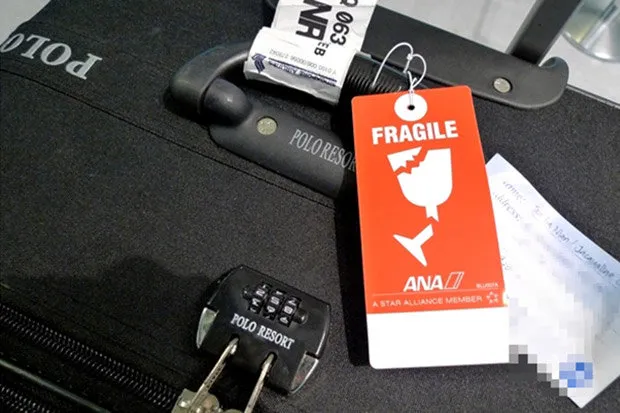
The third method for transporting fragile baggage on a plane is to check it in. At the check-in counter, inform the airline employee that you are carrying fragile baggage. Everything else depends on the airline’s policy. Ideally, a special ‘fragile’ sticker will be placed on your box or suitcase, it will be removed from the conveyor belt, then loaders will use a special lift to take the baggage to the inspection area, from where it will again be transported separately from other baggage for loading onto the plane and placed in the fragile and oversized baggage compartment. In addition, some airlines will ask you to sign a special form stating that your baggage is fragile and releasing the carrier from responsibility for its damage. Such a document is usually requested by carriers in the USA and Europe.
A ‘fragile’ tag does not guarantee that the baggage will remain intact, but efforts will be made to handle it with maximum care.
Some people think that if you stick a ‘fragile’ sticker on the suitcase yourself, your suitcase will be carried by hand. Unfortunately, this is far from the truth. If the suitcase is not removed from the conveyor belt, it will follow the same path as the others. Do you think your dinnerware will withstand that?
Checking in Baggage with Declared Value
The fourth method also involves checking in your fragile item as baggage; however, in addition to the procedures mentioned in method #3, you must also declare the value of the baggage. For this, a special document is issued where you indicate the value of the baggage and pay a special fee. This also does not guarantee one hundred percent safety, but in this case, if the baggage is damaged, the airline will bear responsibility for it and refund the money. Fragile baggage is most often collected at the oversized baggage department, i.e., not on the general carousel. However, if the carousel’s design does not involve the suitcase being dropped onto it from a height, as is often the case in airports, it might be placed there.
How to Pack Fragile Baggage?
Regardless of whether you carry your baggage as hand luggage or check it in, it must be carefully packed. For packing, you can use paper, special bubble wrap, clothes, and towels. If you are carrying glass, it is not enough to simply wrap a glass or vase in something soft; you need to tightly fill all cavities. If you are transporting a fragile item in a suitcase, it is best to place it in the center. Additionally, there should be no empty space in the box or suitcase. Your fragile item should not rattle; it must be firmly secured in one place.