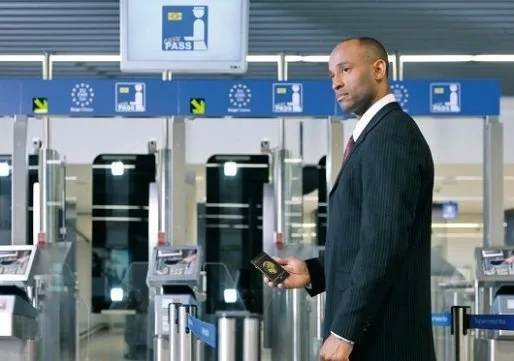
Airport Scanners
Before a flight, every passenger is screened by aviation security personnel. This is to check if you are carrying any prohibited items. Special equipment — scanners — are used for this purpose, helping to screen luggage and passengers thoroughly and quickly.
In this article, we will tell you how an airport scanner works, whether it is harmful to health, and how exactly it helps ensure safety during air travel.
Airport Scanner: Purpose
Screening procedures are mainly carried out using technical equipment. People are also involved, but less frequently. Firstly, good specialists are expensive; secondly, if every passenger and their suitcase were screened manually, pre-flight formalities would take an enormous amount of time. Imagine if you had to arrive at the airport six or seven hours in advance for your belongings to be checked before departure: it doesn't sound very appealing.
To speed up the process, airports use scanners. Furthermore, a machine can detect various nuances that an airport employee might miss — and not just due to human error. For example, the image provided by a scanner can reveal prohibited substances that a passenger is trying to transport inside their body by swallowing them.
However, airport staff are always present during screening — they analyze the contents of suitcases displayed on the monitor, help place items in containers, and manually inspect some items further.
Types of Scanners in Airports
Airport scanners are divided into two types: X-ray and microwave.
X-ray Scanners
It's simple: X-rays scan a person's body and their belongings to detect prohibited items — drugs, weapons, or explosive substances. The operating principle is almost the same as with fluorography in a polyclinic.
Below, we will examine in detail how luggage is scanned at the airport using X-rays and what technical means are used for this. Here is a list of typical scanning equipment:
— introscopes. Introscopes are used to screen cargo (large and small parcels), as well as checked baggage. Since the radiation is localized inside the scanner, it does not affect the human body. The resulting image is displayed on a screen, and a specialist decides whether to clear the baggage or, possibly, inspect it manually.
— tomographs. More modern scanners based on the same X-ray technology. Tomographs display a more detailed three-dimensional image of luggage on the screen — consequently, the inspection is faster.
— personal screening scanners. These scanners are used to screen people. Most often, a backscatter scanner is used: it looks like two booths between which a person stands. After scanning, the operator receives two images — a front and a back view. Less dense elements, such as skin and muscles, appear light in the image, while dense ones (weapons, watches, bracelets) appear dark. Therefore, an airport employee can see metal jewelry on your body.
Some experts believe that X-ray scanning is unsafe for the human body, in particular, it can provoke oncological diseases. Here's the answer: in reality, there is no reliable confirmation of this viewpoint. The radiation dose a person receives when passing through a scanner is too small to harm health.
Fact: the dose you receive during scanning is 200-1000 times less than the dose received during a chest X-ray. You are unlikely to ignore an important medical examination — which means there is even less reason to refuse to fly.
Microwave Scanners
For personal screening — that is, screening of a person — there is a safer alternative in the form of microwave scanners. They emit electromagnetic waves in a small dose — and this radiation is non-ionizing and cannot cause cancer, so it poses no risk to passengers. It is also safe for operators to work near them. Furthermore, microwave scanning is not harmful if you use pacemakers — as the amount of energy emitted during body scanner screening is much lower than that of regular mobile phones.
If you are asked to pass through a booth with rotating half-frames at the airport, it is a microwave scanner. It displays a clear and high-quality three-dimensional image on the monitor, much more detailed than traditional X-ray images. Microwave scanners are rarely used in Russian airports, more often in Europe and the USA.
How is carry-on luggage checked at the airport?
At the airport entrance, bags, packages, and backpacks are scanned by an introscope. As the luggage moves along the conveyor belt, employees examine the image displayed on the monitor and make a decision. If something is amiss, an employee will ask you to open your bag or backpack to check its contents manually. Then, carry-on luggage is checked a second time, after check-in. The procedure is the same: first the introscope, then, if an item appears suspicious, a manual inspection.
How X-ray works at the airport, what screening is and how it proceeds
It is believed that scanning belongings and the body at the airport is the most stressful part of the entire pre-flight process. This is understandable: there are always long queues in the screening area, plus you have to place heavy suitcases on the conveyor and immediately pass through the frame yourself — some passengers fear that something might happen to their suitcase while they are being checked, not to mention bags containing all their documents.
At the airport, you are screened twice: when you enter the terminal building and after check-in. At the terminal entrance, staff will ask you to place your suitcase and bags on a conveyor belt, which will feed items into an introscope — a special X-ray device that scans the contents. Then you will pass through a magnetic frame with a metal detector and proceed to check in for your flight. This is the first stage.
After check-in, you will undergo a second, more complex check. First, you will need to place your carry-on luggage and outerwear in a container, then pass through an X-ray or microwave scanner. Additionally, an employee may conduct a further inspection if something seems suspicious — this usually takes a maximum of five to ten seconds. Sometimes screening staff ask passengers to remove their shoes to ensure no prohibited items are being carried in soles or heels.
How are luggage and passengers checked at the airport?
Passengers are screened twice: at the terminal entrance and after check-in. This is a simple procedure, there's no need to be nervous — metal detectors and X-ray machines work very quickly. Sometimes you may be asked to additionally demonstrate the contents of your carry-on luggage — especially if you are carrying a laptop, tablet, or liquids (cosmetics, medicines, baby food). As a rule, manual inspection also doesn't take long, and if you meet all the regulations, you are calmly allowed into duty-free.
With checked baggage, it's a different story. It will be scanned without your presence. After check-in, it goes for screening, which consists of several stages: scanning with an introscope or tomograph, image evaluation by an operator, and sometimes — manual inspection. If something is wrong with the baggage, you will be invited to view the contents of your suitcase with an aviation security officer, but such cases are extremely rare. Primarily, bags where prohibited items or unidentified items were found during scanning are additionally inspected. Once the baggage has «passed» through all the devices, it will go for sorting, and then — to the aircraft's cargo hold.
There's no need to worry about scanning belongings and the body at the airport — it's a standard procedure that every passenger undergoes before departure. Half an hour or an hour for all checks — and you can calmly head to duty-free or a cafe, drink tea, and plan your further journey.
X-ray scanner before flight
To pass the pre-flight scan, you will need to comply with all airport staff requirements. If the country you are departing from has heightened security rules, you may be asked to remove your shoes, watch, jewelry, or belt. The list of actions required of you also depends on how the airport scanner works: each X-ray machine has its own technical capabilities, so the screening procedure may differ in various airports. The main thing is not to stress and to follow instructions clearly. And if there are no instructions — alas, this also happens — just observe what the people in front of you are doing. This will help you not to get lost!
The scanning process itself also looks different: in some places, you will be asked to simply walk through the device without stopping, while in others, you will have to stand on a special platform, raise your hands, and freeze while the scanner checks you. In any case, it will not take more than two or three minutes.
List of Prohibited Items
The list of items prohibited in carry-on and checked baggage is common to almost all airports worldwide. If screening reveals that you are carrying some of them, you will have to discard these items or forgo your flight entirely.
What is prohibited in carry-on luggage
- Liquids. Separate rules exist for carrying liquids — they can only be carried in containers up to 100 ml.
- Animal products: ham, cheese, yogurts. But if you make a sandwich for yourself, you can take it on board.
- Sharp and blunt objects. For example, a bat, needles, or knitting needles.
- Explosive, flammable, chemical, and toxic substances.
- Weapons. Even toy pistols and a Star Wars lightsaber will not be allowed on the plane.
- Mercury thermometers. You understand: if a thermometer breaks during the flight, it can have health consequences for passengers.
What is prohibited in a suitcase
Rules vary by country. Therefore, first check if alcohol can be carried in airplane baggage at your final destination.
What is definitely not recommended to check in baggage:
- fragile items that may break in the suitcase;
- perishable products (cheese, ham, fish)
- precious metals.

Is it dangerous for health?
Modern screening technologies are safe for health. It doesn't matter what scanners are used at the airport: X-ray (ionizing radiation) or microwave (non-ionizing radiation) — there will be no harm.
According to radiologists, 50 scans using an X-ray screening machine are equivalent to the exposure you receive when getting a dental X-ray. And 1000 scans can be compared to a chest X-ray.
Exceptions are passengers with pacemakers and pregnant women. However, this does not mean that you can avoid screening altogether — airport staff will check you personally.
As for microwave scanners, there's definitely no need to be afraid to pass through them — mobile phones, microwave ovens, and Wi-Fi routers emit exactly the same radiation.