Hotel Meal Plans and Their Explanations
Expectation: five-course dinners and champagne* in your room. Reality: a bun with yogurt for breakfast. Don't want that? Then read this text: it tells you about the most popular types of meal plans in hotels and provides a handy table with explanations of standard abbreviations.

Explanation of Hotel Meal Plans
When you visit a website to choose and book accommodation, you'll notice that the meal plan in the hotel's description is indicated by two or three Latin letters. Not all services explain these abbreviations, so it's best to learn them in advance to understand what's included in the accommodation price and how many meals you are entitled to. The system of designations is standard worldwide.
It's important to understand: meal plans have nothing to do with the assortment of food awaiting you at the location. They only specify how many times a day the hotel will provide you with the opportunity to eat for free on its premises. To find out exactly what is served for breakfast or dinner at the hotel, we recommend reading traveler reviews: food is something all tourists love to talk about.
RO (Room Only)
What it is. This means you only pay for the room, and food is not included in the price.
What else you need to know. Most often, this format is found in very budget hotels or hostels. Sometimes these places have a shared kitchen where you can prepare or reheat food yourself. In this case, the abbreviation SC (Self Catering) will be used.
Why choose Room Only. Suitable for anyone who loves to explore the city's gastronomic landscape independently and prefers to eat at different establishments. You can plan your day as you like, without risking missing a meal you've already paid for. In reality, this is not the most economical option — paying extra for breakfast or half board is still cheaper than daily restaurant bills. But if your budget planning is in order, choose this option: this way you'll definitely be impressed by the local cuisine.
Accommodation in apartments without meals is also often chosen by tourists who need a special diet and prefer to cook for themselves.
BB (Bed and Breakfast)
What it is. Among all types of hotel meal plans, this is the most popular and is most often found in Europe and the USA. Breakfast is included in the room rate, but tourists are expected to have lunch and dinner on their own.
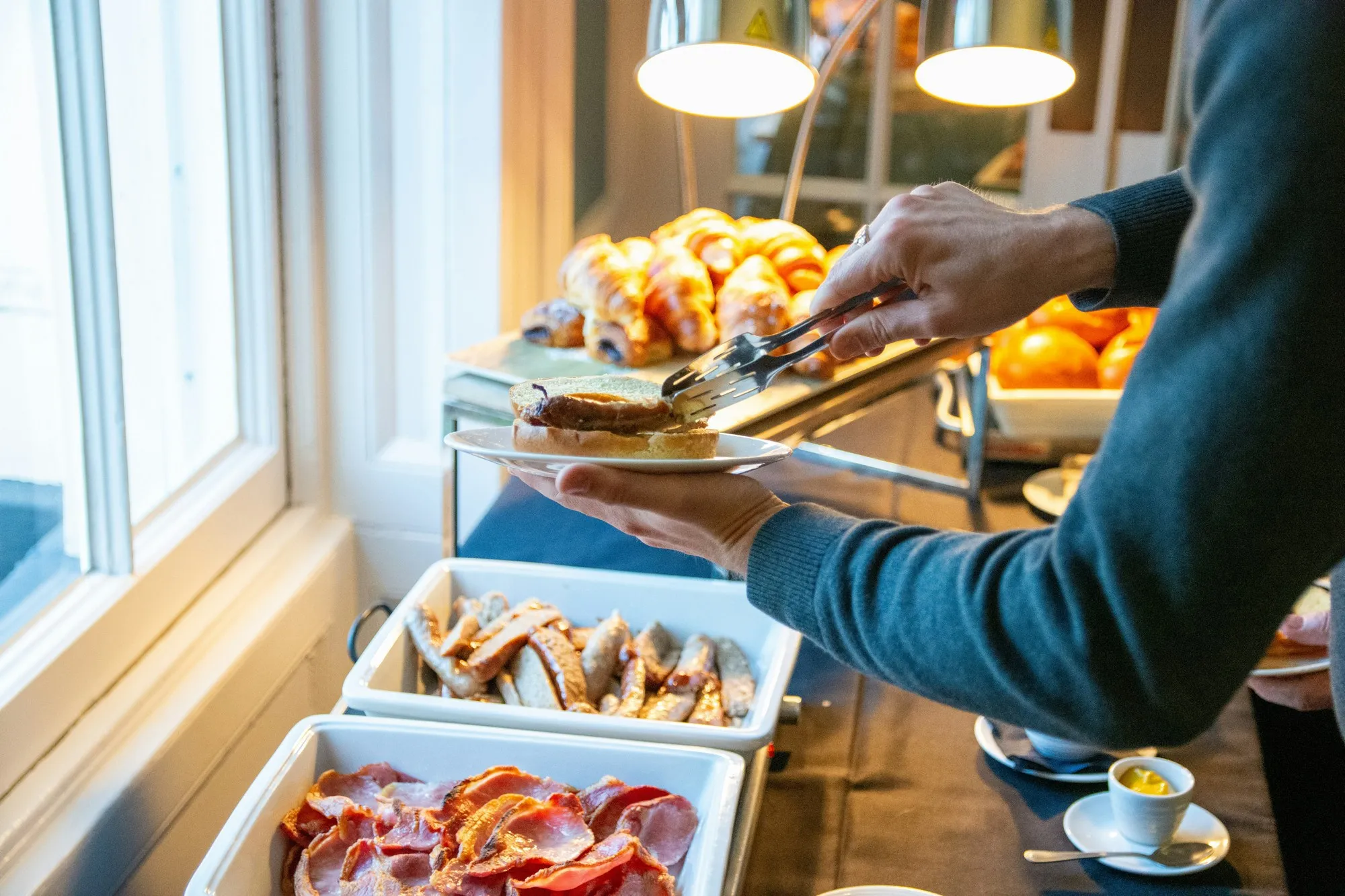
What else you need to know. Breakfast in a B&B can be served in several formats: American breakfast, continental breakfast, buffet. This depends on the country where you are vacationing.
|
Breakfast type |
Abbreviation |
What's included |
|
English or American breakfast |
EB/AB |
Bacon, sausages, ham, scrambled eggs or omelet, hot drinks (tea, coffee), sauces (e.g., ketchup), toast |
|
Continental breakfast |
CB |
Buns, croissants, cookies, butter, jam, yogurt, cereals, milk, sometimes — cheese and ham, hot drinks (tea, coffee) |
|
Buffet |
BBF |
Wide selection of food for every taste |
Why choose Bed & Breakfast. Suitable for anyone who doesn't want to worry about preparing breakfast or having to choose where exactly to eat an omelet or croissant. And for those who want to sightsee from morning till night, without interrupting their day to return to the hotel to eat there.

HB (Half Board)
What it is. Half Board is also called semi-board. This is a two-meal plan. The first meal is always breakfast, the second is lunch or dinner. As a rule, hotels offer a "breakfast + dinner" system, but sometimes you can arrange for lunch to be served instead.
What else you need to know. In some cases, Half Board meals are served buffet-style, but sometimes guests are offered to choose several dishes from a small menu. Drinks are usually only included with breakfast (e.g., coffee, tea, and juice). At other times, guests typically pay for drinks separately.
Why choose Half Board. The Half Board option is well-suited for guests who leave the hotel right after breakfast and return late. These are, for example, active tourists who explore the city independently or go on group excursions that last until 7–8 PM. Half Board is also convenient because the problem of finding food arises only once a day, not three.

FB (Full Board)
What it is. Full Board includes three main meals (most often buffet-style): breakfast, lunch, and dinner. Caution: do not confuse with "all inclusive".
What else you need to know. If the hotel has several restaurants, food is usually served in only one of them. And if guests want to go to a second restaurant, they will have to order from the menu. Furthermore, as with Half Board, not all drinks are available for free. This especially applies to alcohol*: if you plan to spend a pleasant evening with a bottle of wine*, you will have to pay for it separately.
Why choose Full Board. Full Board is popular among tourists who spend the entire day on the hotel premises. This meal plan is common in beach resorts that are far from the city, where the choice of local restaurants is limited, but where there are all the conditions for a fulfilling vacation — from fitness centers to shops. Full Board can be found in hotels in Turkey, Egypt, Tunisia, but in Europe, it will be rare: most likely, only in luxury seaside hotels.

AI (All Inclusive)
What it is. The name speaks for itself: the "all inclusive" system includes unlimited meals throughout the day. This format usually means the ability to have breakfast, lunch, and dinner at a buffet restaurant, visit specialized establishments located on the hotel or resort grounds, frequent bars, and order room service. In short, it's almost impossible to go hungry with such a system.
What else you need to know. Travelers sometimes confuse the "all inclusive" system with Full Board, so be careful: the first option implies that you can eat as much as you want, whenever you want, while the second limits you to three distinct meals (breakfast, lunch, dinner).
The most common "all inclusive" meal option is a buffet. But expensive 4* and 5* hotels often serve guests à la carte. Tourists choose dishes from a menu like in a restaurant, and waiters bring the food.
Why choose "all inclusive". This type of hotel meal plan is popular among tourists who spend time on the hotel premises, and especially among tourists with children. If a child gets hungry between breakfast and lunch, you will always have the opportunity to eat for free at any of the establishments included in the system. "All inclusive" is also suitable for those who are afraid of accidentally spending an indefinite amount of money on restaurant dishes: indeed, if you don't have the habit of tracking your budget, constant lunches and dinners at establishments can seriously hit your wallet. With "all inclusive," you pay once, but you can eat unlimitedly.

Hotel Meal Plans: Explanation
Here we have listed the most common types of hotel meal plans and provided an explanation of the letter designations in the table, so you can quickly refer to it when booking. By the way, we have already written about room categories!
|
Meal Plan Type |
Description |
|
RО |
No meals, only accommodation in the room is included in the price. |
|
BB |
Breakfast only. |
|
HB |
Breakfast + dinner (lunch). Drinks are usually not included. |
|
FB |
Breakfast + lunch + dinner. Drinks are usually not included. |
|
AI |
"All Inclusive." Unlimited access to meals on the hotel premises. |
|
UAI |
"All Inclusive" squared. In addition to food, local alcoholic beverages can be consumed in unlimited quantities. |
Features of Meal Plans in Hotels in Different Countries
• "All inclusive" in Egypt differs from "all inclusive" in Europe. As a rule, buffets are more common there, and the cuisine and drinks are quite monotonous and geared towards Europeans; trying local dishes will most likely not be possible.
• In the UAE, the "all inclusive" system is popular, but due to Muslim traditions, alcohol* is not served in hotels. There are exceptions, but staying in such hotels is not cheap.
• If you're flying to Thailand but can't tolerate spicy food, consider the Half Board or Full Board format. Local food is very specific and spicy, while hotels prepare standard European dishes.
What to choose
• Hotel meal plans depend on your budget. Of course, trying a local dish in a small family restaurant is much more interesting than chewing on the same spaghetti at the hotel. But if you have a limited budget, choose Full Board or "all inclusive": your meals will be taken care of in advance, and you won't have to limit yourself when choosing dishes from the restaurant menu.
• If you are eager to try all the local cuisine, plan to walk a lot around the city, and don't want to constantly depend on the serving times for lunch and dinner at the hotel, opt for Room Only or Bed & Breakfast.
• If you are on a diet, it's better to choose breakfast only or Half Board to be able to select dishes at establishments that suit you.
• If you are a night owl and like to sleep until noon, check in advance until what time breakfasts are served. They usually start early and last until 10 AM. If you don't want to oversleep the breakfast you paid for, it's better to choose the Room Only option and have breakfast outside the hotel.
• In exotic countries, we recommend choosing Half Board or Full Board. Local cuisine can affect the body unpredictably and spoil your vacation experience.
*excessive alcohol consumption is harmful to your health!
And don't forget to subscribe to our Telegram channel! There you'll find: selections of cheap tickets, private sales for subscribers, the most up-to-date news on entry rules for countries around the world, and simply interesting travel content — travel hacks, guides, and expert advice.