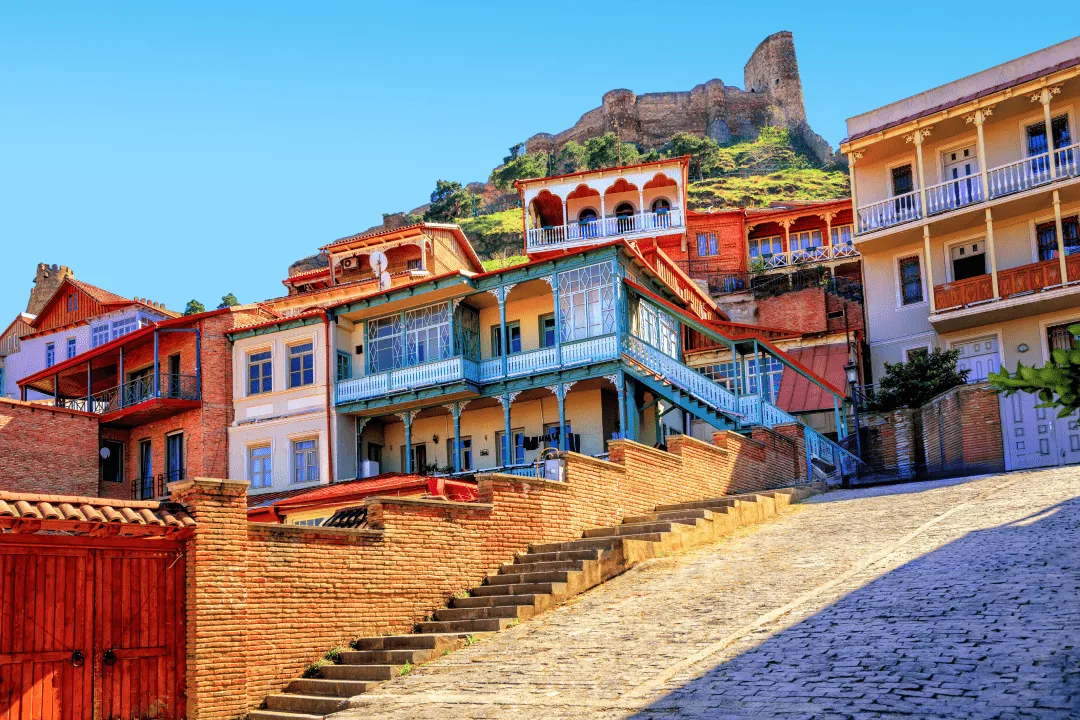
How to move to Georgia
We continue the column «Let's get out ̶o̶n̶ ̶v̶a̶c̶a̶t̶i̶o̶n̶», where Kupi.com team members and their friends share personal experiences of relocating to other countries. In this article, Inga Kudracheva tells you everything you need to know about Georgia: how to get a residence permit, where to find an apartment, how to open a bank account, how much a doctor's visit costs, and how to order khinkali home.

How to get to Georgia
Given the closed airspace over Europe for Russian airlines and the absence of direct flights between Georgia and Russia, the most optimal options for entering the country now are flights with layovers in Istanbul, Minsk, or Yerevan. Flights via Yerevan are very convenient: the layover is only 30–40 minutes, and passengers are usually not even asked to leave the plane. By land, you can enter Georgia from three countries: Russia, Turkey, and Armenia. Foreigners for visiting Georgia vaccination certificates are no longer required.
Tip: if you are entering Georgia from Russia by car, it would be wise to monitor the situation at the Verkhny Lars checkpoint. In winter, the border is often closed due to heavy snowfall and avalanches, and in summer, rarely, but mudslides and landslides occur. Up-to-date information can be found in the channel about Verkhny Lars or on this forum.
Do you need a visa? How to get a residence permit?
Georgia and Russia have a visa-free regime: Russians can stay here for 360 days, and then do a visa run, meaning travel to any country (by land or plane), and then re-enter. After each crossing of the Georgian border the day counter resets.
Any foreigner has the right to obtain a residence permit in Georgia. Despite the fact that Russians can legally live and work in Georgia without a residence permit, having even a temporary residence permit significantly simplifies life: you don't have to do a visa run every 360 days, you can apply for Schengen and other visas in Georgia, for example, to the UK. Also after six years of living in Georgia with a temporary residence permit (excluding student permits), you can apply for a permanent residence permit for five years.
If you are not going to study at a Georgian university, do not plan to buy an apartment in Georgia for $100,000, or invest in the country's economy from $300,000, then you can get a work residence permit.
To obtain a work residence permit, you must be in Georgia for more than 180 days and work for a local company (or open your own sole proprietorship). However, the mere fact of employment and residence in Georgia is not enough to obtain a residence permit. When submitting documents for a work residence permit, you will need to provide a certificate stating that your monthly income in the company exceeds the average monthly living minimum by five times. At the time of writing (February 2023), the amount is 1,256 GEL (251 GEL x 5) at the current exchange rate — approximately 33,745 rubles*. This figure changes, so you need to monitor for updates. You will also need a certificate confirming that your employer's annual turnover (or, accordingly, your sole proprietorship's) exceeds 50,000 GEL (1,343,330 rubles).
Long-term apartment rental
Two years ago, luxurious three- or four-room apartments with fresh renovations in the best areas of Tbilisi could be rented for $500–700 per month, and decent one-room apartments for $200–250. With the influx of migrants last spring, housing prices rose two, or even three, times. There were cases when landlords simply evicted their previous tenants to rent out housing to arriving Russians at several times the price. The situation has stabilized somewhat now, but housing prices in Tbilisi and Batumi have still not critically decreased.
Currently, two-room apartments in good (non-central) areas can be found from $600–800, one-room apartments — from $400–500. But there's also good news: in Georgia, the agent's commission is paid by the landlord, not the tenant.
In Georgia, there are two main websites for finding apartments for rent — myhome.ge and ss.ge. Unfortunately, both are terribly inconvenient to use, plus you come across scam listings, so I still recommend using the help of realtors, who can be found in Telegram chats and Facebook groups. I advise you to enter the search query exactly like this: «rent in Tbilisi», and you will see a huge number of options.
Tip: contact as many realtors as possible right away and continue to monitor options yourself. Be prepared to drop everything during the apartment search and immediately go to viewings. And bring money with you to sign a contract on the spot, if necessary. Good apartments are snapped up quickly now.
There is no central heating in Georgia; water and radiators are heated by a gas boiler, and utility bills are substantial. For example, I live in a three-room apartment, and for gas in January 2023, I paid 227 GEL (6,098 rubles), and for electricity — 57 GEL (1,531 rubles). In summer, the electricity bill is usually two to three times higher because we often use air conditioning to escape the heat.
How to open an account in a local bank
By early 2023, the situation with issuing cards to Russians in Georgia significantly improved. If just a few months ago, Russians were regularly denied opening personal and business accounts, now such cases can be counted on one's fingers. The most popular banks in Georgia are Bank of Georgia, TBC, Credo, and Liberty. The largest of them are Bank of Georgia (Georgians call it «Sakartvelo Bank») and TBC. For opening accounts, I advise choosing from them: these banks have plenty of branches, payment terminals, and ATMs. In almost any store, when paying by card, sellers ask: «TBC or Sakartvelo?» and offer two different payment terminals due to different acquiring conditions.
Bank of Georgia charges 50 GEL (1,343 rubles) for application review. This means that if your account is not opened, the commission will not be refunded. To apply, you need to fill out the form on the website and upload a receipt for the commission payment. To open an account, you will need a passport, receipt, employment contract or a certificate from your workplace indicating your salary, and a statement of funds movement for three months/half a year. Sometimes the bank may request something additional, sometimes they may require a card statement for a year.
Until recently, successful cases of opening accounts for Russians at bank TBC were urban legends, but this bank has also started opening accounts for Russians, though often not multi-currency, but only in GEL. The annual card maintenance costs 110 GEL (2,955 rubles), and the application for a card must be filled out at a bank branch. The application review fee is 50 GEL (1,343 rubles), and a response is given within five business days. In case of a negative decision, the commission is also not refunded.
If it happens that both banks refuse you, you can go to Credo Bank. Last year, it was often the only bank that opened accounts for Russians. But the quality of service and the mobile application's performance at Credo, unfortunately, leave much to be desired.
Tip: in Telegram, there are two large chats where you can monitor the conditions for opening Georgian accounts for Russians and ask questions on the topic. This one and this one.
Healthcare
There is no free healthcare in Georgia — it is paid for both by Georgian residents and foreigners. Compared to Russian prices, healthcare in Georgia (including dentistry) is quite inexpensive. For example, a doctor's visit at a clinic costs 35–70 GEL (940─1,880 rubles), and for a complex tooth extraction at a modern dental clinic a month ago, I paid 100 GEL (2,686 rubles). Calling an ambulance in Georgia is free even for foreigners.
Nevertheless, I strongly advise you to get insurance. Firstly, it is inexpensive and covers 20 to 80% of medical expenses, including doctor-prescribed medications. My current annual plan cost me 1,100 GEL (29,553 rubles), but you can find significantly cheaper options. Secondly, despite inexpensive doctor visits, emergency medicine in Georgia is expensive. For example, an appendectomy can cost you $500–800, and a day in intensive care can cost up to 1,000 GEL (26,866 rubles). MRI scans are also not cheap. A year ago, I paid 400 GEL (10,746 rubles) for an MRI with sedation. Four hours in the Emergency room with tests and an ultrasound cost me 350 GEL (9,403 rubles).
Kindergartens and Schools
As in Russia, Georgia has public and private kindergartens and schools. But, of course, teaching in public institutions will be in Georgian, and, for example, public kindergartens in Georgia are overcrowded, and there are not enough places even for local children. You cannot enroll a child in a public kindergarten without a residence permit or citizenship, but children of foreigners can enroll in a public school.
In Georgian schools, the academic year begins on September 15, there is a 12-year education system, children are not graded until the 5th grade, and English is mandatory from the 1st grade. In private kindergartens and schools, teaching is more often in English and costs vary depending on the level of the school or kindergarten. But Russian-speaking kindergartens and schools can also be found.
In Tbilisi, private kindergartens cost from 250 to 700 GEL (6,716–18,806 rubles) per month, and with schools, the range is even wider. For example, my friends' children attend a private American school, and such education costs them $9,000 per year. Education in Russian private schools usually costs 5–8 thousand GEL per year (134,333–214,932 rubles).
Grocery Delivery and Restaurants
In Tbilisi and Batumi, delivery services for ready-made food from restaurants and a wide variety of goods from stores are well-developed. The most popular are Wolt and Glovo. To register in their applications, you will need Georgian SIM cards. In both applications, you can order delivery from a wide variety of stores: grocery stores, pharmacies, sports stores, jewelry stores, electronics stores, and so on, and delivery usually takes 20–60 minutes. Also, in Georgia, alcohol is sold 24/7 and can also be ordered through Wolt and Glovo.
The restaurant industry in Tbilisi and Batumi is currently experiencing a real boom. During a very severe lockdown lasting almost a year, many establishments closed, but over the past year, an incredible number of modern restaurants and cafes have opened. Prices vary by area and service level, but on average, a cup of coffee will cost you 7–10 GEL (188─268 rubles), and for one khinkali at the popular Georgian restaurant chain «Pasanauri», you will be charged 2 GEL (52 rubles), but, moving away from the center, you can easily find khinkali for 1 GEL (26 rubles). In the most fashionable restaurants in the center of Tbilisi, prices, alas, are now almost like Moscow's.
Transport
In Tbilisi, there is a metro, buses that run on dedicated lanes in several areas, and minibuses. A single trip on a bus or metro will cost you 1 GEL (26 rubles). For convenience, you can buy a rechargeable MetroMoney card for 2 GEL (53 rubles) at any metro station and pay for public transport trips with it, but you can also pay with your phone via, for example, Apple Pay, and the price does not change.
In Georgia, there are two main taxi operators — Bolt and Yandex Go. Personally, I prefer Bolt. Cars are cleaner and arrive very quickly, there is a Pets tariff for animal transportation. Yandex Go works in the Russian application, but «Premium» points, for example, in this case, you will not be able to spend. Both services have an option to order a courier for delivery. A city trip on the «Economy» tariff within 20 minutes usually costs no more than 6–7 GEL (156–182 rubles).
For intercity trips, there is a very convenient car rental service with a driver Gotrip, which operates throughout Georgia. You can choose from a fairly large list of cars for different prices, all drivers know English and Russian.
In the spring of 2020, Tbilisi Mayor Kakha Kaladze ceremoniously rode a scooter along what was then the city's only street with a bike lane. That's when electric scooter rentals launched in Tbilisi and Batumi. Currently, Tbilisi already has several services for renting electric scooters, electric mopeds, and electric cars. The cost of renting scooters starts from 1 GEL (26 rubles) for a start, and then for different services, the price per minute of use varies from 35 to 50 tetri (9─13 rubles) per minute, with Apple Pay available. The most popular services are Scroll and Eleven.
QARI — an application for minute-by-minute rental of electric mopeds (up to 50 km/h) and tiny electric cars (up to 45 km/h). Each moped comes with two helmets. Moped price: 1 GEL (26 rubles) for unlock, then 45 tetri (11 rubles) per minute. Car price: 1 GEL (26 rubles) for unlock, then 59 tetri (15 rubles) per minute. A driver's license is required for registration.
Mobile Operators
In Georgia, a passport is required to get a SIM card. You can choose from three operators — Magti, Beeline and Geocell. I recommend getting a SIM card from Magti — excellent coverage, works even in the most remote parts of the country, many convenient and customizable tariffs. The most convenient tariff with unlimited internet costs 9 GEL (234 rubles) per week or 32 GEL (832 rubles) per month. There is a convenient mobile application where you can set up auto-payment (do this definitely, otherwise you will often find yourself without internet in the most unexpected situations; without internet access, you cannot top up your account through the application).
In conclusion, I want to say that I sincerely love Georgia and consider it an excellent country for living — both long-term and short-term. Here are amazingly responsive people, any intercity trip takes your breath away with stunning views, rich culture, and one of the best national cuisines in the world (yes!). Respect the traditions of Georgian life, be open to people, and you will always be welcome in this country.
*— prices in rubles are approximate, according to the exchange rate at the time of publication.
And don't forget to subscribe to our Telegram channel! There: selections of inexpensive tickets, private sales for insiders, the most current news on entry rules to countries around the world, and simply interesting travel content — travel hacks, guides, and expert advice.