Support

Fortress of São Miguel

About

Fort São Miguel (Portuguese: Fortaleza de São Miguel) is a majestic historical defensive structure that rises proudly in the city of Luanda, the capital of Angola. This fortress is one of the most significant historical landmarks in the country, attracting travelers with its rich history and impressive architecture. Built in the shape of a polygon, it was originally constructed of clay but was eventually rebuilt using more durable materials, ensuring its preservation for centuries.
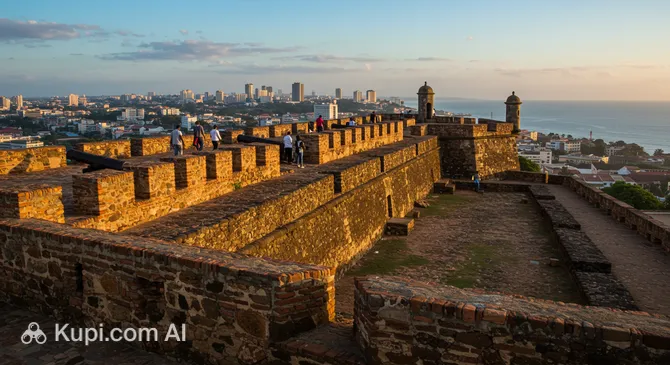
Fortress of São Miguel. Illustration.
Source: Kupi.com AI

Traveler photos:

Located on the picturesque Mount São Paulo, the fort, formerly known also as Fort Aardenburg, impresses with its high fortress walls. Their characteristic beige color harmonizes wonderfully with Luanda's sandy beaches, creating a memorable landscape. This place is not just a stone witness to the past but also an important part of Angola's cultural heritage.

In the past, Fort São Miguel performed not only defensive functions, protecting the city from external threats, but also served as a prison for opponents of the regime and serious criminals. After Angola gained independence from Portugal in 1975, the history of the fortress took a new turn: the Central Museum of the Armed Forces (Museu Central das Forças Armadas) was opened within its walls. Today, visitors can not only see the powerful fortifications but also explore exhibitions that tell the country's military history, making a visit here particularly educational.

Contacts

Fort São Miguel is a significant historical landmark in Luanda. Since it is primarily a historical site, there may not be specific contact phone numbers or email addresses for visitors.

To find out current opening hours or visiting conditions, it is recommended to contact the official tourist information centers in Luanda or look for information on the tourism portals of Angola. The fort can usually be reached by public transport or taxi, guided by its well-known location in the city.

How to contactContact
AddressCalçada de São Miguel, Luanda, Angola

What to Do

A visit to Fort São Miguel in Luanda is an immersion into the rich history of Angola. Today, this impressive fortress functions as a museum, offering visitors a unique opportunity to learn about the country's past. The main attraction inside the fort is the Central Museum of the Armed Forces. It houses an impressive collection of military equipment and weapons spanning various historical periods. Guests can see vintage rifles and pistols, artillery pieces, military trucks and armored cars, and even two light aircraft from the 1930s.

Strolling through the fort's grounds, pay attention to details that tell of significant events. The walls of the fortress are decorated with copper bas-reliefs depicting historical scenes. These works of art add authenticity to the atmosphere and allow for a deeper feel of the spirit of the time. The inner courtyard of the fort also deserves special attention, as impressive statues of key historical figures are installed here.

Among the monuments, you will see a statue of the first King of Portugal, Diogo Cão—the first European to reach the shores of Angola—as well as the famous navigator Vasco da Gama and other prominent figures whose lives were connected to this land. Near the fort, there is another interesting element—elegant ceramic tiles depicting illustrations that tell the story of Angola from ancient times. This is a wonderful addition to the museum's display, allowing for a more complete understanding of the country's journey.

Getting There

Fort São Miguel, one of the most significant historical landmarks in Luanda, is situated on a hill overlooking the bay, making it a prominent point of reference. It can be reached from the city center or from most hotels in several ways, depending on your preferences and your desire to immerse yourself in the local atmosphere.

The easiest and most comfortable option for tourists is typically a taxi. You can order a car via an app, if any are popular in Luanda at the time of your trip, or use official taxis that can be found at hotels or in busy areas of the city. A trip from central Luanda to Fort São Miguel usually doesn't take long, though it depends on traffic conditions.

For those who want to experience the local flavor, there is the option of using public transport. In Luanda, minibus taxis known as "candongueiros" are widespread. While this is a more economical way, it may require some preparation: it is worth checking the route heading towards the fort in advance or being ready to ask locals for directions. Make sure the driver understands you want to go specifically to "Fortaleza de São Miguel," as this is its historical name.

If you are staying relatively close to the fort, for example, near the Marginal (Avenida 4 de Fevereiro), and the weather is pleasant, you might consider walking. This will allow you to enjoy views of the city and the bay on your way to the site. Keep in mind that the fort itself is on a hill, so the final part of the journey will involve an uphill climb.

Nearest city: Luanda

History & Facts

Fort São Miguel (Fortaleza de São Miguel) is not just an ancient fortification, but a true stone chronicle of Luanda and all of Angola. Its history began in 1576, when the Portuguese nobleman and first governor of Angola, Paulo Dias de Novais, laid the foundation for the first defensive structure here. Interestingly, Paulo Dias was the grandson of the famous navigator Bartolomeu Dias, who discovered the Cape of Good Hope. Initially, the fortress was built of clay, but over time it became clear that such an important outpost required a more durable material.

Major reconstruction began later, and in 1638, the clay walls started to be replaced with stone. These works, completed in 1689 under the leadership of D. João de Lencastre, transformed the fort into a powerful citadel. As early as 1627, São Miguel became the administrative center of the colony. Over many years, the fortress played a key role in the region's history, including, unfortunately, as one of the primary departure points for slaves being sent to colonial Brazil. The fort was so significant that it effectively functioned as an autonomous city, protected by its own fortifications.

The fort's history is inextricably linked to the founding of Luanda itself. Paulo Dias de Novais arrived on the West African coast a year earlier, in 1575, and founded a settlement that bore the name São Paulo de Luanda until 1975. It was on February 11, 1575, that de Novais landed on Luanda Island and established contact with the local king of the Ndongo state, Ngolu Dambi. It is believed that the name of the country – Angola – originated from the name of this king's dynasty.

Even after losing its original military significance, Fort São Miguel continued to play an important role. Until Angola gained independence from Portugal in 1975, its walls housed the headquarters of the Portuguese army in Angola. Today, the fort is one of the country's main historical attractions, preserving the memory of the centuries-old and complex history of these lands.

Time Needed

When planning a visit to Fort São Miguel in Luanda, most visitors should expect to spend approximately 1-2 hours for the tour. This time is usually sufficient to take a leisurely stroll through the fort's grounds, examine its main structures, walls, and bastions, and enjoy the views from its heights. The fort is a major historical landmark, and this timeframe will allow you to get a general sense of its significance and architecture.

Of course, the duration of your visit may vary depending on your interests. If you have a deep interest in the history of Angola and fortification structures, wish to explore every corner in detail, read all the information boards (if available), or use the services of a guide, then more time may be required—perhaps up to 3 hours. Photography enthusiasts may also linger to capture perfect shots of the historical buildings and panoramic views.

On the other hand, if your time is limited or you prefer a faster pace, you can see the highlights in about one hour by focusing on the most key points of the fort. In any case, a visit to Fort São Miguel will be an interesting addition to your Luanda itinerary.

Working Hours

Unfortunately, exact information about the opening hours of Fort São Miguel in Luanda is not always available in general sources. To plan your visit in the best way possible, we strongly recommend checking the current schedule immediately before your visit. You can try to find this information on official tourism resources, if any, or contact local tourist information centers upon arrival in Luanda.

It is also worth finding out in advance whether advance ticket booking or registration is required to visit Fort São Miguel, especially if your trip coincides with a popular tourist time. Additionally, we recommend checking whether the attraction is open year-round or if visits are only possible during certain seasons to avoid any unpleasant surprises.

DayOpening hours
Monday8:30 – 17:30
Tuesday8:30 – 18:30
Wednesday8:30 – 17:30
Thursday8:30 – 17:30
Friday8:30 – 17:30
Saturday8:30 – 17:30
Sunday8:30 – 17:30

Nearby

A visit to Fort São Miguel is undoubtedly a highlight for any traveler in Luanda. However, to make your journey even more rewarding and complete, it is worth paying attention to the attractions located nearby. Exploring the surrounding area will allow you to dive deeper into the city's atmosphere, discover new interesting spots, and get a fuller picture of its culture and history.

Near Fort São Miguel, there are several notable sites that can complement your excursion program. From cozy cafes to other historical monuments—everyone will find something to their taste. Below is a list of some of them, along with the distance indicated.

NameDistance
Fortaleza Shopping0.1 km
Museum of the Coin1.1 km
SANA Luanda Hotel Restaurant1.4 km
Church of Our Lady of Carmo1.4 km
Holy Family Church2.4 km
BAR BAR3 km
Café Del Mar Restaurant6.2 km

Have you reached the end of the page?

So the route has been studied inside and out