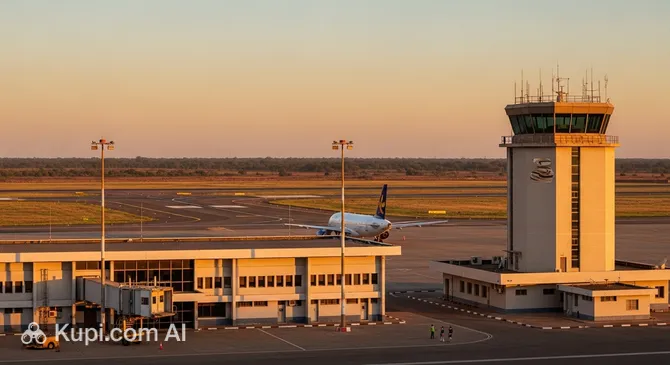
Source: Kupi.com AI
| Characteristic | Value |
|---|---|
| IATA code | SDD |
| ICAO code | FNUB |
| City | Lubango |
| Country | Angola |
| Time zone | Africa/Luanda |
| Popular airlines | TAAG Angola |
| Schedule | Live departures board |
| Characteristic | Value |
|---|---|
| IATA code | SDD |
| ICAO code | FNUB |
| City | Lubango |
| Country | Angola |
| Time zone | Africa/Luanda |
| Popular airlines | TAAG Angola |
| Schedule | Live departures board |
For the most accurate and up-to-date information about Lubango Airport (SDD), it is recommended to consult official sources or contact your airline directly. Below are the main contact details and recommendations.
Getting to Lubango Airport (Aeroporto da Mukanka, SDD) from the city centre of Lubango is effortless, as it is located just a few kilometres away. The journey usually takes minimal time, and the choice of transport depends on your budget and comfort preferences.
Taxi and Transfer
The simplest and most convenient way to reach the airport is to use a taxi service. Cars can be found at almost any point in the city or ordered through your hotel. The trip from the centre of Lubango to the terminal will take just 10–15 minutes depending on traffic conditions. Since the distance is short, the cost will be moderate. It is strongly recommended to agree on the price with the driver before starting the trip, as not all cars are equipped with meters. For greater peace of mind, you can book a private transfer in advance, which guarantees a fixed price and a meeting at the appointed time.
Public Transport
For the most budget-conscious and adventurous travellers, there is the option of travelling by local public transport. The backbone of the transport system in Lubango, as in all of Angola, is made up of route taxis known as "candongueiros". This is the cheapest way to get around, but it can be inconvenient for tourists with large luggage. Routes are not always obvious, so it is worth checking with locals in advance which minibus goes towards the airport. This option is suitable for those who want to immerse themselves in the local atmosphere and are not afraid of challenges.
Car Rental and Parking
If you plan to actively travel around the region, renting a car will be an excellent solution. There are several rental agencies in Lubango, and a car can be rented both in the city or ordered for delivery to the airport. This gives complete freedom of movement. For those arriving at the airport in their own or a rented vehicle, parking is provided. Options for both short-term and long-term parking are usually available.
Lubango Airport (SDD) is a compact and functional aviation hub distinguished by a simple and clear structure. Travellers find it easy to orient themselves here thanks to the logical layout.
The airport features one passenger terminal that serves all flights—both domestic (primarily to the capital of Angola, Luanda) and the few international ones. Thanks to this, you do not have to worry about transferring between different buildings. The terminal scheme is extremely simple: the building is divided into two main parts—the departure zone and the arrival zone.
In the departure zone, you will find check-in counters, a security checkpoint, and a waiting lounge with boarding gates. The arrival zone consists of the baggage claim hall and the customs control point. All services are located close to each other, making movement through the terminal quick and convenient.
Check-in and security screening usually do not take much time due to moderate passenger flow. Nevertheless, it is recommended to arrive at the airport with time to spare: approximately 1.5–2 hours before a domestic flight and 2.5 hours before an international one. This will allow you to calmly go through all procedures, even if small queues arise. Navigation through the terminal is intuitive, and signs will help you find your way, even if you do not speak Portuguese.
The history of Lubango Airport (SDD) is inextricably linked with the history of the city of Lubango itself and the key stages of development of the southern region of Angola. Having evolved from a modest airfield to the modern air gateway of Huíla Province, it has become a reflection of all significant changes in the country's life.
The airport was founded during the colonial period when the city of Lubango was known as Sá da Bandeira. Initially, the air harbour was named Sá da Bandeira Airport and performed an important function, serving both civil and military transport. Its creation was a strategic decision to ensure communication between the capital and the south of the country and control over vast territories.
An important milestone in the airport's history was 1975, when Angola declared independence. Following this event, the city and the airport received their modern names. In subsequent decades, the airport's infrastructure, like many other facilities in the country, faced serious challenges and needed renewal, but despite all difficulties, it continued to fulfil its role as a key transport hub for the region.
A new chapter in the airport's life began in the 2000s with the launch of a large-scale modernisation programme. The culmination of these works was a complete reconstruction completed in 2009. A modern passenger terminal was built, the runway was updated and extended, and advanced navigation equipment was installed. These changes allowed the airport to accept larger types of aircraft and take the quality of passenger service to a new level.
Today, Lubango Airport is a symbol of the region's economic revival and meets international standards of safety and comfort. An interesting fact: among locals, the airport is also known by the unofficial name Mukanka (Aeroporto da Mukanka), which it received from the nearby district. Its impressive transformation from an old colonial airfield into a modern aviation hub clearly demonstrates the dynamic development of the southern part of Angola.
Lubango Airport (SDD), serving the city of the same name and its surroundings in Angola, provides passengers with a necessary set of services for a comfortable wait for their flight. Despite its modest size, the airport strives to meet the basic needs of travellers.
For those wishing to have a snack or make purchases, the terminal features small cafes and eateries where you can order drinks and local dishes. There are also shops offering souvenirs, travel essentials, and press. The selection may not be as wide as in major international hubs, but all necessities are usually available.
Passengers can settle in the general waiting hall. Information regarding the availability and access conditions for VIP lounges is recommended to be checked in advance with your airline, as their services may be limited. Access to Wi-Fi may be provided, though its stability and coverage are not always guaranteed. Power outlets for charging electronic devices can be found in the waiting hall.
Financial services are represented by bank branches and currency exchange points, where you can exchange money or use an ATM. For emergencies, the airport has a medical point ready to provide first aid. Families with children can count on basic amenities, such as a mother and child room, though its availability is best checked upon arrival.
The airport is equipped to serve passengers with reduced mobility: ramps and accessible restrooms are available. For assistance with moving through the terminal or boarding, you should notify your airline in advance. There are no specialised hotels on the airport grounds, however, many accommodation options can be found in the city of Lubango itself, which is a few minutes' drive away. Conference halls or business centres are generally absent at the airport.
When planning a snack or lunch at Lubango Airport (SDD), it is worth considering that this is a small regional airport, and the choice of establishments is corresponding. Nevertheless, you will be able to find a few options to spend time comfortably and refresh yourself before your flight.
The main part of the modest food outlets is located in the public zone (landside), before passing passport control and security. A small cafe usually operates here, where passengers and well-wishers can drink coffee, tea, juice, or cooling beverages. The menu typically features simple snacks: sandwiches, toast, and local pastries. This is a convenient place to pass time while waiting for flight check-in.
After passing security control, in the sterile departure zone (airside), the choice is usually even more limited. There may be a small bar or kiosk offering various beverages and packed snacks—crisps, nuts, chocolate. This is a good option for those who want to grab something for the plane or have a quick snack right before boarding.
Regarding the menu, Lubango Airport offers few options for a full lunch. Some cafes in the public zone may prepare simple hot dishes, for example, grilled chicken with rice or chips, reflecting local culinary habits. However, finding specialised options, such as vegetarian, vegan, gluten-free, or Halal dishes, is practically impossible here. Travellers with strict dietary requirements are strongly advised to bring food from the city.
Prices for food and drinks at the airport are moderate, but, as everywhere, slightly higher than in city establishments. The opening hours of cafes and bars depend directly on the flight schedule—they open for the first morning flights and close after the departure of the last evening one. At night, when there are no flights, all food outlets will likely be closed.
To ensure your journey through the airport of Lubango goes smoothly, make use of these helpful tips. They will help save time and stress, and make your flight as comfortable as possible.
Arrival Time at the Airport. For international flights, it is recommended to arrive 2.5-3 hours before departure, and for domestic ones—1.5-2 hours. This will give you enough time to complete all formalities without rushing, especially during peak hours. Always check the recommendations of your airline, as they may differ.
Check-in and Security Control. To speed up the process, complete online check-in if your airline provides such an option. Keep your passport, visa, and boarding pass ready. When going through security, be prepared to remove laptops and other large electronic devices from your hand luggage, as well as liquids packed in a transparent bag.
Seat Selection on the Plane. If there is an opportunity to choose a seat in advance, consider your preferences. Window seats are ideal for those who love admiring views, especially when approaching the picturesque landscapes of Angola. Aisle seats are convenient if you plan to get up during the flight. Seats in the emergency exit row often offer more legroom but may require an extra fee.
Hand Luggage. Standard rules prohibit carrying liquids in containers larger than 100 ml, as well as any sharp or cutting objects. All liquids must be packed in one transparent bag with a volume of no more than 1 litre. Be sure to check the weight and dimension limits for hand luggage on your airline's website to avoid extra charges at the airport.
Passengers with Connections. If you have a connecting flight, clarify at check-in whether your luggage will be checked through to the final destination automatically. Find out the boarding gate number for your next flight immediately upon arrival to estimate how long the transfer will take.
Customs Control. When entering or leaving the country, be prepared to present your passport and a completed migration card or customs declaration. If you are carrying anything subject to declaration, prepare all necessary documents in advance. Remain calm and answer customs officers' questions politely.
Saving Time and Money. Check in for your flight online to avoid standing in queues. Bring an empty water bottle and fill it after passing security control—this is cheaper than buying water at a premium. Study transfer options from the airport in advance to choose the most advantageous one.
Flight Delay. In case of a flight delay or cancellation, contact your airline representative first. Depending on the wait time, you may be offered drinks, meals, or even accommodation in a hotel. Have your travel insurance contacts at hand in case of unforeseen expenses.
Reached the bottom of the page?
Looks like you know this route inside out
Where travelers fly most — pick a route and check prices