Support

Gold Coast Airport

About the Airport

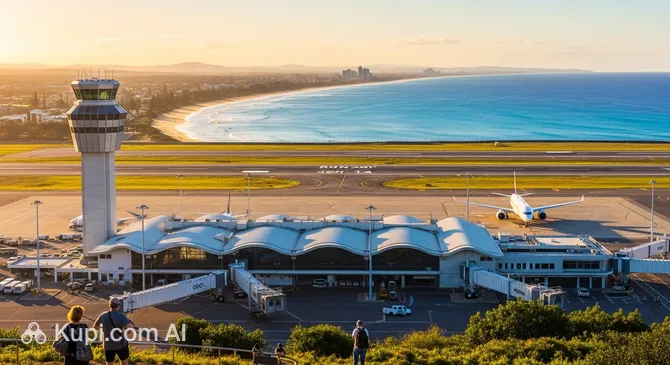
Gold Coast Airport. Source: Kupi.com Binoculars

Gold Coast Airport (OOL) is not just an air gateway to one of Australia's main tourist hubs, but a true geographical wonder. It is uniquely situated on the border of two states — Queensland and New South Wales — meaning its runway crosses the line where different time zones operate during the summer months. As the starting point for exploring famous beaches, theme parks, and picturesque surroundings, this airport welcomes millions of travellers eager to immerse themselves in the atmosphere of the sunny coast.

IATA Code OOL
ICAO Code YBCG
City Gold Coast
Distance to center approx. 25 km
Status International
Annual Passengers over 6.2 million (2024)
Popular Airlines Jetstar, Virgin Australia, Air New Zealand
Schedule "Gold Coast Airport" Online Board

Gold Coast Airport is one of the fastest-growing airports in Australia and is constantly being upgraded for passenger convenience. In 2022, a massive expansion of the southern terminal was completed, doubling the airport's footprint and significantly enhancing the level of comfort for travellers. Beyond standard services, the airport offers a unique experience: depending on the time of year, you might take off in one time zone and land in another without ever leaving the runway. Its proximity to popular resort areas such as Surfers Paradise and Broadbeach makes it the ideal starting point for your Australian adventure.

Contact Information

If you need to get in touch with Gold Coast Airport representatives, please use the following contact information. We recommend checking the official website for the most up-to-date details, as they may change.

  • Official Website: The most reliable source of information. Here you will find flight schedules, terminal maps, and the latest news. You can visit the site at: www.goldcoastairport.com.au
  • Information Desk Phone: For general inquiries and information, you can call +61 7 5589 1100.
  • Airport Address: 1 Eastern Avenue, Bilinga, Queensland 4225, Australia.
  • Email: To contact the airport, it is recommended to use the dedicated contact form available on their official website under the "Contact Us" section.
  • Social Media: The airport maintains active pages on popular social networks, sharing news and answering passenger questions. Look for the official Gold Coast Airport accounts on Facebook and Instagram.
  • Lost Property Information: If you have lost personal items within the terminal, you should complete the form on the airport website under the "Lost Property" section. For issues related to lost checked baggage, please contact your airline's representative directly.
  • Customer Support Contacts: Assistance is provided by staff at information desks within the terminal. You may also use the inquiry phone line for consultation.

How to Get to the Airport

Gold Coast Airport (OOL) is conveniently located at the southern end of the city, making it easily accessible from major tourist areas. Depending on your budget, time, and preferences, you can choose from several ways to reach the terminal. A trip from central Gold Coast, such as the Surfers Paradise area, usually takes between 30 to 50 minutes.

Public Transport is the most budget-friendly option. The TransLink bus network offers several convenient routes. Route No. 777 connects the airport with Broadbeach South station, where you can transfer to the G:link tram, which runs through all popular resort zones. Bus No. 760 will take you to Varsity Lakes train station, from where trains depart for Brisbane. You can pay for your ride using a Go Card or a contactless bank card, which is significantly more economical than buying a cash ticket from the driver.

Taxis and Rideshare Services, such as Uber, DiDi, and Ola, are an excellent choice for those who value speed and comfort, especially when travelling with a lot of luggage. The trip from Surfers Paradise takes about 25-30 minutes, excluding traffic. Taxi ranks and dedicated waiting areas for rideshare vehicles are located directly outside the arrivals terminal exits.

Car Rental provides maximum freedom to explore the picturesque surroundings of Australia. Counters for all leading international and local rental companies operate at the airport. If you are driving your own or a rented car, the airport offers several parking options: from premium parking right at the terminal to more economical long-term lots. It is highly recommended to book parking online in advance, as this allows you to secure a substantial discount.

It is also worth considering Transfers (Shuttles), offered by many hotels and private operators. This is a convenient compromise between the cost of public transport and the comfort of a taxi. Shuttles run on a schedule or can be booked individually; it is best to check their cost and conditions beforehand.

Terminals and Map

Gold Coast Airport (OOL) features a modern and passenger-friendly structure. It consists of one main terminal that serves both domestic and international flights. This significantly simplifies navigation and minimises the risk of getting lost or missing a connecting flight.

The terminal building has two main levels. On the ground floor (Ground Level), the arrival zones are located. Here, passengers pass through border control (for international flights), collect baggage, and proceed to car rental counters, taxi stands, and bus stops. The second floor (Level 1) is dedicated entirely to departures: here you will find airline check-in counters, security screening points, and a spacious departure lounge with boarding gates.

Although there is only one terminal, it is clearly zoned. The southern part of the building is primarily used for international flights, while the central and northern parts serve domestic ones. Movement between zones takes place within the same building, requiring no additional transfers. Navigation is intuitive thanks to clear signage. After passing security, passengers enter a common area with shops, cafes, and restaurants, providing access to all boarding gates.

Check-in and security procedures at Gold Coast Airport are organised quite efficiently. Nevertheless, it is recommended to arrive early: approximately 2 hours before a domestic flight and at least 3 hours before an international one. During school holidays and festive periods, passenger traffic increases significantly, so it is wise to allow extra time for completing all formalities.

Airport History

The history of Gold Coast Airport (OOL) is the story of a humble airfield transforming into one of Australia's most dynamically developing transport hubs. It all began in 1936, when a simple landing strip for light aircraft appeared on this site, serving the small coastal town of Coolangatta. The first regular passenger flights connecting it to Sydney were launched in 1939, marking the beginning of a long journey of growth.

Key stages of development occurred in the second half of the 20th century. In the 1950s, unpaved strips were replaced with asphalt, allowing for larger aircraft. A real breakthrough came in 1981 with the opening of a new terminal named after Australian aviation pioneer Eric Langton. This event prepared the airport for the jet age. In the 1990s, the first international flights were launched, mainly from New Zealand, officially cementing its international status. In 1999, the airport received its modern name — Gold Coast Airport, reflecting its importance to the entire tourism region.

The airport's recent history is marked by large-scale modernisation. In preparation for the 2018 Commonwealth Games, the infrastructure was significantly upgraded. The most ambitious project was the recent expansion of the southern part of the terminal, completed in 2022. This project doubled the terminal area, added new boarding gates, and significantly improved conditions for passengers travelling on international flights.

One of the most curious facts about Gold Coast airport is its unique geographical position. The main runway runs exactly along the border of the states of Queensland and New South Wales. Because of this, the airport is formally located in two time zones during the period when New South Wales switches to daylight saving time, while Queensland does not. This makes it not just an important transport facility, but a genuine geographical curiosity.

Services and Amenities

Gold Coast Airport offers passengers a wide range of services to make waiting for a flight as comfortable and productive as possible. Before departure, you can have a bite to eat at one of the numerous cafes and restaurants offering both Australian cuisine and popular international dishes. Various shops operate in the departure zone, including Duty Free, where you can purchase souvenirs, perfumes, and local delicacies.

For a more comfortable wait, the airport features airline lounges, such as the Qantas Club and Virgin Australia Lounge, offering a secluded atmosphere, snacks, and beverages. Free Wi-Fi is available throughout the terminal, and numerous gadget charging stations allow you to stay connected at all times.

Financial matters can be handled directly in the terminal: ATMs and currency exchange points are available here. Convenient parents' rooms are equipped for travellers with children. Passengers with reduced mobility can count on comprehensive assistance from staff, as well as use specially equipped restrooms and ramps. In case of need, there are first aid points at the airport.

If you have a long layover or an early flight, you won't have to travel far — the Rydges Gold Coast Airport hotel is located right opposite the terminal building. Although the airport does not have its own conference halls, business travellers can utilise relevant services in the airline lounges or at the nearby hotel.

Where to Eat

Gold Coast Airport (OOL) offers passengers diverse dining opportunities to comfortably pass the time before departure or refresh upon arrival. There are options here for every taste and budget — from a quick coffee on the run to a full meal in a relaxed setting.

Most cafes and restaurants are located in the departure lounge after passing security (airside). Here, travellers can find both popular fast-food chains for those short on time, and cosy cafes serving fresh pastries and excellent coffee — an integral part of Australian culture. For a more substantial meal, consider the dining venues offering international and local cuisine, including fresh salads, burgers, pasta, and sandwiches.

If you wish to try something local, look for establishments that focus on fresh Queensland produce. This could be a seafood salad or specialty beverages from local producers. Many cafes offer options for passengers with special dietary needs: it is easy to find vegetarian, vegan, and gluten-free dishes. It is recommended to check the availability of such options, including Halal-friendly choices, directly with the staff.

The price range at the airport varies. A quick snack or coffee will cost an average amount, while a full lunch with a drink in a restaurant will be more expensive, which is typical for airports. Most establishments operate according to the flight schedule, opening early in the morning and closing after the departure of the last aircraft, so even passengers on early morning and evening flights will not go hungry.

Recommendations: Coffee shops and sandwich kiosks are suitable for a quick and inexpensive snack. If you have an hour or more to spare, it is worth visiting one of the restaurants or dining areas in the main departure lounge to enjoy food and drinks in a calm atmosphere while watching the runway.

Travel Tips

Planning a trip through Gold Coast Airport will be easier if you consider a few tips. For domestic flights, it is recommended to arrive 1.5-2 hours before departure, and for international ones — at least 3 hours. The airport can be particularly busy during school holidays and festive periods, so it is worth allowing an extra hour during these times.

To save time, take advantage of online check-in, which most airlines offer. This will allow you to head straight to baggage drop or, if you are travelling with hand luggage only, directly to the security screening area. Security checks here are standard but thorough. Have your boarding pass and passport ready. When choosing a seat on the plane, consider that window seats will offer you stunning views of the coast during takeoff or landing, while aisle seats provide more freedom of movement.

Pay special attention to baggage regulations. On international flights, restrictions apply to liquids, aerosols, and gels (LAGs) in hand luggage: all containers must be no more than 100 ml and packed in a single transparent resealable bag. Customs control in Australia is known for its strictness, especially regarding biosecurity. Be sure to declare all food items, plants, wooden products, and other organic materials. The golden rule is "if in doubt, declare it," as this will help avoid large fines.

For passengers transiting from an international flight to a domestic one, it is important to remember: you will need to pass passport control, collect your luggage, pass customs inspection, and then re-check it for the next flight. Ensure you have enough time between flights to complete all these procedures.

To save a little money, book parking online in advance — this is often cheaper. You can also bring an empty water bottle and fill it at special fountains after passing security. In case of a flight delay, do not panic. First, contact your airline representative for the latest information and possible options (rebooking, compensation). While waiting, you can use the free Wi-Fi, have a snack in one of the cafes, or browse the shops in the terminal.

Reached the end of the page?

That means the route is fully explored