Support

Olympic Dam Airport

About the Airport

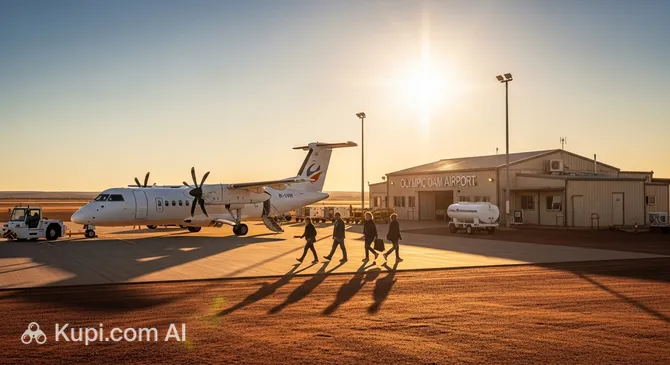
Olympic Dam Airport. Source: Kupi.com Binoculars

Olympic Dam Airport is not just a transport hub, but a true "lifeline" amidst the red sands of the South Australian Outback. Located in immediate proximity to one of the world's largest mineral deposits, it serves as the main air gateway for the town of Roxby Downs and the surrounding industrial facilities. Despite its strictly industrial character, the airport surprises travellers with modern infrastructure and the capability to accommodate jet liners right in the middle of the desert. For tourists, it is a starting point into the world of the harsh yet captivating nature of Australia, where the horizon merges with infinity.

IATA Code OLP
ICAO Code YOLD
City Roxby Downs
Distance to Centre 10 km
Status Domestic / Private
Passengers per Year ~103,000 (2023)
Schedule Check with the air carrier

Features and Advantages of the Airport

Focus on Efficiency
Olympic Dam Airport is privately owned by the mining giant BHP, which leaves a mark on its entire operation. Everything here is subordinated to precision and functionality: from quick check-in to prompt baggage claim. The terminal is designed to minimise waiting time for thousands of rotational workers, so ordinary travellers can also expect to pass through all formalities without unnecessary delays or queues.

Modern Runway
Unlike many regional airfields, Olympic Dam boasts a seriously modernised runway. Following extensive reconstruction, the airport is capable of accepting modern jet aircraft, such as the Airbus A320 and Fokker 100. This ensures a high level of flight comfort and safety, connecting this remote region with Adelaide via regular and reliable flights.

Comfort in Extreme Conditions
Given that the temperature in this region often exceeds 40°C in summer, a crucial advantage of the terminal is its powerful air conditioning system. The airport building represents a saving oasis of coolness amidst the scorching desert. A comfortable microclimate is maintained inside, making the wait for a flight pleasant even on the hottest days of the Australian summer.

Gateway to the Outback
Although the main flow of passengers consists of mine employees, the airport also serves as a convenient entry point for wildlife explorers. It is convenient to start journeys along legendary South Australian routes from here, including trips to Lake Eyre or towards the opal fields of Andamooka. The presence of rental agencies right at the airport allows tourists to immediately transfer to a car and set off towards adventure.

Contact Information

  • Official Website: Olympic Dam Airport does not have a separate public website. The airport primarily serves charter flights for the needs of the mining company BHP, operated by Alliance Airlines. For flight information, it is recommended to contact the air carrier's representatives.
  • Help Desk Phone: +61 8 8671 8500 (please note that international call rates may apply).
  • Airport Address: Olympic Dam Highway, Roxby Downs, South Australia 5725, Australia.
  • Email: A specialised email address for general passenger enquiries is not provided.
  • Social Media: The airport does not maintain official pages on social media.
  • Lost Luggage Information: For all issues related to lost or damaged luggage, please contact the support service of the airline you flew with directly.
  • Passenger Support Contacts: For assistance with booking, changing flight dates, and other services, please contact your airline.

How to Get to the Airport

Getting to Olympic Dam Airport (OLP) from the town of Roxby Downs is not difficult, as it is located just 10 kilometres from the centre. However, given the specifics of this mining town in Australia, the choice of transport differs from what major metropolises offer. Planning your trip in advance is the key to a comfortable start to your journey.

Taxi and Transfer

The simplest and most reliable way to get to the airport is to use a local taxi service or book a private transfer. The journey from the centre of Roxby Downs will take approximately 10-15 minutes. It is recommended to book a car well in advance, especially if you have an early morning or late evening flight. It is best to confirm the cost of the trip directly with the taxi operator, as rates may vary.

Car Rental

If you prefer independence in your movements, car rental is an excellent choice. Several rental companies operate in Roxby Downs. Having your own transport is particularly convenient if you plan to explore the surroundings before or after your flight. The road to the airport is well signposted, and navigation will not cause difficulties. This option ensures maximum flexibility for your schedule.

Airport Parking

For those arriving by private or rented car, parking is provided at Olympic Dam Airport. Options for both short-term and long-term parking are usually available. Since the airport does not have a public website with rates, to clarify current costs and parking conditions, it is recommended to contact the airport administration by phone in advance or seek information from your airline.

Public Transport

It is important to note that there is no regular public transport (buses, trains, or metro) in Roxby Downs serving the route to the airport. The urban transport system is oriented towards the needs of the local population and workers, so tourists should not rely on this method. The main and most predictable options remain taxis and cars.

Terminals and Map

Olympic Dam Airport is a small regional airport distinguished by a simple and functional structure. It is designed for the efficient servicing of passengers, primarily connected with the local mining industry, which makes navigating through it maximally clear and fast.

The airport operates one passenger terminal, which handles all domestic flights — both departures and arrivals. Thanks to its compact size, you will not have to worry about long walks or complex layouts. All key zones are within walking distance of each other in a single building.

The terminal layout is extremely simple: upon entering the building, you immediately find yourself in the general area where the check-in counters are located. After receiving a boarding pass and checking in luggage, passengers pass through the security screening point and enter a small departure lounge. The arrival zone is located right here as well, consisting of a baggage claim belt and an exit to the city. Getting lost in Olympic Dam Airport is practically impossible.

Check-in and screening procedures usually proceed very quickly due to the low passenger flow. Typically, it takes no more than 20-30 minutes to complete all formalities. Nevertheless, it is always recommended to arrive at the airport in advance, in accordance with your airline's rules, especially if you are travelling with luggage.

Airport History

The history of Olympic Dam Airport (OLP) is inextricably linked with one of the world's largest mining projects. The airport was built in the late 1980s specifically to service the mine of the same name and the new town of Roxby Downs, founded in 1987. From the very beginning, its main task was organising flights for personnel working on a rotational basis (Fly-in Fly-out system), which defined its entire subsequent history.

A major stage in the airport's development was a large-scale modernisation completed in 2013. During the works, the runway was significantly lengthened and strengthened, allowing it to accommodate larger jet aircraft such as the Airbus A320 and Boeing 737. The passenger terminal was also updated and expanded to improve comfort and capacity. These changes were driven by plans to expand production at the mine and, consequently, an increase in the number of workers.

Unlike most civil airports, the history of Olympic Dam is not marked by high-profile public events. Its main achievement is stable and efficient operation as a vital transport artery for a huge industrial facility in a remote region of Australia. Thanks to an intense schedule of charter flights for workers, Olympic Dam ranks among the busiest regional airports in the country by the number of take-offs and landings.

A key interesting fact from the airport's history is that it is private property and is managed by the mining company BHP, which owns the mine. It is not oriented towards mass tourism but represents a well-tuned mechanism for delivering thousands of employees to their workplace and back. The main flights are operated by airlines specialising in charter transport, such as Alliance Airlines and QantasLink.

Services and Amenities

Olympic Dam Airport (OLP), despite its modest size, is focused on ensuring comfort for all passengers. Although the selection of services here is not as wide as in major international hubs, you will find everything necessary for a pleasant wait for your flight. A small cafe operates in the terminal building, where you can order hot and cold beverages, sandwiches, and light snacks. There is also an opportunity to purchase newspapers and souvenirs as a memento of your trip to Australia.

For passenger convenience, free Wi-Fi is available throughout the airport, and power outlets for charging mobile devices and laptops are provided in the waiting hall. There are no specialised business lounges or VIP zones at Olympic Dam Airport.

The airport is equipped to serve passengers with reduced mobility: there are ramps and accessible toilets. Travellers with small children can use the baby care room. There is no full-fledged medical centre in the terminal, however, in an emergency, you should contact any airport staff member who will provide first aid or call an ambulance. ATMs are installed in the terminal, but currency exchange services are not provided.

There are no hotels or conference halls on the territory of the airport itself. The nearest hotels and apartments are located in the town of Roxby Downs, which can be easily reached by taxi or a pre-booked transfer. All main infrastructure, including a wider selection of shops and restaurants, is also located there.

Where to Eat

When planning a flight via Olympic Dam Airport (OLP), it is important to consider that this is a small regional airport serving primarily mining industry workers and residents of the nearby town of Roxby Downs in Australia. Consequently, the infrastructure, including dining outlets, is quite limited here and not comparable to major international hubs.

A small cafeteria or kiosk operates in the building of the single airport terminal. This is the main and, as a rule, the only place where you can have a snack. The assortment here is focused on quick and simple options. Passengers can expect:

  • Hot beverages: coffee, tea.
  • Soft drinks, juices, and bottled water.
  • Ready-made sandwiches, rolls, and pastries (pies, buns).
  • Packaged snacks: crisps, chocolate, nuts.

There are generally no options for a full lunch or dinner with hot à la carte dishes at the airport. If you have a long wait planned or prefer a more substantial meal, it is recommended to eat in advance at one of the establishments in Roxby Downs. Specialised dietary options (vegetarian, gluten-free, etc.) are also extremely limited, so passengers with special dietary requirements are advised to bring food with them.

The cafeteria is located in the general area of the terminal (before security control) and is available to both departing and arriving passengers. Its operating hours are usually strictly tied to the flight schedule: it opens shortly before departure and closes soon after the aircraft leaves. Prices may be slightly higher than average due to the airport's remote location. This place is excellent for a quick snack, but not for gastronomic discoveries.

Travel Tips

Travelling through a regional airport like Olympic Dam in the town of Roxby Downs has its own specifics. To ensure your trip goes as smoothly as possible, use these helpful tips.

Arrival Time: Despite Olympic Dam Airport being small and queues usually being shorter here than in major hubs, it is recommended to arrive in advance. The optimal time is 1.5–2 hours before a domestic flight departure. This will give you enough time to complete check-in and security control without rushing.

Check-in and Security: To save time, complete online check-in if your airline provides such an option. Keep your passport or ID and boarding pass ready. Screening rules are standard for Australia, so pack all liquids over 100ml in your checked luggage in advance.

Seat Selection and Hand Luggage: Flights to this region often use smaller aircraft, from the windows of which stunning views of the Australian Outback open up — choose a window seat for the best photos. It is forbidden to take sharp objects and flammable substances in hand luggage. Laptops and other large electronics will likely need to be removed from your bag during screening.

For Connecting Passengers: Olympic Dam Airport serves mainly domestic flights. If you have a connection in a larger city, for example, in Adelaide, ensure you have enough time between flights (at least 2 hours). Check with the airline whether you will need to collect and re-check your luggage.

Customs Control: You will pass customs and immigration control at your first airport of arrival in Australia (for example, in Sydney or Melbourne). There are no such procedures for domestic flights at Olympic Dam Airport. However, remember the strict Australian biosecurity laws: it is strictly forbidden to bring fresh fruit, vegetables, meat, dairy products, and plants without special permission.

Saving Time and Money: Book flight tickets in advance to get the best prices. Travel light to avoid surcharges for excess baggage. If you need transport from the airport, book it well in advance, as options on-site may be limited.

In Case of Flight Delay: Before leaving for the airport, check your flight status on the airline's website. In case of a delay, contact your carrier's representative at the airport. Given the small size of the terminal, the range of services may be limited, so just in case, have a portable charger, a book, or downloaded films with you to pass the time.

Airports in nearby cities

Reached the end of the page?

That means the route is fully explored