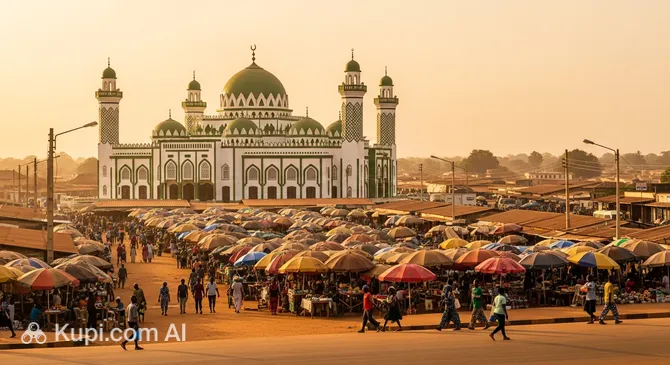
Located in northwestern Benin, Djougou is the largest city and administrative center of the Donga Department. This bustling crossroads sits at an altitude of about 430 meters above sea level, giving its appearance a unique landscape. Djougou is more than just a point on the map; it is a vital transport and commercial hub connecting the region with neighboring Togo.
The city's atmosphere is permeated with a true African rhythm of life. Here, echoes of French colonial heritage and deep local traditions intertwine to create a unique cultural layer. Learning about the history of Djougou allows for a better understanding of how this provincial yet dynamic center developed, maintaining its distinctive face away from the main tourist routes.
Djougou. Illustration.
Source: Kupi.com AI
For the traveler, Djougou is interesting primarily as an authentic slice of modern Beninese life. Despite the lack of typical tourist polish, the city attracts with its honesty: from noisy regional markets to leisurely evening strolls through the streets. We invite you to visit this city to see the real Benin from the inside, feel its hospitality, and discover the beauty of everyday life in West Africa.
Weather Overview
The climate in Djougou is typical of the tropical Sahel zone: heat prevails year-round, and the change of seasons is determined by the amount of rainfall. Travelers should be prepared for air temperatures rarely dropping below +20 °C, and in the hottest months, such as March and April, the thermometer can rise to +38 °C.
The year is clearly divided into a dry season and a rainy period. From May to October, Djougou experiences intense tropical downpours, peaking in August. During this time, humidity increases significantly, and the sky is often overcast. The dry season, by contrast, is characterized by clear weather but may be accompanied by dusty winds from the Sahara. It is worth checking the current weather in Djougou immediately before the trip to pack correctly.
Expect very hot weather from December to May and a humid, sultry period in the summer months. The city's high-altitude location (430 m) makes the nights slightly cooler compared to coastal areas, bringing pleasant relief after a sweltering day. The winter months are considered the most comfortable time to visit, as the probability of rain is minimal.
Average monthly temperature
Average monthly precipitation
Interesting Facts
The word "Benin" originates from the Yoruba language and translates to "country of wars" or "country of quarrels," reflecting the region's turbulent historical past.
Until 1975, the state in which Djougou is located was officially called Dahomey—the historical name of a powerful kingdom that existed in this territory for almost three centuries.
Benin is one of the few West African countries capable of fully meeting its population's needs for basic food products through its own production.
Djougou is located at the intersection of strategic roads and serves as an important "gateway" on the way to the border with Togo, making it a key trade hub for the entire northwestern region.
How to Get There
The transport accessibility of Djougou is determined by its position in the northwest of the country. It can be reached by air or by land, although the region's infrastructure is geared more toward local communication. When planning a trip to Djougou, tourists should consider the significant distances and the specific road conditions in this part of Benin.
The main air hub for the region is Djougou Airport (IATA: DJA). It handles domestic flights, connecting the city with the southern parts of the country, including the largest city, Cotonou. Despite its small size, the airport plays a vital role in ensuring the connection of this remote region with the rest of the country.
Land travel is the most common way to get to Djougou. The journey by car from Cotonou takes between 10 to 12 hours, allowing you to see the changing natural zones of Benin. It is worth remembering that road conditions can deteriorate during the rainy season, so travel time often increases.
Main Attractions
Since Djougou is primarily an administrative and commercial center, its main attraction is the atmosphere of authentic provincial Benin. A walk through the city allows you to see the daily lives of local residents without embellishment, which is especially valued by seekers of authentic experiences. The city's central streets are always full of movement, and local color manifests in details: from the traditional clothing of passers-by to the arrangement of local courtyards.
Special attention should be paid to the local markets. This is the heart of Djougou, where trade bustles and the main exchange of news takes place. Here you can find everything—from bright African fabrics to exotic fruits and the work of local artisans. The city's markets serve as an excellent place for ethnographic observations and allow you to feel the pulse of West African trade.
For those looking for historical monuments, Djougou often serves as a starting point for trips around the region. Relatively nearby is the famous Abomey with its unique complex of royal palaces. However, even in Djougou itself, you can find interesting examples of colonial architecture and traditional mosques, reflecting the diversity of the region's religious life.
Local Cuisine
A gastronomic journey to Djougou is primarily an introduction to West African traditions. The basis of the local diet is fufu—a dense and filling dough made from yams. This dish is usually served with various thick sauces and stews containing vegetables, meat, or fish. The region's cuisine is characterized by simple ingredients and rich flavors thanks to the use of local spices.
On the city streets, you can find many vendors offering quick snacks: fried plantains, portions of rice and beans, and freshly baked flatbreads. The food culture here is closely linked to the local markets, which are the main sources of fresh products. It is here that tourists can try the most authentic dishes in small family stalls, where food is prepared according to ancient recipes.
Regarding drinks, both traditional homemade infusions of local herbs and fruits and Beninese beer are popular in Djougou. On hot days, you should try refreshing non-alcoholic drinks based on ginger or hibiscus. Despite the absence of fine dining in the classic sense, the sincerity and hospitality with which food is served in local establishments make dining in Djougou truly memorable.
Travel Tips
Visiting Djougou will be a vibrant adventure for you if you prepare in advance for the characteristics of this colorful region. To make your trip comfortable and safe, use our practical recommendations.
Clothing and Essentials: Choose light clothing made from natural fabrics (cotton, linen), as it is hot in the city year-round. Don't forget comfortable closed-toe shoes for walking on dusty roads and a hat. When visiting mosques or traditional communities, observe modesty in dress.
Transport:Moto-taxis are best for getting around the city. Always agree on the price of the trip before getting on the motorcycle. For long-distance trips, it is recommended to hire a car with a driver.
Finance: The main currency is the CFA franc. ATMs in Djougou are rare, and cards are accepted only in exceptional cases. Be sure to carry a sufficient supply of cash in small bills.
Health and Safety: Use only bottled water and use insect repellents. Before the trip, it is advisable to consult a doctor regarding malaria prophylaxis. Be attentive to your belongings in crowded places at the market.
Communication: The official language is French. Knowing even basic phrases will significantly facilitate communication. English is not widely spoken, so an offline translator will be very useful.
Local Etiquette: Greetings are very important in Djougou. Always greet people before asking for something. Before taking photos of local residents or their homes, be sure to ask for permission.
What to Avoid: Do not openly display expensive jewelry or electronics. Try not to move around the city or surrounding areas alone after dark.
Seasonality: The best time to visit is the dry season (from November to February), when humidity is lower and roads are in better condition.
Following these simple rules will help you focus on the beauty and hospitality of this amazing corner of Benin. Have a pleasant journey!
Entertainment & Nightlife
Nightlife in Djougou is quiet and local in nature, reflecting the city's status as a provincial center. The main places for evening relaxation are small bars and cafes where local residents gather. The atmosphere here is relaxed: you can listen to African music, have a cool drink, and watch the city life after sunset. There are no large nightclubs with international dress codes here, but on weekends, local establishments often host musical evenings.
For daytime leisure, Djougou offers walks through colorful shopping districts and visits to local celebrations if your visit coincides with the region's traditional festivals. These events are the best way to see folk dances and hear live music performed by local groups. Safety in the city in the evening is at an acceptable level; however, it is recommended to use the services of trusted moto-taxis for moving between establishments after dark.
If you are looking for more diverse entertainment, such as theaters or modern cinemas, keep in mind that Djougou is better suited for immersion in authentic culture than for classic tourist leisure. Nevertheless, interacting with the open and friendly townspeople in local cafes often leaves more vivid impressions than visiting standard tourist sites.
Parks & Museums
In Djougou itself, specialized urban parks in the conventional sense are rare; however, the city is surrounded by natural savanna vegetation, which is a beautiful natural area in its own right. Green spaces on the outskirts of the city allow you to experience the landscape of northwestern Benin, which is especially impressive after the rainy season when everything is covered in vibrant greenery.
While there are no large art galleries in Djougou, the traditional markets and religious structures take on the role of museums. The architecture of local mosques and colonial-era administrative buildings can serve as a kind of open-air museum, telling the story of different periods in the city's development. For a deep immersion into the region's history, travelers often head to neighboring Abomey, home to the famous museum complex of the Dahomey royal palaces.
The cultural heritage of Djougou is best manifested in live communication and craft workshops. Observing the work of local weavers or potters gives a more complete understanding of the people's culture than static museum displays. Thus, the entire city becomes a living space for studying the traditions and daily life of West African society.
Getting Around
The public transport system in Djougou is based on local traditions and the needs of a regional center. The main and fastest way to get around the city is by moto-taxi, known here as "zemidjan." These maneuverable vehicles make it easy to reach markets or hotels, and their drivers in bright vests are easy to spot in the city traffic. It is customary to agree on the fare in advance.
For travel between cities and along the main routes of the Donga Department, shared taxis (known as "brousse") are used. They do not have a strict schedule and depart as they fill with passengers. This is an inexpensive, though not always the most comfortable, way to travel, allowing tourists to fully immerse themselves in the local environment and interact with residents.
Renting a car with a driver is the most convenient option for those planning to visit attractions around Djougou or heading to the Togo border. The payment system in public transport is exclusively cash. Travelers should keep in mind that travel during the rainy season can be difficult due to road conditions, so it is always helpful to have extra time when planning a route.
Accommodation
Accommodation options in Djougou are primarily oriented toward business travelers and those passing through the city in transit. The choice of hotels here is limited, so it is recommended to book a room in advance. One of the best-known accommodation facilities is Hotel Etoile de la Kozah, which offers a standard set of services for a comfortable stay.
Most hotels in the city are middle-class or small guest houses. In such establishments, you can expect basic amenities, cleanliness, and the friendliness of the staff; however, do not expect luxury five-star complexes in this region. Housing is usually located along the main transport arteries or in the central part of the city, which is convenient for access to markets and administrative buildings.
The price range in Djougou is quite affordable compared to the coastal cities of Benin. International online services remain the main booking method, although some private guest houses still practice cash payment upon arrival. When choosing a place to stay during the hot season, pay attention to the availability of air conditioning in the room.
Nearby Cities
Djougou serves as an excellent starting point for exploring the northern and central regions of Benin. Thanks to its location at a crossroads, the city allows travelers to easily plan short trips to neighboring settlements, each of which has its own unique character and natural beauty.
Just a few dozen kilometers away are the small towns of Barei and Copargo. A trip to Copargo will be interesting for those who want to see the traditional way of life surrounded by picturesque hills and fields. It is also worth paying attention to Kolokonde; the journey there won't take much time but will provide plenty of impressions of the rural landscapes of the country's northwest.
City
Population
Distance
Barei
9 259
11 km
Kopargo
70 938
20 km
Kolokonde
17 419
24 km
Bougou
9 505
30 km
Birni
12 559
35 km
For those ready for longer journeys, historical Abomey should be a mandatory stop on the itinerary. Exploring the surroundings of Djougou provides an opportunity to see Benin in all its diversity—from busy trade routes to quiet villages where time seems to have stood still.
Shopping & Souvenirs
Shopping in Djougou is primarily about visiting the local markets, which are the center of the city's economic life. There are no huge shopping malls with global brands here, but that is precisely the charm of local commerce. Main shopping areas are concentrated along the major streets, where shops and stalls offer everything needed for daily life and travel.
Tourists should pay attention to textiles. Benin is famous for its vibrant fabrics with traditional patterns, which can be used to order custom clothing from local tailors right in the city. Djougou is also an excellent place to buy leather goods and handmade wooden souvenirs. Local artisans often sell their products directly at the markets, providing an opportunity not only to buy a unique item but also to talk with its creator.
Shop opening hours are usually standard—from early morning until sunset—though many stalls may close for a break during the hottest time of day. Payment is made primarily in cash in the local currency (CFA francs), so it is wise to arrange for small bills in advance. Bargaining at markets is part of the local culture and is welcomed if conducted in a friendly and respectful manner.