Support

E. Beltram Airport

About the Airport

Captain Aníbal Arab Fadul Airport, also known as E. Beltran Airport, is not merely a runway but a true gateway to the green heart of Bolivia. Located in the city of Cobija, it serves as the primary starting point for explorers of the Amazon jungle, business travellers, and local residents. This compact airport welcomes guests with tropical warmth and offers the feeling that a great adventure begins right at the aircraft steps.
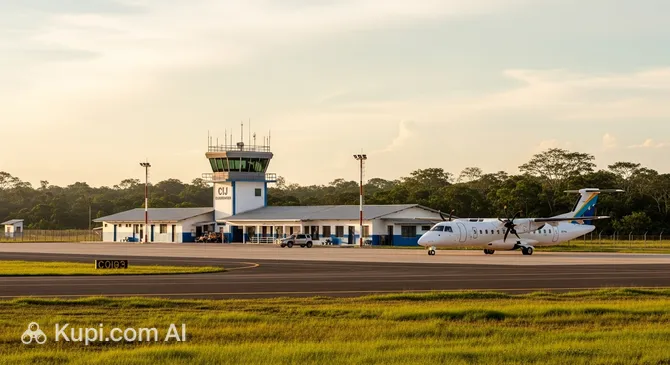
E. Beltram Airport. Source: Kupi.com Binoculars
IATA Code CIJ
ICAO Code SLCO
City Cobija
Distance to Centre About 1 km
Status International
Annual Passengers About 130,000
Popular Airlines Boliviana de Aviación (BoA), EcoJet

The airport's main advantage is its strategic location. It acts as a key transport hub for the entire Pando Department, providing a vital link between this remote Amazonian region and the country's major cities. Thanks to its compact size, the airport is very convenient for passengers: all procedures, from check-in to boarding, are completed quickly and without unnecessary fuss.

Another unique feature is its incredible proximity to the city centre. You can reach a hotel, restaurant, or local market in just a few minutes by taxi or even on foot, which is a rarity. The airport retains the atmosphere of a cosy regional hub, free from the stress typical of giant terminals, allowing travellers to immediately immerse themselves in the unhurried and authentic rhythm of life in the Bolivian Amazon.

Contact Information

Below are the contact details for Captain Aníbal Arab Fadul Airport (CIJ), serving the city of Cobija. Please note that this is a small regional airport, and some contact points may be general numbers for the management company.

  • Official Website: The airport is managed by AASANA (Administración de Aeropuertos y Servicios Auxiliares a la Navegación Aérea) of Bolivia. The airport does not have a separate website; general information is available on the management company's portal: www.aasana.bo.
  • Information Desk Phone: +591 3 842 2270
  • Airport Address: Av. 9 de Febrero, Cobija, Pando Department, Bolivia.
  • Email: A direct email address for passengers is not published. It is recommended to use the telephone for enquiries.
  • Social Media: Official social media pages for the airport are unavailable. News can be tracked via AASANA's resources.
  • Lost Luggage Information: For issues related to lost or damaged luggage, you must primarily contact your airline's representative at the airport.
  • Passenger Support Contacts: For general information and passenger support, please use the main airport information desk number.

How to Get to the Airport

Getting to E. Beltran Airport (Capitán Aníbal Arab Airport, CIJ) from the city centre of Cobija is effortless, as it is located very close by, just a few kilometres away. The main modes of transport are taxis and motorcycle taxis, which are the fastest and most convenient choices for tourists.

Taxis and Motorcycle Taxis are the most popular and reliable way to reach the airport. A trip from any point in the city will take no more than 10-15 minutes. In Cobija, as in many cities in Bolivia, not only regular taxis are common but also motorcycle taxis — a cheaper and faster option for solo travellers with light luggage. The cost of the trip is low, but it is recommended to agree on the price with the driver in advance, before starting the journey, to avoid misunderstandings. Payment is made in cash.

Public Transport in the city is represented mainly by route taxis (trufis) and small buses (micros). Although some routes may pass near the airport, this is not the most convenient option for travellers with suitcases. Schedules and routes can be unpredictable, so to arrive on time for your flight, it is better to opt for a taxi.

Car Rental and Parking. Renting a car is suitable for those planning independent trips around the Pando region — several local rental agencies can be found in the city. However, strictly for transfer to the airport, this option is not practical. If you are travelling by private or rented transport, E. Beltran Airport has a car park where you can leave your vehicle.

Terminals and Map

E. Beltran Airport (CIJ), officially known as Captain Aníbal Arab Fadul Airport, is a small regional aviation hub. It consists of one passenger terminal that handles all domestic flights — both arrivals and departures. Thanks to its compactness, the airport offers passengers simple and intuitive navigation.

The terminal layout is extremely logical. Upon entering the building, you find yourself in the general hall where the Check-in counters and airline offices are located. After check-in, passengers proceed to the security screening area, beyond which lies a small but cosy departure lounge with a boarding gate. The arrival area is organised just as simply: after disembarking, passengers enter a hall with a baggage claim belt, and from there — into the public zone and out to the city.

Since the airport has only one terminal, there is no need for transfers between buildings. All pre-flight and post-flight procedures take place in one location. Passing through check-in and security screening usually takes no more than 30-40 minutes thanks to the low passenger traffic. Nevertheless, it is recommended to arrive at the airport 1.5 hours before departure to calmly check in your luggage and complete all formalities.

Orienting yourself in the Cobija terminal is very easy. Due to its modest size, all key zones — from check-in to the boarding gate — are within sight. It is practically impossible to get lost here. Simply follow the standard signs, and you will easily find the sector you need. The friendly staff are always ready to assist if you have any questions.

Airport History

The history of the air gateway to the city of Cobija is inextricably linked with the exploration and development of the Bolivian Amazon. It is worth clarifying the name immediately: although the name E. Beltran may appear in old directories or due to confusion with neighbouring hubs (for example, in Guayaramerín), officially the airport bears the name Capitán Aníbal Arab. This name was bestowed upon it in 1988 in honour of the legendary pilot Aníbal Arab Fadul, who was a pioneer of commercial aviation in north-eastern Bolivia and made an invaluable contribution to the development of the region's transport accessibility.

For a long time, the Pando Department remained one of the most isolated corners of the country due to the lack of reliable land roads. Aviation here began with small propeller aircraft transporting rubber and Brazil nuts, landing on simple dirt strips. An important milestone in the establishment of modern infrastructure was the opening of the current passenger terminal building in 1984. This event marked the transition from a temporary airfield scheme to full-fledged airport service.

A significant technical breakthrough was the laying of an asphalt runway to replace the dirt one. This allowed Cobija to receive modern jet liners and establish regular connections with the country's key cities — La Paz and Santa Cruz de la Sierra. Modernisation made flights less dependent on weather conditions, which previously often paralysed air traffic during the rainy season.

In the recent history of the airport, the installation of a modern lighting system played an important role. Thanks to this innovation, the air harbour was able to switch to 24-hour operation, receiving flights even after dark. Today, the airport remains the main transport artery of the region, ensuring a link with the outside world even when forest roads become impassable due to tropical downpours.

Services and Facilities

E. Beltran Airport (CIJ) is a small regional airport serving the city of Cobija and its surroundings in Bolivia. Given its size, the range of services here is basic but sufficient for a comfortable wait for your flight. Passengers should plan certain aspects in advance to ensure their journey goes smoothly.

Within the terminal, there are several small cafes where you can have a snack with sandwiches, pastries, and drink coffee or soft drinks. There are also kiosks selling snacks, water, and essential travel goods. The selection of shops is limited, but you can find local souvenirs here.

Opportunities for rest and work at the airport are modest. There are no VIP halls or business lounges here. Wi-Fi access may be limited or provided for a fee in the cafes. The number of power outlets for charging electronic devices is small, so it is recommended to carry a portable power bank.

There are no bank branches or full-service currency exchange points at the airport. All financial transactions, including exchanging money, are best done in the city beforehand. There may be an ATM here, but one should not rely on it as the sole source of cash.

For emergencies, the airport has a medical point to provide first aid. Passengers with children have access to mother and child rooms with changing tables. Travellers with reduced mobility are advised to notify their airline in advance of the need for special assistance to organise accompaniment and comfortable movement through the terminal.

There are no specialised business centres or conference rooms at E. Beltran Airport. There are also no hotels on the terminal premises; however, the nearest hotels and accommodation options can easily be found in the city of Cobija, which is located just a few kilometres from the airport.

Where to Eat

When planning a flight through E. Beltran Airport (CIJ), it is important to consider that this is a small regional airport, and the choice of dining establishments is quite limited. Nevertheless, passengers have the opportunity to have a snack before departure.

The main dining area is located in the general hall of the airport, accessible to both departing and meeting passengers (landside zone, before security control). Here, you will most likely find one or two small cafes or kiosks. There are no full-service restaurants with extensive menus at the airport, so for a substantial lunch or dinner, it is better to choose an establishment in the city of Cobija.

For a quick snack, local cafes usually offer classic Bolivian snacks, such as salteñas (baked pastries with a juicy meat or chicken filling) or empanadas, as well as sandwiches, pastries, and packaged snacks. This is a great way to experience local cuisine in miniature. Available drinks include coffee, tea, soft drinks, and bottled water.

Specialised dietary options, such as vegetarian, vegan, gluten-free, or Halal dishes, will be extremely difficult to find here. If you have strict dietary requirements, it is recommended to bring food with you. The price range in the airport cafes is generally moderate and geared towards locals. Opening hours are usually tied to the flight schedule: they open a few hours before departure and may close during quiet periods.

Travel Tips

Travelling through the airport of Cobija can be an easy and pleasant start or end to your adventure in Bolivia if you prepare in advance. Here are a few tips to help you navigate E. Beltran Airport and avoid unnecessary stress.

Arrival Time: The airport in Cobija is small, so huge crowds are rare here. Nevertheless, it is recommended to arrive at least 2 hours before a domestic flight and 3 hours before an international one. This time will be sufficient to check in, drop off luggage, and pass pre-flight screening without rushing.

Check-in and Security: Procedures are standard but usually faster than in major hubs. Have your passport and ticket ready. Security staff may ask you to switch on electronic devices. Be polite and follow instructions; this will speed up the process for everyone.

Seat Selection: If it is possible to select a seat in advance, consider your preferences. A window seat will offer you breathtaking views of the Amazon jungle during take-off or landing. An aisle seat will give you more freedom of movement during the flight.

Hand Luggage: Remember the standard restrictions: liquids in containers up to 100 ml must be packed in a transparent bag. Sharp objects, weapons, and flammable substances are prohibited. If you have purchased souvenirs, for example, products made from coca leaves, check the rules for their export — they will likely be prohibited on international flights.

Connecting Passengers: Cobija is rarely used as a transit hub for international flights. If you have a connection to a domestic flight, check with the airline if you need to collect and re-check your luggage. Leave a sufficient time margin between flights in case of unforeseen delays.

Customs Control: Upon arrival on an international flight, you will have to pass customs control. You will need to fill out a declaration. Honestly declare all goods subject to declaration to avoid fines. The import of fresh fruit, vegetables, and meat products without a special permit is usually prohibited.

Saving Time and Money: To save time, check in for your flight online if your airline provides such an option. Travel light to avoid paying for excess baggage. There may be a limited selection of cafes at the airport, so bring a light snack and an empty water bottle, which can be filled after passing security control.

In Case of Flight Delay: If your flight is delayed, first contact your airline representative for information. Find out about your rights as a passenger — you may be offered drinks, food, or hotel accommodation depending on the length of the delay. In a small airport like this, leisure opportunities are limited, so a charged power bank and a book or film downloaded to your phone will be very useful.

Reached the end of the page?

That means the route is fully explored