Support

Guayaramerin Airport

About the Airport

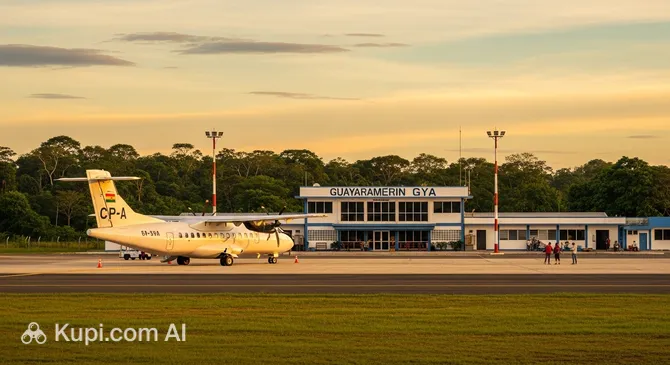
Guayaramerin Airport. Source: Kupi.com Binoculars

Guayaramerin Airport, officially named after Captain Emilio Beltrán, is not merely a transport hub but a true aerial gateway to the heart of the Bolivian Amazon. Located right on the border with Brazil, it welcomes travellers with thick tropical air and breathtaking views of the winding Mamoré River upon approach. This cosy provincial airfield is devoid of the bustle of giant hubs, offering guests an immediate immersion into the relaxed rhythm of life in the Beni Department.

IATA Code GYA
ICAO Code SLGM
City Guayaramerin
Distance to city centre ~2 km
Status Domestic
Annual Passengers No official data
Schedule

Despite its modest size, the airport plays a key role in the life of the region and offers a number of undeniable advantages for tourists:

  • Exceptional Accessibility: The airport is located practically within the city limits. The journey to the central square or the waterfront by taxi or motorcycle taxi takes no more than 5–10 minutes, eliminating the need for long transfers.
  • Gateway to Two Countries: This is an ideal arrival point for those planning to visit not only northern Bolivia but also the Brazilian city of Guajará-Mirim, located on the opposite bank of the river. The ferry crossing is very close by.
  • No Queues: Thanks to the low passenger flow, check-in and security procedures are lightning-fast. Here, you can forget about the stress typical of large international airports.
  • Scenic Approach: The flight to Guayaramerin is an excursion in itself. Planes often fly over vast green expanses of jungle and the river's water surface, providing excellent opportunities for aerial photography.

Contact Information

Guayaramerin Airport is a small regional aviation hub, and finding direct contact details can be challenging. Most flight-related issues are resolved through the airlines. Below is the main available information:

  • Official Website: The airport does not have a dedicated website. It is managed by the National Administration of Airports and Aerial Navigation Services of Bolivia (NAABOL).
  • Information Desk Phone: A single public number for inquiries is not provided. To clarify flight information, it is recommended to contact your airline directly.
  • Airport Address: Final Avenida Beni, Guayaramerin, Beni Department, Bolivia.
  • Email: An official email address for general inquiries is not published.
  • Social Media: The airport does not have official social media accounts.
  • Lost Luggage Information: For all issues related to lost or damaged luggage, please contact the Lost & Found service of the airline you flew with.
  • Passenger Support Contacts: To change a booking, purchase tickets, or order additional services, please contact your carrier's customer service.

How to Get to the Airport

Guayaramerin Airport (GYA) is located in the immediate vicinity of the city, making the journey to the terminal quick and simple. A trip from the centre of Guayaramerin will take very little time, allowing travellers not to worry about complex logistical routes in this part of Bolivia.

Taxis and Moto-taxis are the most common and convenient way to get to the airport. The city operates both standard car taxis and the more exotic and cheaper motorcycle taxis. A motorcycle taxi is ideal for a single passenger with light luggage. A trip by any type of taxi from the central part of the city usually takes no more than 10–15 minutes. It is important to remember to agree on the price with the driver in advance, as taximeters are rarely used.

Public Transport in the form of city buses (`micros` or `colectivos`) does not have a direct route to the airport. However, some routes may pass within walking distance of it. This is the most budget-friendly option, suitable for unpretentious tourists without bulky luggage who are ready for a little immersion in the local atmosphere. The fare is minimal, but convenience and predictability are inferior to taxis.

Car Rental may be advisable if you plan to explore the Beni region on your own. You can find services from local rental agencies in the city. Having your own transport will give you freedom of movement. The airport has a small car park, which is mainly used for short stops to drop off or pick up passengers. Possibilities for long-term parking should be clarified on-site, as they may be limited.

Terminals and Map

Guayaramerin Airport (GYA) is a small regional airport characterised by a simple and clear structure. Travellers need not fear complex navigation, as all infrastructure is housed in one compact terminal that serves both departing and arriving flights.

The airport layout is extremely simple. Once inside the building, you find yourself in the general hall. Here, the airline check-in counters and the main entrance to the security screening area are located. Since there is only one terminal, there are no transfers between terminals, making movement around the airport fast and intuitive.

The Departure Zone consists of a small waiting room after passing security control. Here, passengers await the boarding announcement for their flight. The Arrival Zone is also located in the same building and consists of a hall with a baggage claim belt. After collecting their belongings, passengers exit into the general hall where they can be met.

Due to the small size of the airport and low passenger flow, all pre-flight procedures, including check-in and security screening, usually pass very quickly. Nevertheless, it is recommended to arrive at the airport as standard — approximately 1.5-2 hours before departure, to complete all formalities without rushing.

The main recommendation for navigation is simple: it is practically impossible to get lost in Guayaramerin airport. All key zones — from check-in counters to boarding gates — are within sight. This is an ideal option for those who dislike the bustle of large aviation hubs and appreciate a calm start and end to their journey through Bolivia.

Airport History

The history of Guayaramerin Airport, officially known as Captain Emilio Beltrán Airport (Aeropuerto Capitán de Av. Emilio Beltrán), is primarily a story of overcoming geographical isolation. Its creation was dictated by the acute need to connect a remote border city with the rest of Bolivia, especially given that land routes through the jungle were and remain difficult and seasonal. Although the exact date of the airport's founding is not widely publicised, its appearance in the second half of the 20th century became a key factor for the development of the entire region.

The main stages of the airport's development focused on ensuring stable and all-weather air connectivity. Initially, it was likely a simple dirt runway. A major milestone in its history was the modernisation and paving of the runway, which allowed it to receive more modern turboprop aircraft, which are the backbone of regional aviation in the country. Thanks to its strategic location on the banks of the Mamoré River, right on the border with Brazil, the airport has always played an important role not only in civil transport but also in logistics and meeting state needs.

Although Guayaramerin Airport has not set world records or been the site of high-profile historical events, its main achievement is its daily and vital operation. For local residents, entrepreneurs, and the few tourists, it serves as the only fast and reliable gateway to other parts of the country. An interesting fact: its existence is a direct result of how important aviation is for the integration of the vast and inaccessible territories of the Bolivian Amazon. The entire history of this airport is the story of its indispensable role in the social and economic life of the whole region.

Services and Amenities

Guayaramerin Airport (GYA) is a small regional airport serving domestic flights. Due to its size, the range of passenger services is basic and quite limited. Travellers should prepare in advance for the fact that many amenities typical of large aviation hubs are absent here. The terminal has a main waiting area with seats and restrooms.

Possibilities for shopping and dining at the airport are extremely limited. You are unlikely to find full-service restaurants, cafes, or duty-free shops here. It is recommended to bring snacks and water with you or have a meal in the city before departure. Specialised VIP lounges or enhanced comfort waiting rooms are not available.

Access to Wi-Fi in the airport building is generally not provided. The same applies to charging stations for electronic devices — there may be very few or none at all. Passengers are advised to carry a portable charger (power bank). ATMs and currency exchange points are also absent within the terminal, so it is better to handle all financial matters in the city beforehand.

Specialised services, such as medical points, business centres, or conference rooms, are not provided at Guayaramerin Airport. Passengers with reduced mobility or families with small children should contact their airline in advance to clarify options for assistance during boarding and disembarkation. There are no hotels on the airport territory, but various accommodation options can be found in the city of Guayaramerin itself, located nearby.

Dining

When planning a snack at Guayaramerin Airport (GYA), it is important to remember that this is a small regional airport serving domestic flights. Consequently, the choice of catering establishments here is very limited and not comparable to large international hubs. The infrastructure is designed to meet the basic needs of passengers waiting for their flight.

Typically, a small cafe or buffet operates in the single terminal. It is located in the public zone before security control, so it is accessible to both departing and meeting passengers. Here you can purchase drinks — coffee, tea, water, soft drinks — as well as light snacks such as sandwiches, pastries, or crisps. This is a convenient option for a quick bite if there is little time left before departure.

Sometimes in such small airports in Bolivia, you can find traditional local pastries, for example, salteñas (hearty pastries with meat and vegetables) or empanadas. If you are lucky, this will be a great opportunity to try something authentic. However, do not count on a wide assortment of local cuisine dishes. Prices are usually slightly higher than in the city, which is standard practice for airports.

Specialised dietary options, such as vegetarian, vegan, gluten-free, or Halal dishes, are likely unavailable at Guayaramerin Airport. Passengers with strict dietary restrictions are strongly advised to bring food with them. For a full lunch or dinner, it is better to choose one of the establishments in the city of Guayaramerin before travelling to the airport. The opening hours of the local cafe are usually tied to the flight schedule, and it may be closed during quiet periods.

Traveler Tips

Travelling through Guayaramerin Airport can be simple and convenient if you prepare in advance. To avoid unnecessary haste, we have compiled several useful tips for passengers departing from or arriving at this airport.

Arrival Time and Check-in: Guayaramerin Airport is a small regional hub, so there are no crowds like in capital airports. Nevertheless, it is recommended to arrive approximately 2 hours before a domestic flight departure. This time will be sufficient to calmly pass check-in and pre-flight security screening. Have your passport and ticket ready — this will speed up the process.

Seat Selection: Most flights from Guayaramerin are operated on small aircraft. If you want to enjoy views of the Mamoré River and the endless expanses of tropical forests, choose a window seat. If freedom of movement is more important to you, then an aisle seat is your choice.

Hand Luggage: Standard security rules apply here as well. Liquids can be carried in containers up to 100 ml, packed in a transparent bag. Sharp and cutting objects are prohibited. Be sure to check the weight and dimension limits for hand luggage with your airline, as they may be stricter on regional flights.

Transfer Passengers: If you have a transfer planned, check in advance whether you will need to collect and re-check your luggage. In small airports, transit zones may be absent, and you will likely have to go through all procedures again. Allow sufficient time for the transfer.

Customs Control: Guayaramerin is on the border with Brazil, so customs checks can be thorough. When entering Bolivia, be prepared to declare expensive electronics. When leaving, remember the ban on exporting certain items, including specific types of plants and animals. If you bought souvenirs, keep the receipts.

Saving Time and Money: If possible, complete online check-in for your flight if your airline provides such a service. Infrastructure at the airport may be limited, so bring a water bottle (it can be filled after security) and a light snack. It is better to book a taxi or transport in advance to avoid overpaying on the spot.

In Case of Flight Delay: In the event of a flight delay or cancellation, first contact your airline representative for information. In small airports, the information desk may not work around the clock. Ensure that your hand luggage contains everything necessary for a long wait: a portable charger, a book, medication, and snacks.

Reached the end of the page?

That means the route is fully explored