Support

Oruro

About the Airport

Juan Mendoza Airport is not just a runway at the dizzying height of the Bolivian Altiplano. It is the main aerial gateway to the folkloric capital of Bolivia, the city of Oruro, and the starting point for exploring its unique culture. Located at an altitude of over 3,700 metres, it welcomes travellers with thin mountain air and the promise of incredible adventures. It is from here that the journey begins for many guests attending the famous Oruro Carnival, recognised as a UNESCO masterpiece.
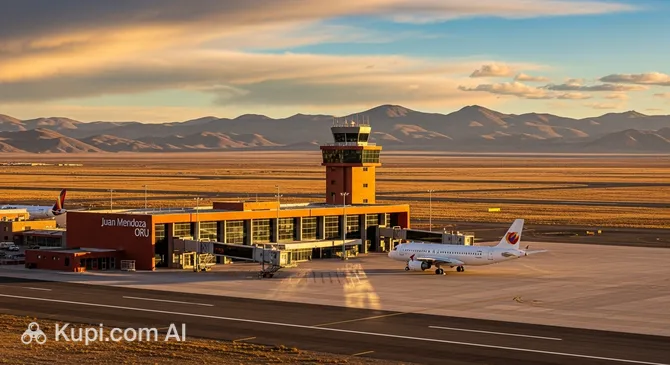
Oruro. Source: Kupi.com Binoculars
IATA Code ORU
ICAO Code SLOR
City Oruro
Distance to centre approx. 5 km
Status International
Annual passengers approx. 100,000
Popular Airlines Boliviana de Aviación (BoA), Ecojet

The main advantage of the airport is its strategic location. It is situated just a few kilometres from the centre of Oruro, making it the ideal arrival point for those wishing to visit the world-renowned Carnival. During peak carnival dates, the airport receives numerous charter and additional flights, becoming a bustling hub for tourists from all over the world.

Juan Mendoza Airport is relatively small, but modern and functional. Following renovation, it offers passengers all the necessary amenities for a comfortable wait, including small cafes and souvenir shops. Its compactness is actually a benefit: it is difficult to get lost here, and all procedures are completed quickly and without unnecessary fuss, which is particularly valuable at high altitude.

For travellers, the airport serves as a starting point not only for exploring Oruro, but also for trips across the region. From here, it is convenient to reach Sajama National Park with its majestic volcanoes or even begin a journey to the famous Uyuni Salt Flat, although this will require an additional ground transfer. The high-altitude location requires tourists to undergo acclimatisation — upon arrival, it is recommended to drink plenty of water and avoid strenuous physical exertion.

Contact Information

  • Official Website: Currently, the airport does not have a separate official website. It is recommended to check information with your airline or on the websites of aviation services in Bolivia.
  • Inquiry Service Phone: +591 2 527 7190. Before calling, we advise verifying the number as it may change.
  • Airport Address: Final Av. Héroes del Chaco, Oruro, Bolivia.
  • Email: An official email address for general enquiries is not published. For communication, it is better to use the telephone or contact your airline's representative office.
  • Social Media: The airport does not maintain official accounts on social media platforms.
  • Lost Luggage Information: For issues related to lost or damaged luggage, please contact the support service of the airline you flew with directly.
  • Passenger Support Service: For general information and assistance within the airport, please contact the information service via the phone number listed above.

How to Get to the Airport

Juan Mendoza Airport (ORU) is located very close to the city centre of Oruro, making the journey there quick and convenient. On average, a trip from the central part of the city to the terminal takes just 10–15 minutes by car, depending on traffic conditions. There are several ways to reach the airport, each with its own specific features.

Taxi and transfer — the most popular and convenient option for tourists. A car can be hailed on the street or ordered by phone (so-called "Radio Taxis", which are considered safer). The cost of the trip is low, but it is always recommended to agree on the price with the driver in advance to avoid misunderstandings. This is the ideal choice if you are travelling with luggage or value comfort.

Public transport in Bolivia is mainly represented by minibuses and buses known as "micros". This is the cheapest method of travel. Although there may not be a direct express route to the airport, some city buses pass in the immediate vicinity. This option is suitable for budget-conscious travellers without large luggage who possess basic Spanish skills to check the route with locals. There are no trains or metro systems in the city.

Car rental can be a good solution if you plan to explore not only the city but also its picturesque surroundings. Local and international rental agencies operate at the airport and in the city. Next to the Oruro airport terminal, there is parking where you can leave a car for both short and long periods. Please note that the driving style in Bolivian cities can be quite chaotic.

Since Oruro Airport mainly serves domestic flights, many travellers arrive at the country's larger international airports. The nearest ones are Jorge Wilstermann International Airport (CBB) in Cochabamba and El Alto International Airport (LPB) in La Paz, from where you can reach Oruro by intercity bus. Other options include airports in Sucre and Uyuni.

Terminals and Map

Oruro Airport (ORU), officially known as Juan Mendoza Airport (Aeropuerto Juan Mendoza), is a small and compact aviation hub. A key feature of its structure is the presence of only one terminal, which handles all flights, predominantly domestic ones. Thanks to this, navigation through the airport is intuitive and presents no difficulties even for inexperienced travellers.

The terminal is a simple single-storey building where all key zones are within walking distance. The airport layout is extremely logical: check-in counters and baggage drop-off are located at the entrance. Immediately behind them is the pre-flight security zone, leading to a small waiting hall (departure zone) with several boarding gates. The arrival zone is also integrated into this same building and includes a baggage claim belt and an exit to the general hall, where passengers are met and where taxis can be ordered. There are no transfers between terminals, as all operations are concentrated under one roof.

Completing all pre-flight formalities at Oruro Airport usually takes minimal time. Due to low passenger traffic, queues for check-in and security are generally small or non-existent. It is recommended to arrive at the airport approximately 1.5–2 hours before a domestic flight departure. This time is more than sufficient to check in, drop off luggage, and pass security control without rushing.

Orienting yourself in the terminal is extremely simple. Since all functional zones — from check-in counters to boarding gates — are clearly visible, it is practically impossible to get lost here. Information screens and signs are present, but most often it is enough to simply follow the flow of other passengers. The compact and logical structure of the terminal makes it very convenient for travellers, allowing them to avoid the stress associated with navigating large aviation hubs.

Airport History

The history of Oruro Airport, officially known as Juan Mendoza Airport (Aeropuerto Juan Mendoza), is inextricably linked with the development of aviation throughout Bolivia. It received its name in honour of the national hero and aviation pioneer Juan Mendoza, who in 1921 performed a historic feat — the first flight over the Bolivian Altiplano, taking off from Oruro. This bold act laid the foundation for future air travel in the region. The airport was officially opened and named after him in 1942.

For decades, the airport remained a modest regional airfield with a dirt runway, serving mainly small aircraft. Its role was important for connecting the mining centre of Oruro with the rest of the country, but its capabilities were severely limited.

Radical changes occurred in the 21st century. A key stage in the airport's history was a large-scale reconstruction and modernisation project, completed in 2013. As part of this project, a new asphalt runway approximately 4 kilometres long was built, a modern passenger terminal was erected, and new navigation equipment was installed. This modernisation allowed the airport to receive medium-haul jet aircraft, such as the Boeing 737 and Airbus A320. The main goal of the project was tourism development, primarily ensuring convenient access for thousands of guests arriving for the world-famous Oruro Carnival, recognised by UNESCO as a Masterpiece of the Oral and Intangible Heritage of Humanity.

Among interesting facts, it is worth noting that Oruro Airport is one of the highest airports in the world, located at an altitude of over 3,700 metres above sea level. Flights at such an altitude require special skill from pilots and special operational characteristics from aircraft. Today, Juan Mendoza Airport stands as a modern aerial gateway, symbolising both the heroic past of Bolivian aviation and its aspirations for the future.

Services and Facilities

Juan Mendoza Airport (ORU) in Oruro is a regional airport serving the city of the same name and acting as an important transport node in Bolivia. Despite its compact size, the terminal provides passengers with all necessary services for a comfortable wait before departure.

Dining and Shops. A small cafe operates in the airport where one can order beverages, light snacks, and local pastries. There are also several kiosks selling souvenirs, press, and travel essentials.

Waiting Halls and Amenities. A general waiting hall is equipped for passengers. Specialised VIP lounges or business class lounges are absent. Power outlets for charging mobile devices can be found in the terminal. Access to Wi-Fi may be limited, so it is better to check connection conditions on site.

Financial Services. ATMs for cash withdrawals are installed within the airport territory. A currency exchange point usually functions as well, however, its operating hours may not be 24/7. It is recommended to exchange the main amount of money in the city beforehand.

Additional Services. To provide urgent assistance, there is a medical point at the airport. Travellers with children can use the mother and child room. The terminal is equipped with ramps and special restrooms for passengers with reduced mobility.

Accommodation and Business Services. There are no hotels directly on the airport grounds; the nearest accommodation options are located in the city of Oruro. Conference rooms or business centre services are not provided at the airport.

Where to Eat

When planning a flight via Oruro Airport (ORU), it is important to consider that this is a small regional air station serving domestic flights. Consequently, the choice of dining establishments here is quite limited and cannot be compared with major international hubs. Nevertheless, passengers have the opportunity to have a snack before departure.

The main and, typically, the only place to satisfy hunger at the airport is a small cafe or buffet located in the general departure hall, before the security zone (landside). This establishment is oriented towards quick snacks. Here you can purchase sandwiches, pastries, such as traditional Bolivian empanadas (filled pastries), as well as crisps, chocolate, and other snacks. Available beverages include coffee, tea, water, and soft drinks.

For a more substantial lunch or dinner, it is recommended to eat at one of the numerous restaurants in the city of Oruro before travelling to the airport. Specialised dietary options, such as vegetarian, vegan, gluten-free, or Halal dishes, are practically impossible to find in the airport cafe. If you observe strict dietary guidelines, it is most reliable to bring food with you.

Prices at the airport are generally slightly higher than in the city but remain quite moderate. The cafeteria's opening hours are directly linked to the flight schedule: it opens a few hours before the first departure and closes after the last aircraft leaves. Therefore, at night or between flights, if they are scheduled with a long interval, the establishment may be closed.

Travel Tips

Planning a trip through the airport of Oruro, known as Juan Mendoza Airport (Aeropuerto Juan Mendoza), requires a little preparation. Given that this is a small regional airport, most processes here are faster than in large hubs. Nevertheless, by following a few simple tips, you will make your journey as comfortable as possible.

Arrival at the Airport and Check-in. For domestic flights within Bolivia, it is recommended to arrive at the airport 1.5–2 hours before departure. This time will be sufficient to pass check-in and security without rushing. If possible, check in for your flight online — this will save you time. Keep your passport or ID card and boarding pass ready.

Hand Luggage and Security. Rules for carrying hand luggage are standard. Liquids (shampoos, creams) can be carried in containers with a volume of no more than 100 ml, packed in a transparent bag. Sharp objects, weapons, and flammable substances are prohibited. Laptops and other large electronics are usually required to be removed from bags and placed in a separate tray for scanning.

Seat Selection and Transfers. If you want to enjoy views of the Bolivian Altiplano from above, choose a window seat. Aisle seats are more convenient if you need to stand up during the flight. If you have a connecting flight, immediately upon arrival at the next airport, check the boarding gate number and verify whether you need to collect and re-check your luggage — on domestic flights, it is often checked through to the final destination.

Customs Control. For international flights to Bolivia, you will need to fill out a customs declaration. Be sure to declare large amounts of cash, as well as any plant and animal products, to avoid fines. If you are flying on a domestic flight but arrived in the country from abroad, these rules remain relevant.

Saving Money and Unforeseen Situations. To save money, book a taxi from the airport in advance or use the services of official counters in the arrivals hall. Prices for food and drinks at airports are usually higher, so you can bring an empty water bottle and fill it after passing security. In case of a flight delay, first contact your airline representative for information about the new departure time and possible compensation (water, meals). Since the airport is small, there is little entertainment here, so bring a book or download films to your device in advance.

Reached the end of the page?

That means the route is fully explored