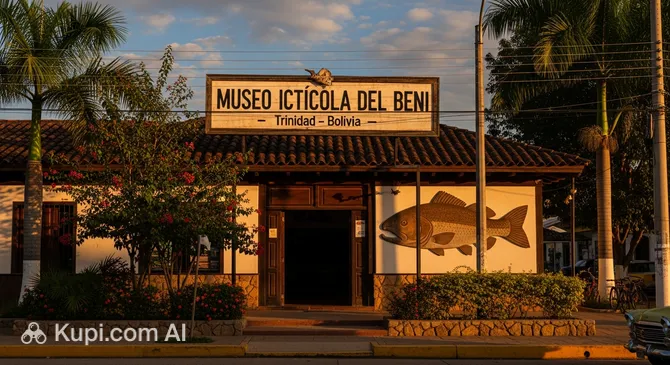
Have you ever wondered what secrets lie beneath the murky waters of the Amazon? In the heart of Trinidad is the unique Beni Ichthyological Museum (Museo Ictícola del Beni) — a place where the underwater world of the Bolivian Amazon comes to life. This specialized scientific and cultural institution is entirely dedicated to studying the rich fauna of the local rivers.
Beni Ichthyological Museum. Illustration.
Source: Kupi.com AI
Traveler photos:
The museum is rightfully considered one of the most important educational centers in the Beni department of Bolivia. Its collection includes hundreds of exhibits: from tiny exotic fish to the impressive inhabitants of the Mamoré River. Visitors often note the special atmosphere of this place, giving it high marks for its informative value and the uniqueness of the species presented.
This is not just an exhibition, but a true tribute to the biodiversity of tropical freshwater ecosystems. For any tourist interested in the nature of South America, a visit here is an excellent opportunity to see those who are usually hidden deep underwater, including legendary Amazonian predators and rare regional endemics.
Contacts
To ensure your visit to the Beni Ichthyological Museum goes as smoothly as possible, we recommend saving its location details in advance. This small but significant scientific institution is located in the central part of the city, making it easy to include in your walking route. Below are the official contact details for the organization.
The main activity at the Beni Ichthyological Museum is the detailed study of its extensive collection. Visitors can see professionally crafted taxidermy specimens, biological models, and herbaria that vividly demonstrate the diversity of life in the Mamoré River basin. Be sure to pay attention to the displays dedicated to the famous piranhas and other predatory inhabitants of the Amazon.
The museum offers excellent educational opportunities: information panels explain in detail the life cycles of fish, their habitats, and their role in the complex tropical ecosystem. It is an ideal place for a family visit, as even children will find it interesting to compare the sizes and shapes of the most unusual aquatic residents.
In addition to touring the halls, you can take interesting photos and learn about local conservation initiatives. Many tourists use a visit to this museum as an introductory primer before heading out on real expeditions to wild nature reserves like Chuchini, to later see some of the presented fish in their natural habitat.
Getting There
Reaching this unique museum is quite easy, as it is located in the Cercado district, right in the heart of Trinidad. If you are already in the city center, you can walk to the building from the main square or the city bus station in just a few minutes.
For those arriving in the city via Trinidad Airport (TDD), the most convenient way to get there is by taxi. The ride to the museum takes only about 10–15 minutes. If you are traveling through Bolivia by intercity bus (for example, from Santa Cruz), the museum is also easily accessible from the arrival terminal by local transport or taxi.
Tourists arriving in the region by water as part of cruises on the Mamoré River usually disembark at the port, which is located relatively close to the city center. From there, the Beni Ichthyological Museum is just a short trip away using local transport services.
Nearest city: Trinidad
History & Facts
The creation of the Beni Ichthyological Museum was driven by the need to systematize and preserve knowledge about the incredible biodiversity of the Bolivian Amazon. The Beni region is crisscrossed by a network of rivers and lagoons that have served as home to hundreds of freshwater species for centuries, many of which remain little-studied to this day.
The museum's collection has been built over decades through the efforts of Bolivian and international scientists. The foundation of the exhibition consists of materials gathered during numerous scientific expeditions. Although Trinidad itself was founded during the colonial period, the museum focuses specifically on the natural history of the region, allowing visitors to trace the evolution of local ecosystems.
Interestingly, some fish species displayed in the halls were mentioned as far back as the descriptions of the first travelers and explorers of the 16th century. The museum serves as a bridge between the past and the present, reminding visitors of the importance of preserving natural resources in the face of modern environmental challenges.
Time Needed
For a standard tour of the entire collection at the Beni Ichthyological Museum, most visitors need between 1 and 2 hours. This time is quite sufficient to leisurely study the information boards and examine the detailed fish models.
If you have a deep interest in biology or plan to photograph every rare specimen, your visit may last longer. Nevertheless, the museum is quite compact, making it very convenient to combine its visit with other excursions around Trinidad within a single day.
Working Hours
When planning your trip to the Beni Ichthyological Museum, keep in mind that it is open on weekdays. The museum's doors are open to visitors from Monday to Friday from 08:00 to 15:00.
The museum is closed on Saturdays and Sundays. Since schedules can change during holidays, we recommend checking for the most current information locally or through the official resources of the city of Trinidad when possible.
Day
Working hours
Monday
08:00–15:00
Tuesday
08:00–15:00
Wednesday
08:00–15:00
Thursday
08:00–15:00
Friday
08:00–15:00
Saturday
Закрыто
Sunday
Закрыто
Nearby
After getting to know the aquatic inhabitants of the Amazon, it is worth spending time at other interesting places in the vicinity. The city of Trinidad is full of small but atmospheric sites that help you better feel the spirit of this region of Bolivia.
Within walking distance of the museum, you can find monuments of local culture and cozy spots for strolls. Here is a list of some attractions located nearby: