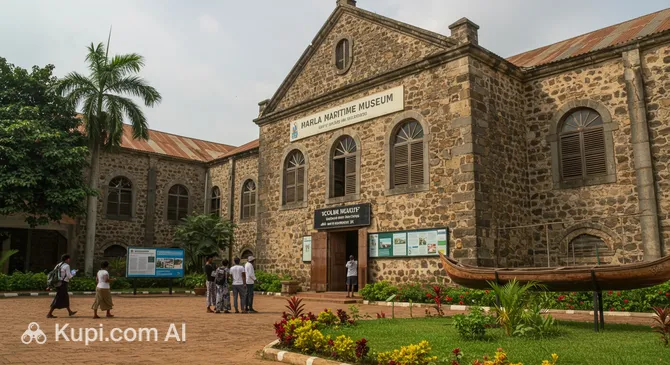
Located in the heart of the country's largest city, Douala, the Douala Maritime Museum (Musée Maritime de Douala) is a key cultural landmark for understanding the region's identity. Situated in close proximity to the bustling port, this modern institution carefully preserves evidence of Cameroon's centuries-old connection with the ocean.
Maritime Museum of Douala. Illustration.
Source: Kupi.com AI
Traveler photos:
The museum offers a unique exhibition dedicated to shipping, fishing, and maritime trade. Here, you can see everything from traditional wooden canoes used by coastal peoples to complex navigation instruments from centuries past. It is rightfully considered an important center for preserving the country's ethnographic heritage and maritime glory.
Visitors are drawn not only by the rich collection of artifacts but also by how the museum illustrates the region's economic development through the lens of human interaction with the elements. With a 4.1 rating, it is one of the city's most respected attractions, offering guests a harmonious blend of education and inspiration.
Contacts
To ensure your trip goes smoothly, we recommend saving the museum's contact details in advance. This will help you quickly find your way or clarify details regarding special exhibitions and events.
Below is the essential contact information for reaching the institution's administration and confirming your route:
Inside the museum’s halls, an exciting journey through the centuries awaits you. The main focus here is on the evolution of seafaring: you can examine intricately crafted ship models and antique instruments that once helped captains find their way across the vast waters of the Atlantic. Special attention should be paid to the section dedicated to traditional fishing, which features tools and everyday items from coastal communities.
In addition to the permanent collection, the museum frequently hosts craft exhibitions, paintings, and photography. These works by local artists add vibrant color to the maritime themes and offer a deeper feel for Cameroonian culture. Those interested in economics will find it fascinating to learn about the development of the Port of Douala—the heart of the country's commercial life, whose history is clearly illustrated through maps and archival documents.
Thanks to interactive elements, the visit will also be interesting for children, making the museum an excellent spot for family leisure. After finishing your tour of the exhibits inside, be sure to look at the modern port nearby—the contrast between the historical pirogues in the halls and the giant container ships outside the window leaves a powerful impression.
Getting There
Reaching this cultural center is easy, as it is located in a lively area near the Port of Douala. Taxis are traditionally considered the most comfortable and fastest way for tourists to get around—drivers know the location well, and the trip from central districts will take very little time.
If you are heading to the museum immediately after arriving in the country, the drive from Douala International Airport will take approximately 20–30 minutes, depending on traffic. For more precise navigation, it is convenient to use modern map services, searching for the address 1588, Douala.
Local public transport, including buses and popular moto-taxis, also runs in this direction. However, to ensure maximum safety and convenience, we recommend opting for licensed taxi services. Parking spaces are usually available near the entrance for visitors arriving in their own or rented cars.
Nearest city: Douala
History & Facts
The annals of this site are inextricably linked to the Age of Discovery. The history of Douala as a maritime hub began as early as the 15th century when Portuguese explorers entered the mouth of the Wouri River. Struck by the abundance of crustaceans, they named the river "Rio dos Camarões" (River of Prawns), which eventually gave its name to the entire country—Cameroon.
In the 19th century, the shores of Cameroon began to attract the attention of European missionaries and merchants. The German firm Woermann-Linie played a special role in the development of the port infrastructure. In 1881, following an agreement with local chiefs, large-scale construction began, transforming coastal villages into a powerful trading hub. It was during this period, under the leadership of Governor von Puttkamer, that the foundations of modern urban planning—including embankments, streets, and stations—were laid.
The museum carefully preserves the memory of how the settlement officially received the name Douala in 1907. The exhibits vividly demonstrate the region's transformation from simple fishing pirogues to giant ocean liners and a modern logistics system. It is a story of progress, trade, and the unbreakable bond between humanity and the water.
Time Needed
To immerse yourself in the atmosphere of maritime adventure and study all the details of the exhibition without rushing, a typical visitor will need about 1.5–2 hours. This time is quite sufficient to carefully examine the ship models, read the artifact descriptions, and see the temporary exhibitions.
If you have a deep interest in the history of navigation or plan to study archival photographs and maps in detail, your walk through the halls could take half a day. In any case, the museum does not require a full day to explore, making it easy to include in a busy city sightseeing itinerary.
Working Hours
The museum warmly opens its doors to visitors throughout the week, except on Mondays. From Tuesday to Friday, it is open from 09:00 to 17:30. On weekends—Saturday and Sunday—the schedule changes slightly, and guests are welcome from 12:00 to 17:30.
Since operating hours or entry conditions may change on public holidays, we strongly recommend checking the museum's official website before your visit to ensure the information is up to date.
Day
Opening hours
Monday
Закрыто
Tuesday
09:00–17:30
Wednesday
09:00–17:30
Thursday
09:00–17:30
Friday
09:00–17:30
Saturday
12:00–17:30
Sunday
12:00–17:30
Nearby
Exploring maritime history can be perfectly combined with visits to other interesting locations in the city. Douala offers many options for recreation, especially if you are traveling with family or looking for active entertainment after an educational excursion.
The area surrounding the museum is rich in amusement parks and leisure centers that will allow you to fully experience the rhythm of this African metropolis. Here is a list of nearby sites that might interest you: