Support

Ndjamena Airport

About the Airport

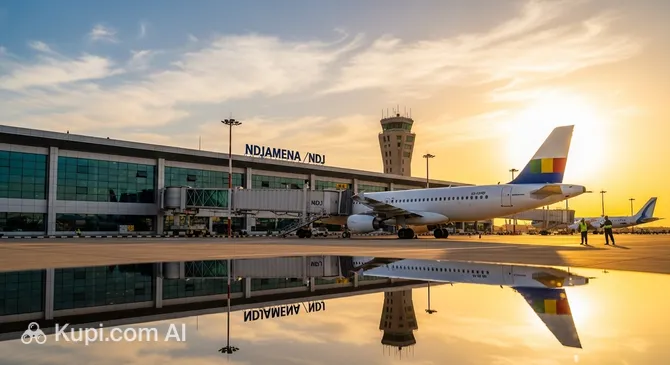
Ndjamena Airport. Source: Kupi.com Binoculars

N'Djamena International Airport (NDJ), also known as Hassan Djamous Airport, serves as the main and sole aerial gateway to Chad receiving international flights. It is not merely a transport hub but a strategic facility connecting this Central African nation with Europe, other parts of Africa, and the Middle East. The airport serves a dual purpose—civilian and military infrastructures are located on opposite sides of the runway, underscoring its importance to the country.

IATA Code NDJ
ICAO Code FTTJ
City N'Djamena
Distance to centre approx. 3 km
Status international
Annual passengers approx. 300,000
Popular Airlines Ethiopian Airlines, Air France, Turkish Airlines
Schedule N'Djamena Airport Online Board

Despite its modest size, N'Djamena Airport plays a key role in the region's transport system. It handles all passenger flights in a single terminal where travellers have access to basic amenities, including Duty-Free shops, currency exchange points, and cafes. Its convenient location, just a few kilometres from the city centre, makes it easily accessible—a taxi ride takes only a matter of minutes.

A significant feature is that a large-scale modernisation project was launched at the airport in early 2024. The renovation includes runway expansion and infrastructure upgrades in line with international standards, which will allow for a significant increase in passenger traffic and attract new airlines in the future. This indicates that the aviation hub is actively developing, striving to offer travellers a higher quality of service.

Contact Information

Getting in touch with representatives of N'Djamena Airport can be challenging, but below is the essential contact information that may be useful for travellers.

  • Official Website: At the time of writing this guide, the airport does not have a unified official website for passengers. It is recommended to check flight information directly with the airlines.
  • Information Desk Phone: +235 22 51 45 42. Please note that getting through may be difficult due to time differences and potential line congestion.
  • Airport Address: N'Djamena International Airport (NDJ), N'Djamena, Chad.
  • Email: A public email address for general inquiries is not provided. It is best to use the telephone for communication.
  • Social Media: The airport does not maintain official pages on popular social networks. Be cautious and do not trust unofficial sources.
  • Lost Luggage Information: If your luggage has been lost or damaged, you should immediately contact your airline's Lost & Found service, which has a counter in the arrival hall.
  • Passenger Support Contacts: For general questions not related to a specific flight, you can contact the information desk by phone. For booking queries, ticket changes, or special assistance, please contact your airline directly.

How to Get to the Airport

N'Djamena International Airport (NDJ) is located very close to the city centre, making the journey quick and convenient. The distance is only a few kilometres, so regardless of the chosen mode of transport, the trip will not take much time. However, transport options for tourists have their own specificities.

Taxi and Transfer — the most popular and recommended way to get to the airport. You can hail a taxi on the street, but be prepared to bargain, as meters are rarely used. It is extremely important to agree on the fare before the journey begins. A more reliable option is to book a transfer through your hotel or a local travel agency. This guarantees a fixed price and saves you from unnecessary hassle. A taxi ride from the city centre usually takes 10–20 minutes depending on traffic conditions.

Public Transport in the conventional sense (such as dedicated shuttle buses or trains to the airport) is absent in N'Djamena. Locals often use shared taxis and motorcycle taxis (clandos), but for tourists with luggage, this method can be uncomfortable and chaotic. If you are travelling light and wish to save money, this might be an option, but it requires knowledge of local routes and a readiness for adventure.

Car Rental — a good choice for those planning to move around the city and its surroundings independently. Several car rental companies have offices in the city. Keep in mind that the driving style in N'Djamena may be unfamiliar to foreigners, and the condition of some roads is less than ideal. There is parking at the airport where you can leave a car, but for long-term parking, it is better to clarify the conditions and security arrangements.

Terminals and Map

N'Djamena Airport (NDJ) has a fairly simple and clear structure, which facilitates navigation for passengers. The airport operates one main passenger terminal that serves both domestic and international flights. Thanks to its compact size, you will not have to cover long distances or use shuttles to move between different zones.

The terminal layout is intuitive. Typically, the check-in area and airline counters are located on the ground floor. After checking in for an international flight, passengers pass through passport control and security screening, after which they enter the departure lounge. The arrival area is also located in the same building. Upon arrival, you will proceed to immigration control counters, then to the baggage claim hall, and finally through customs inspection to the city exit.

Although the airport is small, it is worth allocating sufficient time to complete all formalities (check-in, passport control, screening). It is recommended to arrive at the airport at least 2.5-3 hours before an international flight and 1.5-2 hours before a domestic one. Sometimes procedures may take longer than expected due to manual document processing or an influx of passengers.

Navigation inside the terminal will not cause difficulties. Signs will help you orient yourself and find the necessary zones: check-in counters, boarding gates, or the baggage claim area. Airport staff are generally ready to assist if you have any questions. Since all operations are concentrated in one building, the risk of getting lost is minimal, making your stay at the capital airport of Chad reasonably comfortable.

Airport History

The history of N'Djamena International Airport (NDJ) is closely intertwined with the history of the capital and the state itself. It is not just a transport hub, but a facility with a significant past reflecting key stages in the development of Chad.

The airport was founded during World War II as the Fort Lamy Military Airbase (the former name of N'Djamena). In those years, it played a crucial strategic role, serving as a stronghold for the Free French Air Forces in this region of Africa. Its location allowed for the control of vast territories and the provision of logistical support for Allied operations.

After the end of the war and the country gaining independence in 1960, the airbase began to gradually transform into the country's main civilian airport. It officially received its current name—N'Djamena International Airport—in 1973, following the renaming of the capital. Despite the development of civil aviation, the airport never lost its military significance. A French military base is still located on its territory, making it a unique dual-purpose facility.

Throughout its history, the airport has undergone several stages of modernisation aimed at expanding the runway and updating terminal infrastructure to accommodate modern types of aircraft. Being the only international aerial gateway in the country, it plays a vital role in connecting this landlocked state with the rest of the world, ensuring passenger and cargo transportation.

Services and Amenities

N'Djamena International Airport (NDJ) is the main aerial gateway of Chad and provides passengers with all necessary services for a comfortable wait for their flight. Although the airport infrastructure may seem modest compared to major global hubs, everything needed to satisfy basic traveller needs is present here.

Restaurants, Cafes, and Shops. In the terminal, you will find several cafes and eateries where you can have coffee and a snack with sandwiches or local pastries. Small shops are also open, including a Duty Free zone where you can purchase souvenirs, perfumes, beverages, and travel goods.

Lounges and Wi-Fi. General waiting halls are equipped for passengers. Business class travellers or Priority Pass holders can use the services of the VIP Lounge, which offers more comfortable conditions, drinks, and snacks. Wi-Fi access at the airport may be limited, so it is worth checking the conditions on-site. Power outlets are available in the waiting halls for charging electronic devices.

Financial and Other Services. The airport building features currency exchange points and ATMs for cash withdrawals. In case of need, there is a medical station in the terminal to provide first aid.

Services for Passengers with Special Needs. Passengers with children and travellers with reduced mobility are recommended to contact their airline in advance. The carrier will organise accompaniment through the airport territory and provide necessary assistance during boarding.

Hotels and Business Services. There are no hotels directly within the airport, but several accommodation options are located in the immediate vicinity, within the city limits. Specialised business centres or conference rooms are absent in the terminal, however, basic services for business travellers may be available in the VIP Lounge.

Dining

When planning a snack or lunch at N'Djamena International Airport (NDJ), it is worth noting that the choice of establishments here is quite limited, which is typical for airports of this size. Nevertheless, travellers can find a few basic options to refresh themselves before departure.

Main Dining Areas:

The airport operates one terminal, and the main dining points are located in the public area (landside), accessible before passing passport control and screening. Here, you will usually find a small cafe or restaurant where you can order both light snacks and more substantial meals. This is the best place for a full lunch or dinner. After passing security control (airside), in the departure zone, the choice is typically limited to a small bar or kiosk offering drinks, sandwiches, and packaged snacks.

What to Try:

The menu mainly consists of simple international dishes: sandwiches, pastries, coffee, and soft drinks. Sometimes in the main cafe, you can find local dishes, such as brochettes (small meat skewers) or simple side dishes. For a quick bite, packaged snacks and drinks available at the kiosk in the departure zone are suitable.

Dietary Options and Prices:

Passengers with strict dietary restrictions (vegetarian, vegan, gluten-free) are strongly advised to bring food with them, as finding specialised dishes at the airport is practically impossible. Although Chad is a predominantly Muslim country, and meat in establishments is likely Halal, official certification is usually absent. Prices for food and drinks at the airport are significantly higher than in the city.

Opening Hours:

Establishments at N'Djamena Airport generally operate in accordance with the flight schedule, especially for international flights. They may open a few hours before departure and close after the last flight has departed. 24-hour operation is not guaranteed, so do not count on being able to eat late at night or early in the morning if there are no flights at that time.

Travel Tips

Travelling through the airport of the capital of Chad, the city of N'Djamena, requires certain preparation. Following these tips will make your trip more comfortable and predictable. The main rule is to allocate more time for all procedures than you are used to in major international hubs.

Arrival Time and Check-in. For international flights, it is recommended to arrive at the airport at least 3-4 hours before departure. Check-in and screening processes can be leisurely, and queues unpredictable. If online check-in is available, be sure to use it, but be prepared that luggage will still need to be dropped off at the general counter.

Passing Control. Keep all documents ready: passport, visa (if required), ticket, and Yellow Fever vaccination certificate. Security and customs officers may conduct thorough inspections. Remain calm, be polite, and answer questions clearly. When departing the country, be prepared to pay an airport tax if it was not included in your ticket price.

Hand Luggage and Seat Selection. Rules for hand luggage are standard: liquids no more than 100 ml in transparent packaging, no sharp objects. However, it is better not to risk it and pack all questionable items, including souvenirs, in your checked luggage. When choosing a seat on the plane, consider that a window seat will offer you views of the Chari River and surroundings during takeoff or landing, while an aisle seat provides more freedom of movement.

Transfer Passengers. If you have a connecting flight, be sure to verify with the airline representative at check-in whether your luggage will be transferred automatically. The transit area at N'Djamena Airport may be small with limited services, so be prepared for this.

Saving Money and Waiting. Prices for food and drinks at the airport can be high. To save money, have a snack beforehand and bring an empty water bottle, which can be filled after passing security (if you find a drinking fountain). Keep a small amount of local currency (CFA Franc) for minor expenses. In case of a flight delay, do not wait for detailed announcements. Proactively contact your airline representatives. It is useful to have a book, a charged power bank, and light snacks with you to pass the time.

Airports in nearby cities

Reached the end of the page?

That means the route is fully explored