Support

Baotou Airport

About the Airport

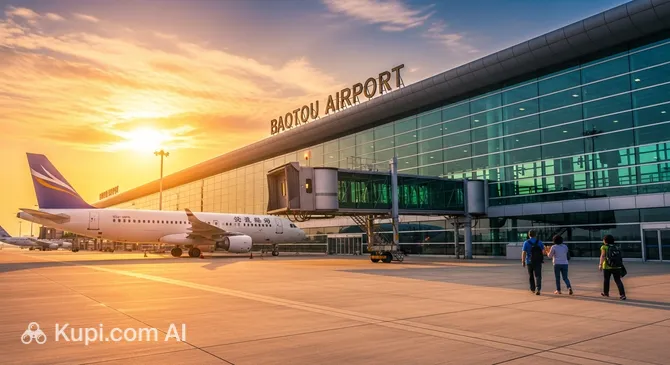
Baotou Airport. Source: Kupi.com Binoculars

Baotou Donghe International Airport is the main air gateway to one of the key industrial centres of China and the starting point for travel through the Inner Mongolia Autonomous Region. Formerly known as Erliban Airport, today it represents a modern and functional transport hub. Despite its compact size, the airport plays an important role in connecting Baotou with the country's largest cities, serving both business trips and tourist flows.

IATA Code BAV
ICAO Code ZBOW
City Baotou
Distance to centre about 23 km
Status International
Annual passengers over 2 million (pre-pandemic level)
Popular Airlines Air China, China Eastern Airlines, China Southern Airlines
Schedule Baotou Airport online flight board

The airport is classified as 4C and is equipped with a 2,800-metre runway capable of handling medium-haul aircraft such as the Boeing 737. The infrastructure includes two terminals: T1 serves international flights, and T2 serves domestic ones. Although the majority of traffic comes from domestic routes, the airport provides passengers with all necessary services for a comfortable journey. Travellers often note its efficiency: thanks to well-planned logistics, flight check-in and security screening take minimum time, making it a convenient point for beginning and ending a trip.

Contact Information

Below is the main contact information for Baotou (BAV) Airport. Please note that data may change, so we strongly recommend checking its validity on official resources before travelling.

  • Official website: It is recommended to find the current website via a search engine using the query "Baotou Erliban Airport official site". Chinese airport websites are often part of regional airport group portals.
  • Information desk phone: +86 472 517 5700. We advise verifying the number on the official website before calling.
  • Address: Donghe District, Baotou, Inner Mongolia, China (China, Inner Mongolia, Baotou Prefecture-level City, Donghe District).
  • Email: Generally, a feedback form on the official website is used to contact the airport rather than a direct email address.
  • Social media: Look for information about official accounts on popular networks (e.g., Weibo, WeChat) on the airport's website.
  • Lost luggage information: In case of loss or damage to luggage, contact your airline's representative office first. Contacts for the airport's Lost & Found service should also be listed on its website.
  • Customer support contacts: For general questions and enquiries, please use the airport information desk phone number.

How to Get to the Airport

There are several ways to get to Baotou Airport, located approximately 23 kilometres southeast of Baotou city centre. The choice of the best option depends on your budget, amount of luggage, and available time. The journey from the city centre usually takes about 30-40 minutes, but it is worth allowing extra time in case of traffic congestion.

Public transport is the most economical method. Special shuttle buses run from the airport to key districts of the city. This is a convenient option for travellers with a small amount of luggage. It is recommended to check routes and schedules in advance, as they may change. The fare for the bus is significantly lower than a taxi, making it attractive for budget-conscious tourists.

Taxi and transfer is the most comfortable and fastest way to reach the airport. A car can be ordered via a mobile app or hailed on the street. A "door-to-door" trip is particularly convenient if you are travelling with family or a large number of suitcases. It is recommended to ensure the driver has switched on the meter, or agree on a fixed price before the trip begins to avoid misunderstandings. This is the most time-predictable option.

Car rental is suitable for those who plan to move actively around the region and not depend on public transport schedules. Many international and local rental companies have counters at the airport. By renting a car, you gain complete freedom of movement to explore not only the city itself but also the surroundings in Inner Mongolia, one of the unique regions of China. For those arriving at the airport in their own or rented car, parking is provided. There are zones for both short-term and long-term parking.

Terminals and Map

Baotou Airport (BAV) represents a modern and compact aviation hub that is easy to understand even for a traveller visiting for the first time. Currently, the airport operates one passenger terminal complex which serves both domestic and international flights. Such a structure significantly simplifies navigation and minimises the time spent moving inside the building.

The terminal layout is logical and intuitive. Departure and arrival zones are clearly separated by levels:

  • Departure Zone is located on the upper level. Here you will find airline check-in counters, security checkpoints, and the main waiting lounge with boarding gates.
  • Arrival Zone occupies the ground floor. Passengers arriving in Baotou enter here after disembarking the aircraft. Baggage claim belts and customs control for international flights are located here.

Since there is effectively one main terminal flow, there is no need for transfers between different buildings. All procedures, from check-in to boarding the plane, take place within a single complex. Navigation through the terminal is facilitated by numerous signs in Chinese and English. If you have any questions, you can always approach the information desk, which is usually located in the central part of the check-in hall.

Regarding timing, passing through check-in and security at Baotou Airport usually takes less time than in major international hubs. Nevertheless, it is recommended to arrive at the airport well in advance: approximately 1.5-2 hours before a domestic flight and 2.5-3 hours before an international one. This time will be sufficient to drop off luggage without rushing, complete all formalities, and find your boarding gate.

Airport History

The history of Baotou Airport begins in the mid-20th century. Although an airfield existed on this site earlier for military needs, it was officially opened for civil aviation in 1956. In the first decades of its operation, it was a small regional airport serving a limited number of destinations and playing a modest role in the region's transport system.

The rapid industrial development of the city of Baotou and all of China in the late 20th century required a radical modernisation of the air harbour. The old infrastructure could no longer cope with the growing passenger flow and increased service quality requirements. The first significant expansion phase was carried out back in the 1980s, but the real breakthrough occurred in the new millennium.

A key moment in the modern history of the airport was a large-scale reconstruction completed in 2014. Within the framework of this project, a new, more spacious and modern passenger terminal was built, and the runway was extended. These improvements allowed for the reception of larger aircraft types and significantly increased capacity, transforming the airport into a modern transport hub compliant with international standards.

One of the important achievements in the airport's history was surpassing the mark of one million passengers per year, which confirmed its growing significance. Today, Baotou Airport is an important element of the infrastructure of the Inner Mongolia Autonomous Region, ensuring reliable connections with the country's largest cities and promoting the development of both business ties and tourism in this unique region.

Services and Amenities

Baotou Airport offers its guests all necessary services for a comfortable wait for their flight. Before departure or after arrival, you can have a meal in one of the restaurants or cafes, which serve both local dishes and familiar continental snacks. The airport shops feature a wide selection of souvenirs, travel goods, and locally produced products, allowing you to buy gifts at the last minute.

For those who value enhanced comfort, the terminal operates premium lounges and VIP zones. Here you can relax in silence, enjoy complimentary beverages and snacks, as well as fresh newspapers. Free Wi-Fi is available throughout the airport, and numerous charging stations for gadgets will help you stay connected. Financial matters can easily be resolved at bank branches or currency exchange points located in the public area.

The airport cares about the well-being of all passengers. In case of necessity, you can contact the medical point for first aid. For travellers with children, mother and child rooms are equipped where you can feed and change a baby in a calm environment. Passengers with reduced mobility are provided with all necessary assistance: special escort services, ramps, and equipped washrooms.

If you have a long layover or an early flight, several hotels of various price categories are located in the immediate vicinity of the airport. For business travellers who need to work or hold a meeting, the airport can offer business centre services or conference room rentals equipped with everything necessary for productive work.

Where to Eat

At Baotou Airport (BAV), travellers can find several options for a snack or a full lunch. Dining establishments are mainly concentrated in the main terminal building, and they can be found both in the public area before security control and in the sterile departure zone. This is convenient if you want to sit with people seeing you off or have a bite directly before boarding the flight.

The range of dishes includes both Chinese-style fast food establishments familiar to many, and cafes offering more substantial meals. Particular attention should be paid to places where you can try local cuisine. Although the selection may not be as wide as in the city, you have a chance to experience the gastronomy of Inner Mongolia. Look for noodles, lamb dishes, or traditional milk tea on the menu — this is an excellent way to form a final impression of the region before departure. Muslim travellers are advised to check for Halal certification at individual outlets.

For those in a hurry, coffee shops where you can grab coffee and pastries, or small eateries with instant noodles, will be the ideal choice. If time permits, you can settle into one of the restaurants with table service and enjoy a quiet lunch. The price range at the airport is generally higher than the city average, which is standard practice for air hubs.

Regarding special dietary needs, such as vegetarian, vegan, or gluten-free dishes, their availability may be limited. It is recommended to clarify the ingredients of dishes directly with the cafe or restaurant staff. Most establishments operate according to the flight schedule, opening early in the morning and closing after the departure of the last planes.

Travel Tips

When planning a departure from the airport of Baotou city, remember a few simple rules that will make your journey more comfortable. We recommend arriving at the airport in advance: for domestic flights — 2–2.5 hours before departure, and for international ones — at least 3 hours. Check-in counters usually close 40–60 minutes before the aircraft's departure, and it is better to have a time buffer in case of unforeseen queues.

To save time, check in for your flight online if your airline provides such an option. Security control at airports in China can be quite strict. Prepare all liquids for inspection in advance, and remove laptops and other large gadgets from your bags. This will help speed up the process for you and other passengers.

Pay special attention to carry-on luggage regulations. China has very strict requirements for portable chargers (power banks): they can only be carried in hand luggage, and they must clearly display a marking indicating the capacity. Lighters and matches are generally prohibited on board. Standard restrictions apply for liquids — containers up to 100 ml, packed in a transparent bag.

When choosing a seat on the plane, consider your priorities: a window seat will offer beautiful views during take-off and landing, while an aisle seat allows you to stand up freely without disturbing neighbours. Seats by emergency exits often offer more legroom. If you want to save money, bring an empty water bottle with you and fill it at drinking fountains after passing security control — this is much more economical than buying water at the airport.

Passengers transferring in Baotou should clarify in advance whether they need to collect their luggage and check it in again. Carefully follow the "Transfer" signs. Even for domestic transit, re-screening by security may be required. Use the waiting time to relax in the lounge area or have a snack in one of the cafes.

When passing through customs control (relevant for international flights), be ready to declare goods if their value or quantity exceeds established limits. If you are unsure, it is better to choose the "Red Channel" and consult with a customs officer. Information on prohibited import and export items is best studied in advance on official websites.

In case of a flight delay or cancellation, contact your airline representative first. They will provide current information and explain further actions. Depending on the length of the delay, the airline may be obliged to provide you with beverages, meals, or even hotel accommodation. Keep all receipts for unforeseen expenses — they may be needed to claim compensation.
Reached the end of the page?

That means the route is fully explored