Source: Kupi.com AI
| Characteristic | Value |
|---|---|
| IATA code | JRJ |
| City | Changting |
| Country | China |
| Time zone | Asia/Shanghai |
| Schedule | Online timetable |
| Characteristic | Value |
|---|---|
| IATA code | JRJ |
| City | Changting |
| Country | China |
| Time zone | Asia/Shanghai |
| Schedule | Online timetable |
Finding accurate and up-to-date contact information for regional airports like Ruijin (JRJ) can sometimes be challenging. We have gathered available data and recommendations to help you find your way.
Ruijin Airport is an important transport hub serving the city of Changting and surrounding areas in southeastern China. Since the airport is located some distance from the city centre, it is important to plan your route in advance. You can reach the terminal in several ways, each with its own advantages depending on your budget, time, and preferences.
Public Transport is the most economical option. Generally, special shuttle buses run between Ruijin Airport and key points in Changting city. This is a convenient way to reach your destination, although it is tied to a schedule. It is recommended to verify the current timetable and stop locations in advance, as they may change. A bus journey will take longer but will allow for significant savings.
Taxis and Private Transfers offer greater comfort and flexibility. This is the fastest way to get from the airport to the city or vice versa, especially if you have a lot of luggage. The journey from the centre of Changting to the airport will take approximately 1.5–2 hours depending on traffic conditions. You can use official taxis at the terminal (ensure the driver switches on the meter) or book a car via popular mobile apps in China. For maximum convenience and a fixed cost, it is recommended to book a private transfer in advance.
Car Rental is an excellent choice for those planning to travel actively around the region. Rental company offices can be found at the airport. This option offers complete freedom of movement, but it is worth remembering that foreign tourists usually require a local driving licence to drive in China. If you have all the necessary documents, you can easily reach Changting and explore the surroundings at your own pace. The airport provides parking where you can leave a car for both short and long terms.
When planning your journey, it is also worth considering flights to neighbouring airports that may offer more convenient connections or better fares. Among them are Liancheng Airport (LCX) in Longyan, Ganzhou Airport (KOW), and Ji'an Jinggangshan Airport (JGS), from where you can also reach Changting by ground transport.
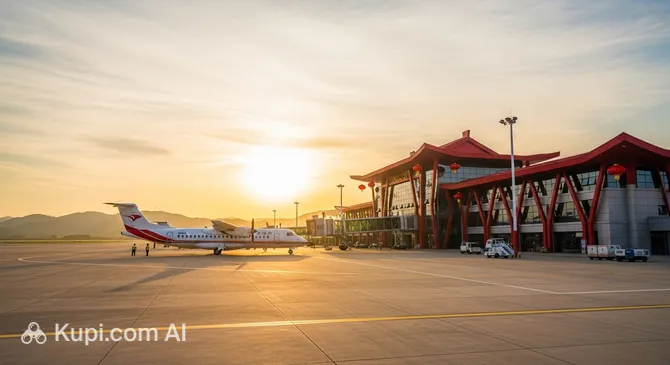
Ruijin Airport (JRJ) is a modern regional aviation hub distinguished by a simple and passenger-friendly structure. All flights, both departures and arrivals, are handled in a single passenger terminal. This significantly simplifies navigation and reduces the time required for pre-flight formalities.
The terminal building features a logical and intuitive layout. Typically, in airports of this type, the departure area with check-in counters and security checkpoints is located on one level or floor, while the arrival area with baggage claim is on another, most often on the ground floor. Thanks to its compact size and clear signage in Chinese and English, orienting yourself here is very easy, even if you are visiting for the first time.
Since the airport operates only one terminal, the issue of transfers between terminals is irrelevant — all services and boarding gates are located in one building. The departure zone is situated after passing security control and includes a comfortable waiting lounge with several boarding gates. The arrival zone is designed for quick baggage retrieval and exit to public transport or the car park.
Check-in and security screening at Ruijin Airport usually take minimal time thanks to its small size and the absence of the huge passenger flows typical of metropolises. Nevertheless, the standard recommendation is to arrive at the airport approximately 1.5–2 hours before the departure of a domestic flight. This time will be more than sufficient to check in luggage, pass all controls, and find your boarding gate without rushing.
The history of Ruijin Airport (JRJ) is, in essence, the history of the region's most modern stage of development. Being one of the newest aviation hubs in China, it commenced operations very recently. The official opening took place on 30 December 2023, marking a new era of transport accessibility for the southern part of Jiangxi Province and neighbouring territories.
The decision to construct the airport was driven by the need to stimulate the economy and tourism. The design and construction of the airport began in March 2021 and were completed within a tight timeframe. Its primary task is to ensure convenient connections with historically significant cities, such as Ruijin and the nearby Changting. Thus, the airport plays a key role in the regional development strategy.
Since Ruijin Airport has only just begun its operational activities, its history is not yet filled with high-profile events, records, or large-scale renovations. At present, it is a modern Class 4C complex with a runway length of 2,600 metres, designed with the future in mind. Its history is being written right now, with every takeoff and landing, and it has already become an important symbol of the region's growth and openness.
Ruijin Airport (JRJ) offers passengers all necessary amenities for a comfortable wait for their flight. Despite its relatively small size, the terminal is designed considering the needs of modern travellers. Here you can spend time peacefully before departure by utilising a wide range of services.
For those feeling hungry, the airport features cafés and small eateries where you can try local dishes or have a cup of coffee. Shops offer a range of travel essentials, souvenirs, and local delicacies that make excellent gifts from your trip. Free Wi-Fi is available throughout the terminal, and waiting halls are equipped with special zones featuring power outlets and USB ports for charging electronic devices.
For a more comfortable wait, passengers can utilise the services of VIP lounges. These offer a private atmosphere, complimentary beverages and snacks, newspapers, and typically separate business areas with access to office equipment. Financial services are represented by ATMs from several major banks. In case of need, a medical point operates around the clock at the airport, ready to provide first aid.
The airport is well-equipped for passengers with special needs. For families with small children, there are mother-and-child rooms equipped with changing tables. Passengers with reduced mobility can count on staff assistance when moving through the terminal, as well as use specially equipped restrooms and ramps. There are no hotels directly on the airport grounds, but many accommodation options can be found in Ruijin city itself, which is easily accessible by taxi or bus.
Ruijin Airport (JRJ) is a compact regional aviation hub, so the choice of dining establishments here is more modest than in large international hubs. Nevertheless, passengers can find several options to have a snack before departure or after arrival. The main dining points are concentrated in the main terminal building.
Primarily, you will find small cafés here offering Chinese cuisine. You can easily find popular fast-food options such as noodle soups, fried rice, dumplings (jiaozi), and steamed buns (baozi). While there may not be specialised restaurants featuring Jiangxi provincial cuisine, some establishments may offer simplified versions, such as hearty soups or rice and meat dishes. This is a good opportunity for a quick introduction to the region's gastronomy.
Most establishments are located in the public area (landside), before security control. The selection is usually larger here, and one can have a full lunch. In the secure area (airside), after passport control and screening, the choice is typically limited to one or two small cafés or vending machines with drinks and snacks, ideally suited for a quick bite right before boarding.
Travellers with specific dietary needs (vegetarians, vegans, or those observing a gluten-free or Halal diet) should be prepared for limited choices. Finding specially marked meals may be difficult. It is recommended to bring necessary snacks with you. Prices at the airport are traditionally higher than in the city but remain at an acceptable level for an air terminal. The opening hours of cafés and restaurants are usually tied to the flight schedule, opening in the morning and closing after the departure of the last aircraft.
To ensure your journey through Ruijin Airport goes smoothly and without unnecessary stress, it is worth familiarising yourself with a few useful tips in advance. Planning is key to a comfortable start or end to your trip to the city of Changting and other corners of China.
Arrival Time and Check-in. It is recommended to arrive at the airport at least 2–2.5 hours before the departure of domestic flights. This time is usually sufficient to complete all formalities without rushing. To save time, use online check-in if your airline provides this option. However, remember that luggage must still be dropped off at a separate counter.
Passing Security Control. Screening procedures at airports in China can be quite strict. Be prepared to remove laptops, tablets, and other large electronics from your hand luggage in advance. Particular attention is paid to power banks — their capacity must be clearly marked on the casing, and carriage in checked luggage is prohibited. Liquids are permitted in containers up to 100 ml, packed in a transparent bag.
Seat Selection and Hand Luggage. If it is possible to choose a seat during check-in, consider your preferences. Window seats offer beautiful views during takeoff and landing, while aisle seats allow you to stand up freely without disturbing neighbours. Do not place sharp objects, lighters, or other flammable substances in your hand luggage, aside from permitted liquids and electronics.
Tips for Transfer Passengers. If you have a connecting flight, clarify immediately upon arrival whether you need to collect and re-check your luggage. Follow the "Transfer" signs to your airline's counter or directly to the boarding gate if you already have a boarding pass for the next flight. Study the airport map in advance so as not to get lost.
Ways to Save. To avoid spending money on overpriced water, bring an empty bottle with you — after security screening, it can be filled at drinking fountains in the secure zone. also consider booking a taxi or transfer to the city in advance via online services. This often works out cheaper than taking a car upon arrival.
In Case of Flight Delay. If your flight is delayed, first contact an airline representative for information on the new departure time and possible compensation (water, meals). Remain calm and use the free time to rest, work, or explore the shops and cafés in the terminal. Having travel insurance may help cover unforeseen expenses.
Have you reached the end of the page?
So the route has been studied inside and out