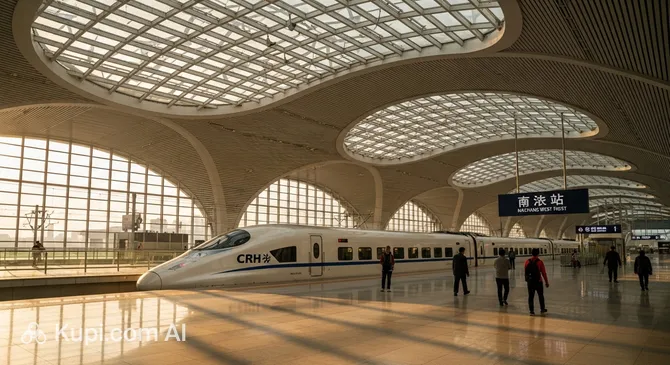
Nanchang Railway Station is a key transport hub in Jiangxi Province and one of the most significant points on the railway map of East China. Located in the Xihu District, this station welcomes thousands of passengers daily, serving both conventional trains and selected high-speed lines. The station building combines the monumentality of traditional Chinese architecture with modern functionality, serving as the main gateway to the city for many travellers.
It is important for passengers to know that the station covers a large area and spans several levels. The main waiting halls are located on the second floor, accessible via escalators from the main lobby. Navigation within the complex is duplicated in English, which helps in locating the correct platform or exit. An extensive station square is situated in front of the building, where city transport flows converge.
Contact Information
Official Website:www.12306.cn (China Railway unified portal)
Enquiry Phone: +86 12306 (unified hotline, English support may be limited)
Address: Erqi South Road, Xihu District, Nanchang, Jiangxi Province, China
Opening Hours: The station is open 24 hours, although ticket counters may have technical breaks during the night.
Luggage Storage: Automatic lockers and manual "Left Luggage" services are available, usually located near the entrance or in the waiting hall.
Accessibility: The station is equipped with lifts and dedicated restrooms for passengers with reduced mobility; it is recommended to contact staff in advance for boarding assistance.
How to Get There
Getting to Nanchang Railway Station is quite simple, as it is located within the city limits and is excellently integrated into the transport network.
The most convenient method is to use the Nanchang Metro. The Nanchang Railway Station stop is on Line 2. Metro exits lead directly to the station square or the underground level of the station, allowing you to avoid street traffic.
If you prefer a taxi, the journey from the city centre will take approximately 15–20 minutes, depending on traffic. Taxi stands are well-organised; simply follow the "Taxi" signs upon exiting. Additionally, numerous city bus routes run to the station, connecting it with all districts of the city.
Services and Amenities
The station in Nanchang offers a wide range of services for a comfortable wait. The main building houses spacious waiting halls equipped with ample seating. For those who value enhanced comfort, VIP lounges and zones for passengers with "Soft Seat" tickets are available.
Key amenities include:
Ticket Offices: Separate windows for exchanging electronic tickets and cash purchases (look for windows marked "English Speaking" if you do not speak Chinese).
Hot Water: Free dispensers with hot water for tea and noodles (a standard feature in Chinese stations).
Restrooms: Free washrooms and mother-and-child rooms.
Connectivity: Free Wi-Fi is available (a Chinese mobile number is often required for registration) as well as charging stations for mobile devices.
Where to Eat
It is difficult to stay hungry at the station. Inside the building and on the station square, there is a range of dining establishments. For a quick bite, international fast-food chains (such as KFC or McDonald's) are ideal, often operating from early morning until late evening. This is a reliable option with a familiar menu.
If you wish to try local cuisine, look for Chinese eateries offering noodles (including the famous Nanchang rice noodles) and rice dishes. The average cost in such places is quite reasonable. Additionally, the waiting halls feature convenience stores where you can purchase water, snacks, fruit, and instant noodles for your journey.
Station History
The history of Nanchang Station is inextricably linked with the development of China's railway network in the 20th century. The original station was built back in the 1930s, but the station acquired its modern appearance and scale much later.
A key stage was the massive reconstruction and expansion in the mid-1990s, coinciding with the opening of the strategically important Beijing — Kowloon (Hong Kong) railway line. This transformed Nanchang into one of the country's most important transit hubs. In recent decades, the station has been modernised repeatedly to accommodate growing passenger numbers and the introduction of high-speed trains, while retaining its role as the "heart" of Jiangxi Province's transport system.
Passenger Tips
When planning a trip through Nanchang, consider a few important points:
Arrive Early: It is recommended to arrive at the station at least 1–1.5 hours before departure. Security screening and identity checks are mandatory in China and may take time during peak hours.
Documents: International tourists must carry their passport. To enter the station and board the train, you are often required to pass through the Manual Lane, as automatic gates typically read only Chinese ID cards.
Luggage: Pay close attention to the list of prohibited items. Knives, scissors, aerosols, and flammable liquids (including unsealed beverages) may be confiscated during security checks.
Boarding: Boarding for the train stops 5 minutes before departure. Keep an eye on the display board for your train number, as gates open only after the train is announced.