Support

Biancheng (Xiangxi Biancheng) Airport

About the Airport

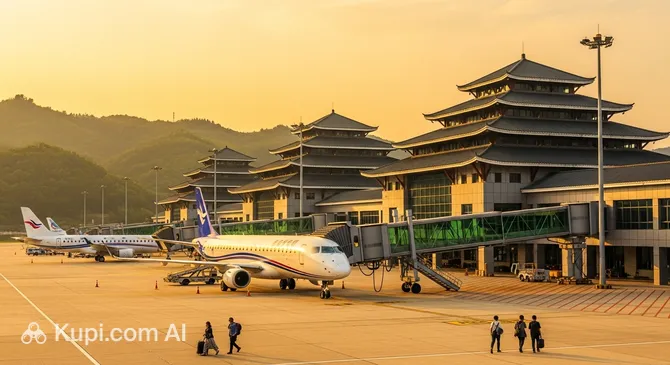
Biancheng (Xiangxi Biancheng) Airport. Source: Kupi.com Binoculars

Biancheng Airport is not merely a new transport hub, but a true aerial gateway to the mystical world of mountains and ancient legends of the Xiangxi region. Named after the famous novel "Border Town", this modern aviation hub harmoniously combines advanced technology with the unique cultural flair of the Tujia and Miao peoples. Upon descent, passengers are greeted by breathtaking views of emerald peaks, promising the start of an unforgettable journey through one of the most picturesque corners of China. The airport is designed to immerse travellers in an atmosphere of tranquillity and natural beauty from their very first minutes.

IATA Code DXJ
ICAO Code ZGSX
City Qianzhou (Xiangxi)
Distance to Centre ~35 km
Status Domestic
Annual Passengers ~300,000 (design capacity)
Schedule Recommended to check airline websites

Airport Features and Highlights:

The main advantage of Biancheng Airport is its novelty and modernity. Opened in 2023, the terminal is equipped with state-of-the-art technology, ensuring a swift passage through all pre-flight formalities without the unnecessary hustle and queues typical of large metropolises.

The architectural appearance of the complex deserves special attention. The terminal building incorporates elements of the traditional "Diaojiaolou" style (stilt houses), characteristic of the ethnic minorities in this region. This turns the airport into the first attraction tourists encounter upon arrival.

Its strategic location makes it an ideal starting point for travel. The airport is situated at a convenient distance from the region's main tourist gems, such as the ancient town of Fenghuang and the famous Aizhai Bridge, allowing for significant time savings on transfers along mountain roads.

Contact Information

  • Official Website: Currently, Xiangxi Biancheng Airport does not have a separate official website. It is recommended to check up-to-date information on flight schedules and services on the websites of airlines flying to Qianzhou.
  • Enquiry Service Phone: You can use the unified enquiry service for Hunan airports by calling +86-731-96777. Please note that service may be provided primarily in Chinese.
  • Airport Address: China, Hunan Province, Xiangxi Tujia and Miao Autonomous Prefecture, Huayuan County.
  • Email: There is no public email address for general passenger enquiries. It is recommended to contact the airline directly for communication.
  • Social Media: The airport does not maintain official pages on international social media platforms.
  • Lost Luggage Information: For all issues related to lost or damaged luggage, please contact the Lost & Found counter of your airline at the airport directly.
  • Passenger Support Contacts: To resolve issues regarding tickets, check-in, or special services on board, contacting your airline's support service directly will be most effective.

Getting to the Airport

Reaching Biancheng Airport from the city of Qianzhou, located in a picturesque region of China, is possible via several convenient methods. Depending on your budget, time, and preferences, you can choose public transport, a taxi, or a rental car. When planning your trip, consider that the airport is located some distance from the city centre, so we recommend allocating sufficient time for the journey.

The most economical way to get to the airport is via specialised shuttle buses. They run regularly between key points in the city and the passenger terminal. The journey usually takes about 40-60 minutes, but this time may vary depending on traffic conditions. This is an excellent choice for budget travellers. Tickets can usually be purchased immediately before departure at special counters or from the driver.

For those who value comfort and speed, a taxi or a pre-booked transfer is the ideal solution. A car journey from the centre of Qianzhou to Biancheng Airport will take approximately 30-40 minutes, excluding traffic jams. The cost will be significantly higher than the bus and is usually calculated by the meter. We recommend using official taxis or popular ride-hailing apps in China to ensure a fair price.

If you plan to actively explore the Xiangxi region, consider renting a car. This option offers maximum freedom of movement. Please note that foreign tourists often require a Chinese driving licence to drive in China, so it is worth clarifying all formalities in advance. The airport itself provides convenient parking where you can leave your car for both short and long periods.

To summarise: the bus is the most budget-friendly option, the taxi is the fastest and most comfortable, and car rental is the best choice for independent travellers. Whichever method you choose, we advise setting off early to complete check-in and pre-flight security checks without rushing, starting your journey with positive emotions.

Terminals and Map

Biancheng Airport (DXJ), serving the Xiangxi region, is a modern and compact aviation hub. Its infrastructure is designed with passenger convenience and speed of service in mind, making it very straightforward even for first-time visitors.

Currently, the airport operates one passenger terminal, which handles all domestic flights. Thanks to this, there is no need for long walks or using shuttles to move between different parts of the airport. All navigation takes place within a single building.

The terminal layout is quite simple and intuitive. As in many modern airports, the departure and arrival zones are separated by levels:

  • Departure Zone is usually located on the upper floor. Here you will find airline check-in counters, security checkpoints, and boarding gates.
  • Arrival Zone is located on the lower floor. Passengers arrive here after the aircraft lands. Baggage claim belts and exits to the taxi rank and buses are also located here.

Completing all formalities usually does not take much time. Since the airport is not overloaded with a huge number of flights, check-in and security procedures are quite swift. Nevertheless, it is recommended to arrive at the airport approximately 1.5-2 hours before a domestic flight departure to drop off luggage and pass security control without haste.

For convenient navigation, numerous signs in Chinese and English are installed throughout the terminal. Following them, you will easily find the necessary check-in counter, your boarding gate, or the baggage claim area. Information screens update flight status data in a timely manner, so do not forget to monitor them.

Airport History

The history of Biancheng Airport (Xiangxi Biancheng) does not stretch far back into the past — it is one of the youngest and most modern airports in China. Its story is primarily one of rapid regional development and a desire to make its unique beauties accessible to the world. The official opening of the air harbour took place quite recently, on 18 August 2023. This day became a major milestone for the entire Xiangxi prefecture, marking the appearance of the first civil airport in its history.

The project to create an airport in this picturesque but relatively remote corner of Hunan Province was approved in 2018. Construction was carried out over several years and became a massive undertaking aimed at stimulating tourism and economic growth. The airport was designed and built from scratch using the most modern technologies and aviation safety standards. Since it is brand new, it is too early to speak of significant renovations or modernisations — it is initially the embodiment of advanced engineering solutions.

One of the most interesting facts is related to the airport's name. "Biancheng" (边城) translates as "Border Town" — a direct reference to the famous eponymous novel by Chinese writer Shen Congwen, the action of which unfolds in these very lands. Such a name emphasises the airport's deep connection with the rich cultural heritage of the region, known for gems like the ancient town of Fenghuang.

The main achievement of Biancheng Airport to date is its very existence. It was built as a 4C-class airport capable of receiving medium-haul aircraft such as the Airbus A320 and Boeing 737. From its first days of operation, it has connected Xiangxi with direct flights to major cities in China, radically reducing travel time for tourists. In essence, the entire brief history of the airport is a story of how modern infrastructure opens a new chapter in the life of an entire region full of ancient traditions and incredible landscapes.

Services and Amenities

Biancheng Airport (Xiangxi Biancheng) (DXJ), being a modern aviation hub, provides passengers with all necessary services for a comfortable wait for their flight. The terminal is designed with the needs of travellers in mind and offers well-thought-out infrastructure.

Dining and Shopping: Cafés and small restaurants are located in the airport, where you can try local dishes or have a cup of coffee before departure. There are also shops selling souvenirs, travel essentials, and regional products. The selection may not be as extensive as in major metropolises, but it covers the basic needs of passengers.

Lounges and Connectivity: For business class passengers and airline loyalty programme members, VIP lounges are available, offering a higher level of comfort, snacks, and drinks. Free Wi-Fi is available throughout the terminal, and charging stations for mobile devices are installed in waiting areas near boarding gates.

Additional Services: The airport has ATMs for cash withdrawal. A medical point is provided for emergencies. Travellers with small children can use the nursing room. The airport is fully equipped to serve passengers with reduced mobility, including ramps and special assistance upon request.

Accommodation and Business: Although there may not be a hotel directly on the airport grounds, various accommodation options can easily be found in nearby settlements and the city of Jishou. Specialised conference halls or large business centres are generally absent at the airport, but basic business services may be provided in VIP lounges.

Dining

Biancheng Airport (DXJ) is a small regional airport, so the choice of dining establishments here is not as wide as in major international hubs. Nevertheless, passengers can find several options for a snack or a full meal, mostly located within the single terminal building. Most cafés and restaurants are concentrated in the "airside" zone, after passing security control.

For those wishing to experience local cuisine, it is worth paying attention to the restaurant offering dishes from Hunan Province. The cuisine of this region is known for its bold and often spicy flavours. Here you can order hearty dishes featuring meat, fish, and vegetables with rice. This is a great option for a full lunch while waiting for a flight. If you do not like spicy food, please clarify this when ordering — the chef may be able to prepare a less piquant version for you.

If you are short on time, the best choice would be "fast food" style establishments or small cafés. In the departure zone, there is usually at least one spot where you can quickly order noodles or dumplings — a classic option for a quick, hot snack. There are also cafés serving coffee, tea, pastries, and sandwiches. In the public zone (landside), before check-in and security, the selection is usually limited to vending machines with drinks and snacks or a small shop.

Food prices at the airport are generally higher than the city average. Regarding dietary restrictions, finding specialised vegetarian, vegan, or gluten-free menus can be difficult. It is recommended to clarify the ingredients of dishes with staff or choose obvious vegetable side dishes. The opening hours of most establishments are tied to the flight schedule — they open with the first morning flights and close after the departure of the last evening one.

Travel Tips

To ensure your journey through Xiangxi Biancheng Airport goes as smoothly as possible, we have compiled several useful tips. Proper preparation will help save time, stress, and money, allowing you to focus on your upcoming holiday in the picturesque region of Qianzhou.

Arrival Time and Check-in: For domestic flights within China, it is recommended to arrive at the airport 2–3 hours before departure. This time is sufficient to drop off luggage, pass security control, and find your boarding gate without rushing. To save time, use online check-in on your airline's website if this option is available. This will allow you to proceed immediately to baggage drop or, if you are travelling light, to the security screening area.

Security Control and Hand Luggage: Security services in Chinese airports operate very thoroughly. Be prepared to remove all electronic devices from your hand luggage, including laptops, tablets, and power banks. Pay special attention to battery regulations: they must have clear capacity markings and be carried strictly in hand luggage. Lighters and matches are generally confiscated. Liquids are permitted in containers up to 100 ml, packed in a transparent bag.

Seat Selection and Transfers: If it is possible to choose a seat during check-in, consider your preferences. A window seat will offer you magnificent views of the mountain landscapes, while an aisle seat allows you to stand up and stretch your legs freely. Passengers with connections should clarify the procedure in advance: if you have a single ticket, luggage will likely be transferred automatically. If tickets are from different airlines, you will have to collect your luggage and check in for the next flight again.

Customs Control: When entering the country from abroad, you will need to fill out an arrival card. Sums exceeding 5,000 US dollars, as well as certain goods, are subject to declaration. Although Biancheng Airport primarily serves domestic flights, it is important to know these rules if you are arriving in the city after an international flight with a connection in another Chinese city.

Savings and Unforeseen Situations: To save money, bring an empty water bottle and fill it at drinking fountains after passing security. Prices for food and drinks in airports are traditionally higher. In case of a flight delay or cancellation, immediately contact your airline representative. Depending on the length of the wait, you may be provided with drinks, meals, or even hotel accommodation. Keep all receipts if you incur additional expenses.

Reached the end of the page?

That means the route is fully explored