Support

Yuncheng Airport

About the Airport

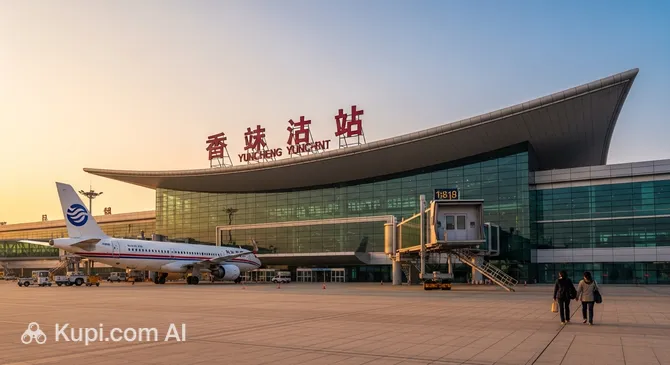
Yuncheng Airport. Source: Kupi.com Binoculars

Yuncheng Guangong Airport is the main air gateway to the Yuncheng urban district in Shanxi Province. The airport is named after Guan Gong, a legendary military general and one of the most revered figures in Chinese history, adding a distinct cultural touch. Opened in 2005, this modern airport complex serves as an important transport hub connecting the region with dozens of cities across China and several international destinations. The airport plays a key role in the development of tourism and the economy of the province, offering travellers a convenient starting point for exploring the rich heritage of this land.

IATA Code YCU
ICAO Code ZBYC
City Yuncheng
Distance to centre approx. 11 km
Status International
Annual Passengers 2,193,632 (2023)
Popular Airlines Air China, China Southern Airlines, Shenzhen Airlines
Schedule Yuncheng Airport online flight board

Despite its relatively small size, Yuncheng Guangong Airport offers passengers everything needed for a comfortable journey. The single terminal is well-organised, allowing for quick completion of all pre-flight formalities. For passenger convenience, there are basic facilities: several cafés, shops, and information desks. Transport links to the city are well-established — you can reach the centre of Yuncheng by bus or taxi in approximately 20–30 minutes. Thanks to an extensive network of domestic flights, the airport is a convenient starting point for further travel around the country, connecting Yuncheng with over 30 cities.

Contact Information

To resolve issues related to your journey through Yuncheng Guangong Airport (YCU), you can use the following contact details. We recommend saving important phone numbers and addresses before your trip.

  • Official website: www.yunchengairport.com.cn. Please note that the website is primarily in Chinese.
  • Information desk phone: +86 359 258 1456. Language barriers may arise when calling, as staff primarily speak Chinese.
  • Address: Guan Gong Street, Yanhu District, Yuncheng, Shanxi, China.
  • Email: A direct email address for general enquiries is not published. It is recommended to use the phone or the feedback form on the official website if available.
  • Social media: Links to the airport's official social media accounts, if available, should be sought on its official website.
  • Lost & Found: In case of lost checked luggage, please contact your airline's representative first. If you have left personal belongings in the terminal building, contact the airport information desk at the phone number listed above.
  • Passenger support service: On-site assistance can be obtained at the information desks located within the airport terminal.

How to Get to the Airport

Getting to Yuncheng Guangong Airport (YCU) from Yuncheng city centre is quite simple, as it is located just 11 kilometres northeast of the city. Travellers can choose from several convenient methods depending on their budget, time, and preferences.

Taxi or pre-booked transfer — the fastest and most comfortable way to get to the airport. The journey from the city centre usually takes about 20-30 minutes, but time may vary depending on traffic conditions. Taxi fares are generally quite affordable. It is recommended to ensure the driver turns on the meter or to agree on a price in advance. Booking a transfer through your hotel or an online service can be convenient if you are travelling with a lot of luggage or in a group.

Public transport in China is well-developed, and Yuncheng Airport is no exception. This is the most economical option. Special bus routes connect the airport with key points in the city, including the railway station and central districts. The bus journey will take approximately 40-60 minutes. It is best to check the schedule and exact routes upon arrival, as they may change.

For those preferring maximum freedom of movement, car rental is available. Several car rental companies have offices both at the airport and in the city itself. However, it is worth remembering that foreign tourists generally require a local driving licence to drive in China, and international permits may not be valid. If you are arriving at the airport in your own or a rented car, parking is at your service. There are zones for both short-term and long-term parking.

Terminals and Map

Yuncheng Guangong Airport (YCU) is a modern and relatively compact aviation hub serving domestic flights across China. Its structure is simple and intuitive, making navigation easy even for first-time visitors.

The airport operates two passenger terminals — T1 and T2. The main passenger flow goes through the new and modern Terminal 2 (T2), which was built to increase capacity. The older Terminal 1 (T1) may be used for some regional or charter flights, as well as for special purposes. Most travellers will be using T2.

The layout of Terminal 2 is logical and simple. The ground floor usually houses arrival zones, check-in counters, and baggage claim. The first floor is dedicated to the departure zone, where security checkpoints and boarding gates are located. Due to the airport's small size, transitions between key points — from the entrance to check-in counters and from security to the gate — take minimal time. Signs are in Chinese and English, which significantly facilitates orientation.

Departure and arrival zones are clearly separated. In the departure zone, after check-in and luggage drop-off, passengers go through standard security screening. The waiting hall is comfortable enough, although the choice of shops and cafés may be limited compared to major international hubs. The arrival zone includes baggage claim belts and an exit to the city, where you can find taxis or other transport.

One of the main advantages of Yuncheng Airport is the speed of procedures. During normal times, check-in and security screening take no more than 30-45 minutes. Nevertheless, it is recommended to arrive at the airport at least 1.5-2 hours before a domestic flight to avoid rushing, especially during peak hours or national holidays.

Airport History

Yuncheng Guangong Airport (YCU) is the modern air gateway to the historic Shanxi region in China. Although it is a relatively young airport, its history reflects the rapid development of the region and its deep cultural roots. Construction of the airport began in 2002, and the official opening for commercial flights took place in February 2005, which was an important step in improving transport accessibility for the city of Yuncheng and its surroundings.

One of the most interesting features of the airport is its name — Guangong. It is named after Guan Yu (Guan Gong), a legendary general of the Three Kingdoms period, who is revered in Chinese culture as a deity of war and a symbol of loyalty. He was born in this very region, and the airport's name serves as a tribute to this great historical figure, immediately immersing arriving tourists in the rich past of the area.

Since its opening, the airport has undergone several key stages of modernisation. The first major reconstruction was completed in 2012: a new terminal T2 was built, and the runway was extended to 3,000 metres. This allowed it to accommodate larger aircraft, such as the Boeing 737 and Airbus A320, and significantly expand the route network. An important achievement was receiving international airport status in 2014, after which flights to Hong Kong were launched, followed by other countries, such as Thailand.

Yuncheng Airport has demonstrated impressive passenger growth rates, surpassing the 1 million passenger mark in 2016 and 2 million just two years later, in 2018. In recent years, further expansion projects have been launched, including plans to build a third terminal and a new runway to achieve class 4E status, which will allow it to handle long-haul wide-body aircraft and strengthen its position as an important transport hub in North China.

Services and Facilities

Yuncheng Airport (YCU) is a modern and well-equipped transport hub offering passengers all necessary services for a comfortable start or end to their journey across China. Conditions have been created within the terminal to ensure that waiting for a flight is as pleasant and carefree as possible.

You can refresh yourself before your flight in one of the cafés or restaurants, serving both local cuisine and more familiar international snacks. In the shops, you will find souvenirs, daily necessities, newspapers, and gifts. This is a great opportunity to buy something to remember your trip to Yuncheng.

For those for whom staying connected is important, free Wi-Fi is provided throughout the airport. Charging stations for mobile phones and other gadgets are also installed in the waiting halls. Passengers preferring enhanced comfort can use the services of VIP lounges, where beverages, snacks, and fresh newspapers are offered in a quiet atmosphere.

Basic financial services are available at the airport: you will easily find ATMs and can use currency exchange points. In case of illness or the need for first aid, a medical centre operates in the terminal, where you can seek qualified assistance.

The airport cares about the comfort of all passengers. Mother and child rooms are provided for families with small children. A barrier-free environment has been created for passengers with reduced mobility: ramps, lifts, and specially equipped toilets. Airport staff are always ready to provide necessary assistance and escort.

Basic business services may be available for business travellers. If you have an early departure or a long layover, there are several hotels located in the immediate vicinity of the airport where you can rest comfortably.

Dining

Yuncheng Airport (YCU) offers passengers a basic but sufficient selection of establishments to grab a snack before departure or upon arrival. Dining options are concentrated in the main terminal building and are oriented towards both quick bites and more substantial meals with a focus on local cuisine.

Most cafés and small restaurants are located in the public area before security control (landside), but there are a few dining points in the secure departure zone (airside). Here you will find establishments offering Chinese cuisine, particularly noodles, dumplings, and rice dishes with various toppings, as well as coffee shops with pastries, sandwiches, and beverages. Since Yuncheng is in Shanxi Province, famous for its love of noodles, it is highly recommended to try one of the local dishes if you have time for a full meal.

For those looking for specific dietary options, such as vegetarian, vegan, or gluten-free dishes, choices may be limited. In Chinese restaurants, you can ask for rice with vegetables prepared, but finding certified Halal or vegan establishments in an airport of this size is unlikely. The most reliable option for a quick snack would be fruits or packaged snacks from convenience stores.

Food prices at the airport are generally higher than in the city but remain at a moderate level. Most establishments open early in the morning and operate until the last flight departs, adjusting to the flight schedule. Coffee shops and mini-markets are suitable for a quick snack, while local restaurants are good for a hearty lunch where you can leisurely enjoy traditional noodles.

Travel Tips

To ensure your journey through Yuncheng Airport is as comfortable and stress-free as possible, take advantage of these useful tips. Planning is the key to a successful trip!

Arrival time at the airport: We recommend arriving at the airport at least 2 hours before a domestic flight and 3 hours before an international one. This time will be sufficient to check in, drop off luggage, and complete all pre-flight formalities without rushing.

Check-in and security: To save time, use online check-in if your airline provides this option. Security screening procedures in China airports can be strict. Remove all metal items from your pockets in advance, and take laptops and other large gadgets out of your hand luggage.

Seat selection on the plane: Want to admire the clouds and views during takeoff and landing? Choose a window seat. If the ability to stand up freely and stretch your legs is more important to you, your choice is an aisle seat. Seats in the emergency row offer more space but may be available for an additional fee and have certain restrictions.

Hand luggage: You can carry liquids in containers of no more than 100 ml each in your hand luggage, packed in a single transparent bag. Pay special attention to power banks — they must be carried in hand luggage only, and must have a clear label indicating capacity. Carrying lighters and matches is generally prohibited.

Transit passengers: If you have a connecting flight, check with the airline in advance whether you need to collect your luggage and check in for the next flight again. In the transit zone, follow the "Transit" or "Transfer" signs to quickly find your required gate.

Customs control: Upon arrival on an international flight, you will have to go through customs control. Fill out all necessary documents (e.g., arrival card) clearly and in advance. If you have goods subject to declaration, be sure to inform the customs officer.

Saving time and money: To save money, explore options for getting from the airport to the city by public transport. Bring an empty water bottle with you and fill it after passing security — this is cheaper than buying expensive water in the departure zone.

Flight delays: In case of a flight delay, remain calm. Monitor information on the departure boards and in your airline's app. Contact the carrier's representative to find out about your rights to beverages, meals, or hotel accommodation during long delays.

Reached the end of the page?

That means the route is fully explored