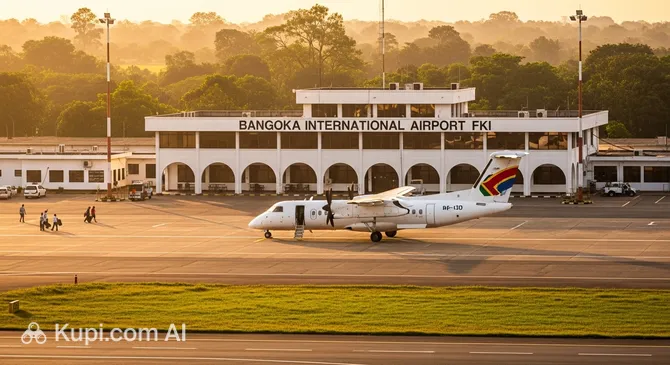
Source: Kupi.com AI
| Characteristic | Value |
|---|---|
| IATA code | FKI |
| ICAO code | FZIC |
| City | Kisangani |
| Country | Congo Democratic Republic Of |
| Time zone | Africa/Lubumbashi |
| Schedule | Live departures board |
| Characteristic | Value |
|---|---|
| IATA code | FKI |
| ICAO code | FZIC |
| City | Kisangani |
| Country | Congo Democratic Republic Of |
| Time zone | Africa/Lubumbashi |
| Schedule | Live departures board |
Finding precise and up-to-date contact information for Bangoka Airport (FKI) can be challenging, as many regional airports do not have centralised public enquiry services. Here are the most complete details available to date:
Getting to Bangoka Airport (FKI) from the city centre of Kisangani, located approximately 17 kilometres away, can be done in several ways. Given the specifics of the transport system in Congo (DRC), it is recommended to plan your trip in advance. On average, the journey to the airport takes 30 to 60 minutes, although this time can increase significantly depending on road conditions and traffic.
Taxi and Private Transfer — this is the most reliable and convenient way to reach the airport for tourists. You can arrange a transfer through your hotel or use the services of local licensed taxis. It is strongly recommended to agree on the fare in advance to avoid misunderstandings upon arrival. A pre-booked transfer ensures not only a fixed price but also greater safety and comfort, especially if you have a lot of luggage.
Public Transport in the form of shared minibus taxis and motorcycle taxis is the most budget-friendly option. However, it is suitable mainly for experienced and undemanding travellers. Such transport lacks a strict schedule, is often overcrowded, and makes numerous stops along the way. This method is not recommended for tourists with large luggage or those travelling to Kisangani for the first time.
Car Rental is also possible, but note that self-driving can be difficult due to the specific local traffic and road conditions. A more practical alternative is renting a car with a driver, which is essentially analogous to a private transfer. For those who still decide to drive their own or a rented car, parking is available at Bangoka Airport. It is recommended to check the conditions and safety of long-term parking in advance if required.
Bangoka Airport (FKI) consists of a single passenger terminal that serves both domestic and international flights. Thanks to its compact size and simple layout, navigating the airport poses no difficulties even for those visiting for the first time. All key zones are within walking distance of each other.
The terminal structure is intuitive. Departure and arrival zones are clearly demarcated. Upon entering the building, you find yourself in a general hall with airline check-in counters. After receiving a boarding pass and checking in luggage, passengers proceed to the security screening and passport control area, and then to the departure lounge. Since all operations are concentrated in one building, there is no need for transfers between terminals. This is the main air hub for the city of Kisangani and an important gateway to this region of Congo (DRC).
The arrival zone is located separately and includes immigration control counters, a baggage claim belt, and a customs inspection area. The terminal infrastructure offers a basic set of services: a small waiting area and a few kiosks selling drinks, snacks, and souvenirs. Do not expect a wide variety of shops or restaurants here as found in major international hubs.
Regarding the time required to complete formalities, it is recommended to arrive at the airport well in advance. For international flights, it is best to arrive 2.5–3 hours before departure, and for domestic flights — 1.5–2 hours. Although the airport is small and long queues are rare, a time buffer will allow you to avoid rushing and pass through all control stages calmly.
To navigate the terminal, simply follow the standard signs in English and French. A key tip is not to leave security and passport control until the last moment, as processing speeds can vary. Overall, the simplicity and logical layout make Bangoka Airport convenient for travellers.
The history of Bangoka International Airport (FKI) is inextricably linked with the turbulent history of the city of Kisangani and the entire Democratic Republic of the Congo. The airport was built during Belgian colonial rule in the mid-20th century, when the city was named Stanleyville. From the very beginning, it played a key role in the region's transport system, serving as an important hub connecting remote areas of the Congo River basin with the rest of the world.
The most dramatic pages of the airport's history occurred in the 1960s, during the Congo Crisis. The airport repeatedly became a strategic object over which battles were fought. In 1964, it found itself at the centre of global attention during Operation Dragon Rouge — a large-scale humanitarian mission to rescue hostages, which used the airfield as its main base. Later, in 1967, the airport again became the scene of fierce clashes during the so-called "Six-Day War" involving mercenaries.
Throughout its history, Bangoka Airport has undergone several stages of modernisation, although many were dictated more by military and humanitarian necessity than by the planned development of civil aviation. In various years, work was carried out to strengthen and lengthen the runway, as well as to update navigation equipment. The airport was actively used by UN peacekeeping missions, which also contributed to maintaining its infrastructure in working order.
Today, Bangoka Airport remains the most important air gateway for the north-east of the DRC. An interesting fact: its history is a vivid example of how a civilian facility can turn into a key arena for historical events while retaining its primary function — connecting people. Despite all difficulties, it continues to serve both passenger and cargo flights, playing an indispensable role in the life of the region.
At Bangoka Airport (FKI), passengers have access to essential services required for a comfortable wait before their flight. Dining options are usually represented by a few cafes and refreshment areas where one can have a snack, drink coffee, or purchase light bites. Small shops are also available within the terminal, selling souvenirs, travel essentials, and newspapers.
For a more comfortable wait, general lounges are available. It is best to check the availability and access conditions for VIP lounges in advance with your airline representatives. Access to Wi-Fi may be limited, and charging stations for mobile devices are infrequent, so it is recommended to carry a portable power bank.
Currency exchange points operate within the airport territory, and ATMs may be installed for cash withdrawals. In case of need, passengers can visit the medical point for first aid. Standard assistance is provided for travellers with children and passengers with reduced mobility. To request an escort or wheelchair, you must notify your airline in advance.
There are no hotels within the airport building; however, travellers can find accommodation options in the city of Kisangani, located nearby. Specialised business centres and conference rooms are generally not provided, as the airport is primarily oriented towards passenger transport.
When planning travel through Bangoka International Airport (FKI) in Kisangani, it is important to understand that this is a small regional airport. Dining opportunities here are quite modest and not comparable to major international hubs. Nevertheless, you will be able to find basic options for a snack before departure.
In the airport's single terminal, there is typically a small cafe or kiosk operating. Most often, such establishments are located in the general area (landside), accessible before passing through security control. The assortment usually includes simple snacks, pastries, soft drinks, bottled water, tea, and coffee. Sometimes you can find simple local dishes, such as fried plantain, brochettes (small skewers), or sandwiches.
For passengers requiring a full meal, it is recommended to eat in the city of Kisangani before arriving at the airport. Options for people with specific dietary requirements (vegetarian, vegan, gluten-free, or Halal certified meals) are likely unavailable at the airport. If you have strict dietary restrictions, it is best to bring food with you.
The opening hours of catering establishments at FKI Airport directly depend on the flight schedule — they open a few hours before departure and close after the last plane departs. Prices for food and drinks are usually moderate. It is recommended to carry cash in the local currency, as payment by bank card may not be available.
Travelling through Bangoka Airport, the gateway to the city of Kisangani and its surroundings, can be simple and straightforward if you prepare in advance. Follow these tips to make your experience as comfortable as possible.
Arrival Time at the Airport
For domestic flights within Congo (DRC), it is recommended to arrive at the airport at least 2 hours before departure. If you have an international flight, allow at least 3 hours. This will give you enough time to complete all formalities without rushing, even taking possible queues into account.
Check-in and Security Control
Keep all necessary documents ready: passport, visa (if required), e-ticket, and vaccination certificate (especially for Yellow Fever). Procedures at regional airports may take longer, so patience and organisation are your best helpers. Pack liquids and electronics so they can be easily removed for screening.
Seat Selection
If you wish to enjoy the views, choose a window seat. Flights over this part of Africa offer breathtaking panoramas of the Congo River and endless tropical forests. An aisle seat is suitable for those who value the ability to stand up freely and disembark among the first upon arrival.
Hand Luggage: Do's and Don'ts
Standard rules apply here too: liquids in containers up to 100 ml, packed in a transparent bag; no sharp objects or flammable substances. It is highly recommended to take a portable charger (power bank) with you, as sockets in the waiting lounge may be occupied or unavailable. Also, place all valuables, documents, and necessary medication in your hand luggage.
Passengers with Connections
Bangoka Airport mainly serves domestic flights. If you have a connecting flight, check with the airline in advance whether you need to collect your luggage and check it in again. Leave a sufficient time margin between flights to avoid unpleasant surprises.
Customs Control
Upon entering the country, be ready to present your passport with a visa and an international vaccination certificate. Honestly declare all valuables and large amounts of cash to avoid misunderstandings. Remain calm and answer customs officers' questions politely.
How to Save Time and Money
If possible, check in for your flight online. Exchange a small amount of money into Congolese Francs (CDF) for minor expenses at the airport, as card payments may be unavailable. To avoid inflated prices, agree on the taxi fare to the city in advance or use official transfer services if available.
If Your Flight is Delayed
In case of a flight delay or cancellation, immediately contact your airline representative for instructions. The airport infrastructure is limited, so be prepared to wait. A downloaded film on a tablet, an interesting book, and a light snack will help pass the time. Maintain a positive attitude — it is an important part of any adventure!
Reached the bottom of the page?
Looks like you know this route inside out
Where travelers fly most — pick a route and check prices