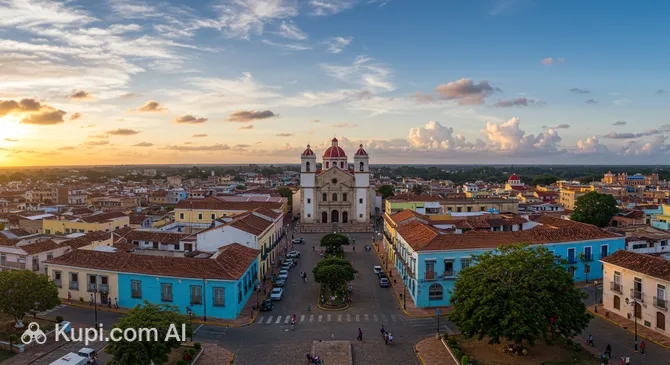
La Vega is the pulsing heart of the fertile Cibao Valley and one of the oldest cities that the Dominican Republic can boast of. Founded in the late 15th century, it combines a spirit of provincial tranquility with the dynamics of an important agricultural center. There are no endless beaches here, but there is something more — an authentic Dominican atmosphere steeped in the aromas of coffee and centuries-old traditions.
The city's geographical position in the center of the country makes it the "food basket" of the region. With a population of about 220,000, La Vega remains a lively and energetic place where modern life is closely intertwined with a rich historical heritage from the colonial era. The city does not strive to be a glossy tourist hub, and it is precisely this sincerity that attracts travelers looking for real Caribbean culture.
La Vega. Illustration.
Source: Kupi.com AI
The main magnets for visitors are its famous religious shrines and vibrant festivals. La Vega is considered the cradle of the Dominican carnival, and the proximity of holy sites turns it into a center for pilgrimage. If you want to see the country beyond the hotel resorts, immerse yourself in the history of the first settlers, and feel the rhythm of life in the Cibao Valley, this city will be a true discovery for you.
Weather Overview
The climate in La Vega is typical for tropical regions but has its own characteristics due to its location in a valley. Summer reigns here year-round: average temperatures range from +25°C to +32°C. The Cibao Valley is reliably protected from strong ocean winds, so the air here often feels more humid and warmer than on the coast.
The rainy season usually lasts from May to November, peaking in late spring and autumn. Rainfall is often short-lived but intense, turning the surrounding landscapes into a lush emerald green. If you are planning a visit, it is useful to check the weather in La Vega in advance to choose the most comfortable time for excursions to historical ruins.
The most favorable time for a trip is considered to be from December to April — during these months, rain is rare, and the heat is not so exhausting. The water temperature in nearby rivers and waterfalls at this time is refreshing, and the sky is clear, which is ideal for a pilgrimage to Santo Cerro or participating in the famous winter carnivals.
Average monthly temperature
Average monthly precipitation
Interesting Facts
La Vega was founded by Bartholomew Columbus (Christopher's brother) in 1495, making it one of the oldest European settlements in the New World.
The original city was completely destroyed by a powerful earthquake in 1562, after which residents moved the settlement to its current location, leaving the ruins of the old fortress to archaeologists.
It was here in 1510 that the famous Dominican carnival originated — the oldest and most massive festival in the Caribbean.
The city was the first on the American continent to be granted the status of a diocese and in the 16th century had its own mint, cathedral, and monasteries.
La Vega is famous for the "miracle of Our Lady of Las Mercedes": legend has it that the image of the Virgin Mary protected the first settlers by stopping the arrows of the indigenous people during a battle.
How to Get There
La Vega is very conveniently located from a logistics standpoint: the city sits at the intersection of key highways connecting the capital with the northern coast. Although the city does not have its own passenger airport, getting here from the country's main air gateways is easy. Travelers usually choose ground transport, which is quite well-developed in this region.
Most tourists arrive in La Vega on comfortable buses from companies like Caribe Tours from Santo Domingo (a distance of about 130 km, 2.5–3 hours away) or from Santiago (about 50 km, about 1 hour away). If you prefer independence, renting a car is an excellent option; however, keep in mind that the highways in the Cibao Valley are often crowded with agricultural machinery. Detailed route information can be found in the section on how to get to La Vega.
There is no traditional passenger rail service here, as the tracks are used primarily for the region's industrial needs. The main emphasis is on bus stations and taxi stands, which provide connections between the city and neighboring provinces.
Main Attractions
The main treasures of La Vega are hidden in its rich past. One of the most significant landmarks is the Cathedral of the Immaculate Conception. This majestic building is striking in its architecture, which combines modern elements with traditional forms, and serves as the spiritual center of not only the city but the entire province. Inside, an atmosphere of tranquility prevails, perfect for reflection.
For history buffs, the ruins of Old La Vega (La Vega Vieja), located in the National Park, are a must-see. This site, where one of the first Spanish settlements on the island once stood, has been transformed into an archaeological park. Here you can see the remains of the Concepción fortress and the San Francisco monastery, which serve as reminders of the times of Bartholomew Columbus and the gold mines of the valley.
Another important point on the city map is Santo Cerro hill. It is believed that the miracle of Las Mercedes occurred here, and today a church stands at the summit, drawing thousands of pilgrims annually. In addition to its religious significance, it offers a panoramic view of the vast expanses of the Cibao Valley, making it an ideal place for nature contemplation and photography.
Local Cuisine
The gastronomy of La Vega is a celebration of natural flavors and the generous gifts of the Cibao Valley. The cuisine here is simple, hearty, and incredibly aromatic. The main dish served almost everywhere is "La Bandera Dominicana" (rice, beans, and meat), but in this region, you should pay special attention to mangú (mashed green plantains) with fried cheese and salami, which locals adore for breakfast.
For those with a sweet tooth, the Mil Hojas Reposteria bakery is a must-visit. Here you can try traditional Dominican desserts and pastries, considered some of the best in the city. If you are looking for a more refined gastronomic experience with a modern twist, check out OhLaLa Experience, where local ingredients meet modern culinary techniques.
Don't forget to try the local coffee — it is particularly strong and aromatic here, as the plantations are located very close by. For a refreshing drink on a hot day, a freshly squeezed tropical fruit juice or a cold Dominican beer is perfect. Street food at the city markets is an adventure in itself: the fried pork (chicharrón) from La Vega is famous nationwide for its crunch and flavor.
Travel Tips
A trip to La Vega will be comfortable and memorable if you take into account a few practical nuances of life in the Dominican provinces. These tips will help you settle in faster and get the most enjoyment out of the city.
Clothing and Essentials: Choose light clothing made of cotton or linen, as the humidity in the valley is high. Be sure to bring comfortable shoes for walking around historical ruins. Important: when visiting churches like the Cathedral, shoulders and knees should be covered.
Transport: Within the city, it is most convenient to use official taxis. If you decide to take a motoconcho, hold on tight and confirm the price in advance. For trips to neighboring cities, choose Caribe Tours buses — they are reliable and air-conditioned.
Finances: The main currency is the Dominican peso. There are many ATMs in the center, and restaurants accept cards, but always carry cash for markets and small purchases. A 10% tip is appreciated if it is not already included in the bill.
Health and Safety: Drink only bottled water and avoid ice in street drinks. La Vega is generally safe in the center, but in the evening, it's better to avoid unpopulated outskirts and not display expensive jewelry or electronics.
Communication: Spanish is the main language. English is understood in large hotels and some restaurants, but knowing a few phrases in Spanish (e.g., "¿Cuánto cuesta?" — how much does it cost?) will make your life much easier. You can buy a SIM card at Altice or Claro operator offices.
Local Etiquette: Dominicans are very polite and value greetings. A simple "¡Hola!" or "Buenos días" will open many doors for you. Don't be surprised by loud music and noisy conversations — it's part of the local culture.
What to Avoid: You should not criticize religious traditions or carnival customs — for locals, these are a matter of great pride. Also, avoid walking alone on deserted streets after sunset.
Extra Tip: Try to be in the city in February. Even if you're not a fan of crowds, the Carnaval Vegano is something you should see at least once in your life because of its incredible energy.
La Vega is a city with an open soul that will reward the curious traveler with vibrant colors and sincere hospitality. We wish you an unforgettable journey to the very heart of the Dominican Republic!
Entertainment & Nightlife
Nightlife in La Vega has a distinct local flavor and lacks intrusive tourist pretension. Most activity is concentrated in the city center, where cozy bars and unpretentious dance floors are located. It is common to start the evening here with a leisurely dinner that smoothly transitions into socializing to the rhythms of bachata and merengue. A popular spot for relaxation is Lite Lounge Restaurant, where you can enjoy quality drinks in a modern setting.
Another noteworthy establishment is Lunbar Tapas y Tragos, offering a "tapas and cocktails" format that is ideal for groups looking for variety. The local crowd is very friendly, and the atmosphere in these venues is usually relaxed. The dress code is mostly casual, although Dominicans prefer to look neat and stylish for evening outings.
As for daytime entertainment, the main event is undoubtedly the Carnaval Vegano. If your visit coincides with this period (late January to February), you will find yourself in the epicenter of the country's most vibrant parade featuring unique "diablos cojuelos" masks. At other times of the year, you can witness cockfights — a traditional, though specific, spectacle for the region — or go on a horseback ride through the city's picturesque surroundings.
Parks & Museums
Despite its status as a major center, La Vega offers few traditional museums, focusing instead on living history. The main site is the Concepción de la Vega National Park. This is an open-air archaeological museum where the ruins of the ancient city allow you to literally touch the stones laid by the first Spanish conquistadors. A walk here feels like a journey through time, and information boards help you imagine the scale of the settlement's past greatness.
Among the green zones, Duarte Park in the city center stands out — a traditional meeting place surrounded by the shade of trees and historical buildings. However, for true natural scope, locals and tourists head to the area of Santo Cerro hill. It is not just a religious shrine but also a beautiful natural platform with panoramic views, where you can escape the city bustle surrounded by tropical greenery.
The city's cultural life is most vibrantly represented in small galleries and exhibition halls dedicated to the history of the Carnival. Here you can see costumes and masks from past years, which are true works of art. Even a simple walk past the Cathedral of the Immaculate Conception gives an idea of the region's aesthetic preferences, where architectural heritage is carefully preserved.
Getting Around
The transport system of La Vega is typical for large Dominican cities: it is chaotic but efficient in its own way. The main form of public transport is the guagua (minibus), which plies the main streets and connects the center with the outskirts. The fare is inexpensive, but the buses are often crowded, especially during morning and evening rush hours.
For quick travel over short distances, locals and tourists often use motoconchos (motorcycle taxis). This is the fastest way to get through traffic jams, which are often created here by trucks carrying agricultural products. However, you should always agree on the price of the trip in advance and keep safety in mind. Traditional taxis are also available; it is best to call them by phone or through popular apps.
In the center of La Vega, it is quite possible to get around on foot — the main attractions are compactly located. There are no special transit cards or unified payment systems; fares for guaguas and taxis are paid in cash to the driver. If you plan to explore the Cibao Valley and neighboring towns, renting a car would be the most practical solution, giving you freedom of movement regardless of public transport schedules.
Accommodation
Accommodation in La Vega is mainly geared toward business travelers, pilgrims, and those who want to experience the real Dominican Republic. You won't find massive five-star "all-inclusive" complexes here, but you can stay in cozy city hotels or colonial-style guesthouses. Most hotels are concentrated in the city center, within walking distance of the main squares and churches.
The price range here is quite affordable: budget options start at $30–$50 per night. If you plan to visit the famous Carnival in February, we strongly recommend booking accommodation several months in advance, as the city fills with guests from all over the world during this period, and rooms in local hotels sell out instantly.
For those who prefer a more secluded stay in nature, consider accommodation options on the outskirts or in the nearby mountain areas, where eco-lodges and villas are available. Within the city itself, apartments are popular and often rented through online platforms, giving tourists the chance to feel like a local in the heart of the Cibao Valley.
Nearby Cities
Thanks to its location in the center of the island, La Vega is an ideal starting point for short trips around the region. The city's surroundings offer a sharp contrast between bustling metropolises and quiet mountain retreats, allowing you to diversify your itinerary without long journeys.
Just 16 kilometers away is the town of Jarabacoa, often called the "Dominican Alps." This place is a must-visit for ecotourism enthusiasts: cool mountain air, waterfalls, and opportunities for rafting or horseback riding create ideal conditions for a break from the tropical heat. Also worth noting is Río Verde Arriba, where you can observe the authentic life of the agricultural heartland.
City
Population
Distance
Rio Verde Arriba
33 809
11 km
Villa Tapia
24 871
14 km
Cayetano Germosen
16 439
15 km
Jarabacoa
68 585
16 km
Cenovi
17 857
17 km
If you crave a more active urban pace or shopping, you can reach Santiago de los Caballeros, the country's second-largest city, in an hour. Exploring the surroundings of La Vega will help you see the multifaceted Dominican Republic, where mountains meet valleys and history meets the rhythm of modern life.
Shopping & Souvenirs
Shopping in La Vega is primarily about discovering local production and authentic goods. There are no giant shopping malls with global brands here, but there is an abundance of small shops and stalls concentrated around the central squares. The main focus is on what the valley lives by: high-quality coffee, cocoa, and handmade items.
The city markets are the heart of local trade. This is the place to buy the freshest tropical fruits brought directly from the surrounding plantations. If you are looking for something special, look for leather goods and ceramics — local craftsmen maintain production traditions passed down through generations. La Vega is also known as a place where you can purchase unique religious souvenirs related to the Santo Cerro shrine.
Shops usually operate from 9:00 AM to 6:00 PM with a siesta break in the middle of the day, which is typical for the Dominican provinces. Cards are accepted at larger outlets and chain establishments, such as the Mil Hojas Reposteria bakery, but for purchases at markets and small stalls, be sure to have cash pesos. Tax Free returns are practically non-existent in small towns, so the focus should be on finding unique local items.