Support

Alamein International

About the Airport

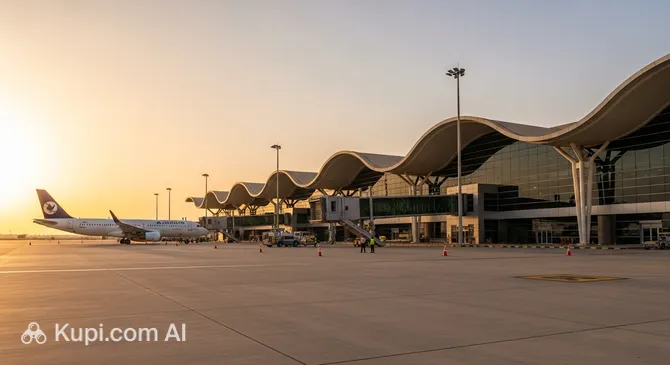
Alamein International. Source: Kupi.com Binoculars

Alamein International Airport is a modern aerial gateway to the "Egyptian Maldives," offering tourists direct access to the turquoise waters of the Mediterranean Sea and the luxurious resorts of the North Coast. Located at a strategic point near the city of El Dabaa, it has become a key hub for travellers wishing to combine a beach holiday with exploring the region's historical heritage without tiring transfers from Cairo. The airport is distinguished by its novelty and compact size, which eliminates the hustle and bustle typical of large aviation hubs and sets a relaxed mood from the very first minutes of arrival.

IATA Code DBB
ICAO Code HEAL
City El Dabaa (serves New El Alamein)
Distance to centre 15 km to El Dabaa, 50 km to New El Alamein
Status International
Annual Passengers Capacity up to 1 million

Features and Advantages of the Airport

Alamein Airport underwent extensive reconstruction and began fully servicing civil flights in 2023, becoming an important part of the tourism infrastructure for the entire coast.

  • Modern Terminal: The passenger terminal is equipped with the latest equipment, ensuring rapid passport control and baggage claim processing.
  • Comfort and Service: For the convenience of guests, VIP lounges, rest areas, and duty-free shops are provided, allowing you to spend time comfortably while waiting for your flight.
  • Proximity to Resorts: The airport is located in immediate proximity to popular resort zones, such as Marina and Sidi Abdel Rahman, which significantly reduces transfer times to hotels.
  • Seasonal Activity: The air harbour is oriented primarily towards the summer tourist season, accepting both scheduled and charter flights from various countries.
  • Safety: The airport operates modern security and control systems that comply with high international standards.

Contact Information

Finding direct and up-to-date contacts for small regional airports, such as Alamein International, can be challenging. Most flight-related issues are resolved through the airline. Below is the main information that may be useful to a traveller.

  • Official Website: At the moment, the airport does not have its own dedicated website. Basic information about airports in Egypt can be found on the portal of the managing company, Egyptian Airports Company (EAC).
  • Information Desk Phone: There is no direct public phone number for inquiries. For the most accurate information regarding flight status, check-in, or other services, it is recommended to call your airline directly.
  • Airport Address: Alamein International Airport, Alexandria - Matrouh Road, near El Dabaa, Egypt.
  • Email: A dedicated email for passenger communication is not provided. Please use the feedback forms or email of your airline.
  • Social Media: Official social media accounts for the airport are not maintained.
  • Lost Luggage Information: If your luggage has been lost or damaged, you must immediately contact the Lost & Found service of your airline. It is the carrier that bears responsibility for luggage.
  • Passenger Support Contacts: Support regarding booking, ticket changes, seat selection, and special assistance is provided by the airline whose services you are using.

How to Get to the Airport

Alamein International Airport (DBB) is a key transport hub for the resorts of the North Coast of Egypt. You can get to the airport from the city of El Dabaa and neighbouring tourist zones in several ways, the choice of which depends on your budget and comfort preferences.

Taxi and Private Transfer — the fastest and most convenient method. A trip from the centre of El Dabaa or the nearest hotels in resort zones (El Alamein, Marina) will take approximately 30-60 minutes. The estimated cost of a taxi ride is 300-500 Egyptian pounds. It is important to agree on the price with the driver in advance or use official taxi services at hotels. For maximum convenience, especially with luggage, you can book a transfer through your hotel or a travel company — this guarantees a fixed price and a comfortable journey.

Car Rental provides freedom of movement and the opportunity to explore the coast on your own. Rental company offices are available both at the airport and in large neighbouring cities, for example, in Alexandria. The drive from the centre of El Dabaa to the airport by car will take about 20-30 minutes. The cost of renting an economy class car starts from 1500-2500 Egyptian pounds per day. Parking is available at Alamein Airport, where you can leave your car for both short and long terms.

Public Transport in this region is poorly developed and does not offer direct connections to the airport. There are no direct bus routes or railway stations at the terminal. Theoretically, one could use intercity buses running along the coastal highway between Alexandria and Marsa Matruh, ask the driver to stop at the turn nearest to the airport, and take a taxi from there. However, this method is extremely inconvenient, requires significant time, and is not recommended for tourists, especially those with luggage. There is no metro in this part of Egypt.

Terminals and Map

Alamein International Airport (DBB) is a modern and compact aviation hub designed for the convenience of tourists arriving at the resorts of the North Coast of Egypt. Its structure is extremely simple, making navigation easy even for those visiting for the first time.

The airport consists of one passenger terminal, which serves both international and domestic flights. Thanks to this, there is no need to transfer between terminals — all processes, from check-in to boarding, take place in one building. The terminal layout is logical: departure and arrival zones are clearly separated. Immediately after entering the building, you find yourself in the check-in area, followed by security screening and passport control.

The departure zone includes several boarding gates, a small Duty Free shop, several cafes, and comfortable waiting lounges. The arrival zone consists of passport control counters, a baggage claim belt, and customs inspection. Due to the small size of the airport, the path from the aircraft to the terminal exit usually does not take much time.

Check-in and screening at Alamein Airport generally proceed faster than in large international hubs. However, during the peak tourist season (summer), queues are possible. It is recommended to arrive at the airport 2.5-3 hours before the departure of an international flight to complete all formalities without haste. Navigation inside the terminal is intuitive, with signs in Arabic and English everywhere, so getting lost here is practically impossible.

Airport History

The history of Alamein International Airport (DBB), located near the city of El Dabaa, is relatively short but very significant for the tourism industry of Egypt. The airport was officially opened in 2005 and became a key infrastructure project designed to accelerate the development of the country's Mediterranean coast, known as the North Coast.

The main stage of the airport's development involved its creation from scratch. Unlike many historic airports, Alamein International did not go through a long path of renovations but was initially designed as a modern terminal for servicing tourist flows. Its appearance radically changed logistics for travellers heading to popular resorts, reducing travel time from Cairo or Alexandria by several hours.

Although the airport itself is a modern structure, it is located in a region with a rich history. It was here that the famous battles of the Second World War at El Alamein took place. Today, the airport serves as a gateway not only to beach resorts but also for those coming to visit war memorials and museums, paying tribute to historical events. Thus, the air harbour symbolically connects the past and present of the region.

Among interesting facts, it can be noted that Alamein Airport operates primarily in a seasonal mode, reaching peak activity in the summer months when the coast fills with holidaymakers. Its main record and achievement is not the number of passengers carried, but the very fact of successfully transforming the North Coast into an accessible and attractive international destination, which gave a powerful impetus for the construction of new hotels and resort complexes.

Services and Facilities

Alamein International Airport (DBB) offers passengers a set of essential services and amenities to make waiting for a flight comfortable. Despite its relatively small size and seasonal nature of operation, the terminal is equipped with everything necessary for travellers arriving at the resorts of the North Coast of Egypt or flying home.

Within the airport, you will find several cafes and snack bars where you can have a bite to eat or drink coffee before departure. Shops are open, including a Duty Free zone. Here you can purchase souvenirs, perfumes, sweets, and essential items. The selection may not be as large as in major hubs, but the main categories of goods are represented.

For passengers who value enhanced comfort, VIP lounges may be available. They offer a quieter atmosphere, snacks, beverages, and other privileges. Throughout the terminal, free Wi-Fi is generally available, and waiting halls have stations for charging mobile phones and other gadgets.

Financial services are also at your disposal: ATMs and currency exchange points are located in the airport building. To ensure passenger safety, a medical point is in operation, ready to provide first aid. Travellers with small children can use the mother and child room. For passengers with reduced mobility, a barrier-free environment has been created, and necessary assistance is provided during boarding and disembarking.

There are no specialised business centres or hotels directly within the airport building. However, many hotels and resort complexes are located a few minutes' drive away in the city of El Dabaa and neighbouring resort zones, where conference rooms for business meetings can be found.

Where to Eat

Alamein International Airport (DBB) is seasonal and relatively small, so the choice of dining establishments here is functional rather than diverse. Nevertheless, passengers can find several options to have a snack or drink coffee while waiting for their flight. Main food outlets are concentrated in the departure zone after passing passport control and security screening (airside).

Most often, several cafes and kiosks operate at the airport, offering a standard set for travellers. Here you can buy sandwiches, pastries, crisps, chocolate, as well as hot and cold drinks, including coffee, tea, and bottled water. This is a good option for a quick snack if you don't have much time before boarding. Full-service restaurants with a menu are generally absent here, so for a substantial lunch or dinner, it is better to eat beforehand, prior to arriving at the airport.

Regarding local cuisine, its offerings at the airport are limited. Sometimes in cafes, you can find traditional Egyptian sweets or pastries, which can be a pleasant addition to a cup of tea. For passengers with special dietary needs (vegetarians, vegans, gluten-free diet), the choice may be extremely limited. It is recommended to carry your own snacks to avoid inconvenience. Most products in Egypt comply with halal standards, but for certainty, it is better to choose certified packaged goods.

Prices in establishments at Alamein Airport correspond to the standard level for terminals — they are noticeably higher than in city cafes. The opening hours of food outlets are directly tied to the flight schedule. They open a few hours before departure and close after the last plane departs, so during quiet periods between flights, cafes may be closed.

Travel Tips

Travelling through Alamein International Airport, which serves the resort region of El Dabaa, can be a comfortable start or end to your holiday in Egypt if you prepare in advance. Here are some useful tips to help you navigate.

Arrival Time at the Airport. For international flights, it is recommended to arrive at the airport at least 3 hours before departure. At the height of the tourist season, queues for check-in and screening are possible, so an extra buffer of time will allow you to avoid unnecessary haste.

Check-in and Security. To save time, use online check-in for your flight if your airline provides such an option. Security control at Egyptian airports can be multi-level and thorough. Keep your passport and boarding pass handy, and be ready to remove outerwear, belts, and take all electronics out of your hand luggage.

Seat Selection on the Plane. If you want to enjoy views of the Mediterranean Sea during takeoff or landing, choose a window seat. If freedom of movement and the ability to stand up easily are more important to you, your choice is an aisle seat.

Hand Luggage. Standard rules prohibit carrying liquids in containers larger than 100 ml, as well as sharp objects. All liquids must be packed in one transparent bag. Be sure to check your airline's hand luggage rules, as they may differ. Always keep valuables, documents, medication, and electronics with you in your hand luggage.

Connecting Passengers. If you have a connecting flight, clarify in advance whether you need to collect your luggage and check it in again. Immediately after arrival, find information about your next flight on the board to find out the boarding gate number.

Customs Control. When entering Egypt, be ready to present your passport and, if necessary, a visa. There are restrictions on the import and export of currency, alcoholic beverages, and tobacco products. The export of items of historical value (including ancient souvenirs and corals) is strictly prohibited.

Saving Time and Money. Exchange a small amount into local pounds in advance for minor expenses or use an ATM at the airport. Prices for food and drinks in the departure zone are usually higher, so you can take a small snack with you (for example, nuts or bars), but water will have to be bought after passing screening.

Flight Delay. In case of a delay, remain calm. Monitor information on the boards and announcements. Contact a representative of your airline for up-to-date information. During long delays, passengers are entitled to drinks, meals, and in some cases — accommodation in a hotel.

Reached the end of the page?

That means the route is fully explored