Support

Cairo International Airport

About the Airport

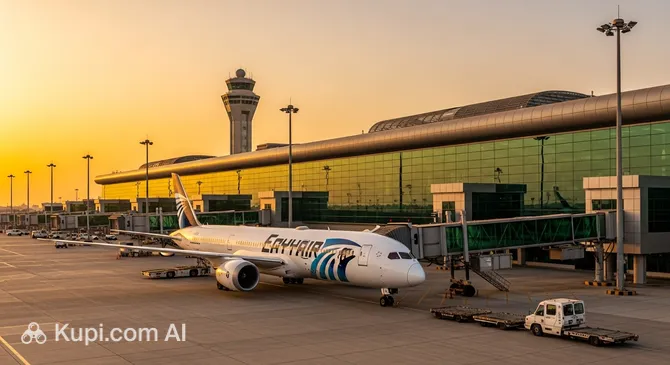
Cairo International Airport. Source: Kupi.com Binoculars

Cairo International Airport is not merely a transit point, but a true aerial gateway to the world of ancient civilizations and eternal sands. It is here that your immersion into the atmosphere of Egypt begins, where the bustle of a modern metropolis intertwines with the anticipation of encountering thousands of years of history. This hub, one of the busiest in Africa, welcomes millions of travellers annually who strive to see the Great Pyramids and feel the breath of the Orient.

IATA Code CAI
ICAO Code HECA
City Cairo
Distance to Centre ~22 km
Status International
Passengers per Year over 27.7 million (2024)
Schedule Regular air service

Airport Features and Advantages

Egypt's main air harbour possesses a number of unique features that make waiting for a flight comfortable and informative:

  • Airport Museum: Terminal 3 houses a unique museum displaying authentic artefacts from the Egyptian Museum, the Museum of Islamic Art, and the Coptic Museum. This is an excellent opportunity to touch history without leaving the transit zone.
  • Convenient Transport: A free automated train (People Mover) connects all terminals, car parks, and nearby hotels, allowing you to quickly reach your desired location.
  • Comfort and Leisure: The airport offers numerous lounge zones, Duty Free shops featuring local souvenirs, and direct access to a five-star hotel for those with a long layover.

Contact Information

For your convenience, we have compiled the main contact information for Cairo International Airport (CAI). We recommend checking the official website for the most up-to-date data before your trip.

  • Official Website: www.cairo-airport.com
  • Information Service Phone: +202 2265 5000
  • Address: Airport Road, Heliopolis, Cairo, Egypt
  • Email for General Inquiries: callcenter@cairo-airport.com
  • Social Media: The airport maintains official pages on social networks (such as Facebook), where you can follow news and flight status updates.
  • Lost Luggage Information: In case of lost luggage, please contact your airline's representative office first. The airport's own baggage tracing service can also provide assistance.
  • Passenger Support Service: For all questions related to your stay at the airport, you can contact the main information service via phone or email.

How to Get to the Airport

Cairo International Airport (CAI) is the main aerial gateway of Egypt, located approximately 22 kilometres northeast of the city centre. You can reach it in several ways, the choice of which depends on your budget, time, and comfort preferences. On average, a trip from the city centre takes from 45 to 90 minutes, but this time can increase significantly during peak hours due to heavy traffic.

Taxis and Private Transfers are the most popular and convenient way to get to the airport for tourists. You can use official white taxis (it is recommended to agree on the price in advance or insist on using the meter) or order a car via mobile apps such as Uber or Careem, which often ensures a more predictable cost. For maximum convenience, especially if you have a lot of luggage or are travelling with family, you can book a private transfer in advance. This is slightly more expensive, but the driver will meet you at the designated location and assist with your belongings.

Public Transport is the most budget-friendly option. City buses and microbuses run to the airport from various districts of Cairo, including Tahrir Square. However, this method can be challenging for those unfamiliar with the city and who do not speak Arabic, as routes are not always obvious. A more organised alternative is the Cairo Airport Shuttle Bus — special minibuses that operate on various routes and deliver passengers from key points in the city directly to the terminals. These can be booked in advance. There is no direct metro line to the airport, but you can travel to the nearest stations (for example, in the Heliopolis area) and take a taxi from there.

If you prefer to move around independently, you can use a car rental service. Many international and local companies have offices both in the city and at the airport. This option is suitable for experienced drivers ready for the peculiarities of Cairo traffic. The airport grounds feature both short-term and long-term car parks near all terminals, which is convenient if you arrive in your own or a rented vehicle.

Terminals and Map

Cairo International Airport (CAI) is the main aviation hub of Egypt and one of the busiest in Africa. It consists of three main passenger terminals (Terminal 1, Terminal 2, and Terminal 3), as well as a seasonal terminal for pilgrimage flights. Each terminal serves different airlines, so it is critically important to check in advance which terminal your flight departs from.

Terminal 3 is the newest and most modern. It serves as the hub for the national carrier EgyptAir and Star Alliance airlines. It features spacious waiting halls, numerous shops, cafes, and restaurants. Navigation is intuitive thanks to clear signage in English and Arabic. Departure and arrival zones are clearly separated, simplifying passenger movement.

Terminal 2 was completely renovated and reopened in 2016. It serves flights for many major international airlines, including carriers from the SkyTeam and Oneworld alliances. In terms of comfort and services, it rivals Terminal 3. Terminals 2 and 3 are connected by a covered, air-conditioned pedestrian bridge, making the transfer between them quick and convenient.

Terminal 1, known as the "Old Airport", has a unique structure and consists of several separate halls (Departure Hall 1, 2, 3 and Arrival Hall 3). It primarily serves budget airlines and flights not belonging to major alliances. Despite its age, it handles passenger traffic well, though it may seem less organised compared to the newer terminals.

To move between all three main terminals, a free automated mini-train (Automated People Mover) is in operation. The journey takes just a few minutes. To clear check-in, passport control, and security, it is recommended to arrive at the airport at least 3 hours before an international flight and 2 hours before a domestic one. Queues are possible during peak hours, especially at the initial security check at the airport building entrance.

Airport History

The history of Cairo International Airport (CAI) dates back to the Second World War. Originally, the site hosted the American airbase Payne Field, built in 1942 for the needs of the US Air Force. It served as a vital transit point for Allied forces in the African theatre of operations.

After the war ended, in 1945, the base was transferred to the civil authorities of Egypt. By 15 December 1946, the Civil Aviation Authority took control of the airport, and it began serving international flights. The old terminal, located in the Heliopolis area, quickly ceased to cope with the growing passenger traffic, which prompted massive development.

A key stage in the airport's history was 18 March 1963, when a new complex, known today as Terminal 1, was inaugurated. This event marked the birth of the modern Cairo airport, capable of accommodating a large number of aircraft and passengers. Over the years, the airport continued to expand: in 1986, Terminal 2 was opened, and in 2009, the state-of-the-art Terminal 3, which became the main hub for the national carrier EgyptAir and Star Alliance airlines. Later, Terminal 2 underwent a complete renovation and was reopened in 2016 to meet the latest standards.

Throughout its history, the airport has repeatedly witnessed important events, welcoming heads of state and delegations from all over the world. Today, it is not just Egypt's main aerial gateway, but also one of the busiest airports in Africa, setting numerous records for passenger traffic. An interesting fact: despite all modernisations, the airport maintains continuity — old halls are integrated into the new structure, reminding visitors of its rich past.

Services and Amenities

Cairo International Airport (CAI) offers passengers a wide range of services and amenities to make their stay comfortable, regardless of the purpose of their trip. Conditions here are designed for both short waits and long layovers.

Within the terminals, there are numerous restaurants, cafes, and coffee shops where you can taste both local Egyptian cuisine and familiar international food. For shopping enthusiasts, Duty Free shops are open with a large selection of perfumes, luxury goods, and souvenirs. Numerous stalls are also available where you can buy gifts, clothing, and travel essentials.

For those who value enhanced comfort, Business Lounges and VIP Halls are available. They offer comfortable seating, snacks and beverages, fresh press, and a quiet atmosphere for rest or work. Access can be obtained for a fee or via privilege cards from various airlines and banking programmes.

Staying connected is easy: the airport provides access to Wi-Fi (conditions may vary depending on the terminal and zone). Special stations and sockets are installed throughout the airport for charging gadgets.

Financial matters can be resolved on the spot: the terminals feature bank branches, ATMs, and 24-hour currency exchange points, which is particularly convenient for arriving tourists. In case of need, passengers can visit medical points where first aid is provided.

For passengers with children, mother and child rooms are equipped where you can feed and change a baby in a calm environment. Passengers with reduced mobility are provided with all necessary assistance: special transport, ramps, lifts, and accompaniment by airport staff upon prior request.

If you have a long connection or an early flight, you can stay at the Le Méridien Cairo Airport hotel, which is connected to Terminal 3 by a pedestrian bridge. There are also other hotels in the immediate vicinity of the airport. For business travellers, conference rooms and business centres equipped with everything necessary for meetings and negotiations are available.

Where to Eat

At Cairo International Airport (CAI), passengers have access to a wide choice of establishments for every taste and budget. Whether you are looking for a quick snack before departure or a full dinner, you will find a suitable option in one of the terminals.

Most modern cafes and restaurants are concentrated in Terminal 3, which serves many international flights. Here, in the departure zone (airside), after passing passport control, the main food court is located featuring famous global chains such as McDonald's, Burger King, Sbarro, and Starbucks. Terminal 2 also has a good selection of venues, including Costa Coffee and other cafes. Terminal 1 offers a more modest but sufficient assortment of food outlets. Most establishments in the departure zones operate 24 hours a day or have extended opening hours to serve passengers of all flights.

If you wish to try local cuisine, pay attention to restaurants offering Egyptian and Middle Eastern dishes. This is a great opportunity to enjoy the taste of falafel, shawarma, or fresh pastries before flying out. For those who prefer something familiar, international fast-food chains are always available. For a more relaxed break, restaurants with à la carte service are ideal, where you can order full hot meals and beverages in a comfortable setting.

Regarding special dietary needs, practically all food at the airport is Halal. Vegetarian options, such as salads, sandwiches with vegetables, and hummus, are available in many cafes. Finding certified gluten-free or vegan dishes may be more difficult, so it is recommended to check the ingredients with the staff. Prices at the airport are expectedly higher than in the city but remain at an acceptable level compared to other major international hubs.

Travel Tips

To ensure your journey through Cairo International Airport goes smoothly, we recommend arriving in advance. For international flights, it is best to be on-site 3-4 hours before departure, and for domestic flights within Egypt2 hours. The airport in Cairo can be very busy, especially during peak seasons, so extra time will help avoid unnecessary stress.

To save time, use online check-in for your flight if your airline provides this option. At the airport, keep all documents ready: passport, visa (if required), and boarding pass. Security procedures can be multi-stage and quite thorough, so be prepared for several security checks on the way to the boarding gate.

If you want to enjoy views of the desert or the lights of Cairo at night during takeoff or landing, choose a window seat. An aisle seat will be more convenient if you need to stand up often or if you have a connecting flight and it is important to leave the plane quickly. Book your seat in advance online to get the best option.

Hand luggage rules at Cairo airport are standard. Liquids are allowed in containers up to 100 ml, packed in a transparent bag. Ensure there are no prohibited items in your bag: sharp objects or flammable substances. You are usually asked to remove all electronics, including laptops and power banks, during security screening, so keep them handy.

If you have a transfer in Cairo, check the departure terminal of your next flight in advance — they may be located at a significant distance from each other. Shuttles run between the terminals. For long layovers involving exiting into the city, a transit visa may be required. Clarify this point with your airline.

When entering and leaving Egypt, customs regulations must be observed. If you are carrying large sums of cash (exceeding the established limit) or expensive electronics, they should be declared. This will help avoid questions when departing the country. If in doubt, use the "Red Channel".

Besides online check-in, other tricks can help save money. Take an empty water bottle with you and fill it at drinking fountains after passing security control. Prices for food and beverages at the airport can be high, so a light snack brought with you won't go amiss. Duty Free offers a standard assortment, but do not hesitate to compare prices — they are not always more favourable than in the city.

In case of a flight delay or cancellation, contact your airline representative first. They should provide information on the flight status and your rights to beverages, meals, or hotel accommodation during long waits. The airport has many cafes, shops, and paid lounge zones where you can spend time comfortably.

Reached the end of the page?

That means the route is fully explored