Support

Corisco Island

About the Airport

Corisco Island
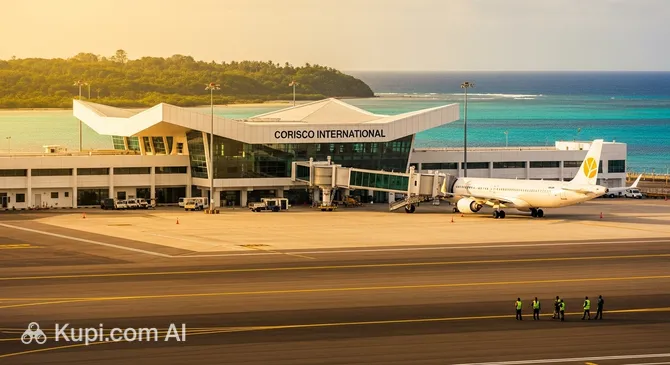
Corisco Island. Source: Kupi.com AI

Corisco Island Airport is not merely a transport hub, but a true aerial gateway to the tropical paradise of Equatorial Guinea. This modern terminal, surprisingly harmoniously integrated into the exotic landscape, welcomes travelers seeking seclusion on the island's white sandy beaches. Here, far from the noise of metropolises, begins your acquaintance with the unique culture and pristine nature of this secluded corner of Africa.

Despite its compact size, the airport possesses all the necessary infrastructure for comfortably welcoming guests. The terminal building, constructed using modern architectural solutions, creates a sense of lightness and spaciousness, setting a relaxed mood immediately upon landing.

AirportCorisco Island
IATAOCS
ICAOFGCO
CityCalatrava
TimezoneAfrica/Malabo
ScheduleOnline board

Features and advantages of the airport:

The main feature of the Corisco air harbour is its unique location. The runway is situated in immediate proximity to the ocean, offering passengers breathtaking views of the turquoise waters of the Gulf of Guinea during takeoff and landing. This turns an ordinary flight into a genuine excursion over one of the region's most picturesque locations.

Thanks to the low passenger flow, security and baggage claim procedures take place here in record time. Travelers are spared the long queues and bustle typical of major hubs. The airport is designed so that the path from the aircraft steps to the exit into the city takes mere minutes, allowing you to immerse yourself in the holiday atmosphere almost instantly.

Contact Information

Given the specific nature and remoteness of Corisco Island Airport (OCS), which is a small regional hub, many communications here are conducted directly on-site or through air carriers. The airport's digital presence is limited.

  • Airport Address: Corisco International Airport, Corisco Island, Litoral Province, Equatorial Guinea.
  • Official Website: The airport does not have its own website. It is recommended to check flight information on the websites of national airlines (e.g., CEIBA Intercontinental).
  • Inquiry Service Phone: There is no direct public phone number. Communication is maintained through airline representatives during arrival/departure hours.
  • Email: An official email for passenger inquiries is not published.
  • Social Media: Official social media accounts for the airport are not maintained.
  • Lost Luggage Information: Baggage tracing issues are handled by representatives of the airline operating the flight. It is recommended to contact staff immediately after landing in the baggage claim area.
  • Support Contacts: For general inquiries, you may attempt to contact the head office of the Equatorial Guinea Airport Management (ADGE) in Malabo or Bata.

How to Get to the Airport

Transport logistics on Corisco Island are characterized by extreme simplicity and a calm rhythm, typical of this secluded resort. Since the island's area is small and the road network is limited, you can reach the airport from any point in Calatrava or the coastal bungalows in a matter of minutes. There is no city bustle, traffic jams, or complex traffic schemes here.

Public Transport

The island lacks familiar forms of urban public transport such as metro, scheduled buses, or trains. Movement is primarily by private vehicle or on foot, enjoying the views.

Transfers and Taxis

This is the most reliable and common way to get to the terminal.

  • Hotel Transfer: Most accommodation facilities on the island offer a meet-and-greet service for their guests. It is recommended to order a car in advance when booking your room. This guarantees that the driver will deliver you directly to the airport entrance at the required time.
  • Local Taxi: There are practically no official taxi services with meters here. Transport is provided by local private drivers. The cost of the trip must be agreed upon in advance, before getting into the car. Prices are usually reasonable but may vary depending on the season and negotiation skills.
  • Travel Time: The trip from the settlement center or main beaches to the airport takes from 5 to 15 minutes.

Car Rental and Parking

There are no major international car rental services on the island. Transport can only be rented privately from locals (most often scooters or older SUVs), but this is rarely practical for a trip to the airport.

An open parking area is equipped in front of the small terminal building. Parking is generally free and does not require advance reservation, as there is no congestion here.

Nearest Airports and Alternative Routes

Corisco Airport is a local node, so for planning long-distance travel, tourists often have to use larger regional air hubs. Here is a list of the nearest airports through which connecting routes can be built:

  • Libreville Airport (Gabon) — located approximately 51 km away. This is a major international hub receiving many flights.
  • Bata Airport — located 121 km away. An important transport hub for the mainland part of Equatorial Guinea.
  • Port-Gentil — an airport in Gabon, 191 km away.
  • Mongomeyen — located 206 km away, serving the city of Mongomo.
  • Príncipe — the air harbour of the neighboring island nation of São Tomé and Príncipe, located 229 km away.

Recommendations for Departing Passengers

Despite the airport being small, it is recommended to arrive 1–1.5 hours before departure. This will allow you to complete all formalities calmly without rushing. Be sure to check the current flight schedule with your tour operator or hotel, as flights may depend on weather conditions over the ocean.

Terminals and Map

The infrastructure of Corisco Island Airport (OCS) fully corresponds to its status as the air harbour of an exclusive and uncrowded resort. You will not find confusing labyrinths of corridors or multi-level transitions here. Everything is arranged as compactly, functionally, and intuitively as possible for any traveler.

Number of Terminals and Their Purpose

The airport has one single passenger terminal. This modern single-story building serves both domestic flights from the mainland of Equatorial Guinea (Bata) and the capital (Malabo), as well as international flights (primarily from Gabon). There is no separation into different terminals; all arrival and departure operations are carried out under one roof, creating an atmosphere of intimacy and comfort.

Airport Layout and Service Zones

The interior space of the terminal is organized according to a classic linear scheme, eliminating the possibility of getting lost. Navigation here is extremely simple:

  • Check-in and Departure Zone: Located immediately at the building entrance. Here you will find airline check-in counters and the security checkpoint. The departure lounge (sterile area) is small but comfortable, equipped with seating and air conditioning to provide relief from the tropical heat.
  • Arrival Zone: Located in the opposite part of the hall or an adjacent sector. Passport control for arriving international flights is quick due to the small number of passengers.
  • Baggage Claim: Due to small transport volumes, complex baggage carousels are often replaced here by a simplified belt or even manual baggage delivery by airport staff in a designated area.

Terminal Features and Transitions

The main "highlight" of Corisco Airport is the absence of aerobridges ("sleeves").

  • Boarding and Disembarking: Carried out in the old-fashioned, scenic way — on foot across the apron. The aircraft stops in immediate proximity to the terminal building. This gives tourists an excellent opportunity to take their first photos against the backdrop of the liner and palm trees immediately after descending the steps.
  • Transfers: The distance from the terminal exit to the aircraft is only a few dozen meters, so buses are not used to transport passengers here.

Processing Time

Corisco Airport is famous for the absence of queues. The entire process of pre-flight formalities here takes place in a relaxed rhythm:

  • Check-in: Usually takes no more than 10–15 minutes. However, counters close strictly according to schedule (usually 30–40 minutes before departure), so it is not advisable to be late.
  • Security Check: Security screening is quick but thorough. Staff are polite and accommodating to tourists.
  • Baggage Claim: Suitcases are unloaded almost immediately after the aircraft engines stop. Waiting rarely lasts longer than 15 minutes.

Navigation Recommendations

Since the terminal building is small, you will not need maps or apps for orientation. The main advice is to keep your documents (passport and ticket) handy when entering the terminal, as initial checks may be carried out by security at the very threshold of the building. If you have any questions, any uniformed staff member will be able to direct you, as the entire hall is within sight.

History of the Airport

The history of Corisco Island International Airport (OCS) is a narrative not of centuries of development, but of a rapid technological breakthrough. Unlike many ancient air harbours of the world, this facility is a symbol of the modern history of Equatorial Guinea, embodying the country's ambitions for tourism and infrastructure development in the 21st century.

From Isolation to Openness: The Beginning of the Journey

For a long time, the beautiful island of Corisco remained a difficult-to-access corner. Historically, communication with the mainland (the city of Bata) and the capital (Malabo) was carried out primarily by sea. The journey by boat was long and dependent on the whims of the weather. The need for reliable and fast communication had been growing for years, but the implementation of the project began only within the framework of a large-scale state program for the modernization of the country's infrastructure.

The official birth date of the air harbour is considered to be October 10, 2011. It was on this day that the grand opening of the airport took place, timed to coincide with the celebration of the Independence Day of Equatorial Guinea. This event became a turning point in the life of the island, transforming it from a closed community into a promising tourism cluster.

Construction and Development

Constructing an airport on a small piece of land in the middle of the ocean was a true engineering challenge. Builders had to solve complex logistical tasks regarding the delivery of materials and equipment by sea. The project was implemented in record time with the involvement of international contractors.

A key stage was the creation of the runway. Its placement required careful planning of the territory so as not to disturb the fragile coastal ecosystem. From the moment of opening, the airport was immediately equipped with modern navigation equipment, allowing it to receive flights even in the dark, although main operations here are conducted during the day.

Interesting Facts and Achievements

Despite its "youth," Corisco Airport possesses a number of unique characteristics that surprise even seasoned travelers:

  • Impressive Runway Length: The length of the runway is about 3000 meters (according to other data — 2900 m). This is an absolute record for an island with an area of only 14 square kilometers. Such length allows it to receive large passenger liners like the Boeing 737 or Airbus A320, which is rare for such small and remote resorts.
  • Architectural Minimalism: The airport terminal was designed not to dominate nature, but to complement it. The building is executed in a modern style, but taking into account the tropical climate, ensuring natural ventilation and protection from the sun.
  • "Gateway to Paradise" Status: With the advent of the airport, travel time from the mainland was reduced from several hours by sea to a 15–20 minute flight, making weekend tours to Corisco a reality for residents and guests of the country.

Today, Corisco Airport does not plan large-scale expansions, as its current capacity amply covers the island's needs. Its history is an example of how a single infrastructure object can completely change the fate of a region, opening its beauty to the whole world.

Services and Amenities

The infrastructure and service at Corisco Island Airport (OCS) fully reflect its specific nature: it is a small regional node oriented towards the rapid transit of tourists to holiday destinations. Here you will not find the scale typical of capital hubs, but the basic needs of travelers will be met. Considering that all formalities take minimal time, long waits in the terminal are rare, so the range of services here is quite concise.

Restaurants, Cafes, and Shops

Gastronomic and retail opportunities in the terminal are limited. The airport is not designed for long layovers, so full-service restaurants or a Duty-Free zone are absent here.

  • Dining: A small kiosk or mini-bar may operate in the waiting area, offering soft drinks, bottled water, and light snacks (chips, biscuits). Hot meals are generally not provided. It is recommended to have a snack at your hotel before leaving for the airport.
  • Shops: There are no major retail outlets. Sometimes during arrival/departure hours, local artisans may offer handmade souvenirs, but this depends on the season and tourist flow.

Waiting Lounges and VIP Service

The terminal has one general waiting hall. It is equipped with a sufficient number of seats and an air conditioning system, making the stay comfortable even in the heat. There are no specialized business lounges of international networks (such as Priority Pass) here. There is a separate room for official delegations and dignitaries (VIP), access to which is usually closed to ordinary tourists or requires special coordination with the administration.

Finances and Communication

When setting off for Corisco, it is important to take care of financial matters in advance and be ready for a "digital detox."

  • ATMs and Currency Exchange: There are no ATMs or currency exchange points in the airport building. Payment for services and goods on the island is made primarily in cash (Central African CFA franc — XAF). It is strongly recommended to withdraw cash in major cities (Malabo or Bata) before arriving on the island.
  • Wi-Fi and Gadget Charging: The public Wi-Fi network in the terminal works unstably or may be absent altogether. Travelers should rely on mobile internet (roaming or local SIM cards), although coverage on the island may be uneven. There are few power outlets for charging phones in the waiting hall, so having a fully charged power bank is advisable.

Services for Special Categories of Passengers

The small size of the terminal works to the advantage of passengers requiring special attention.

  • For Passengers with Reduced Mobility: The single-story layout of the building without stairs or elevators makes movement in a wheelchair unobstructed. The absence of aerobridges is compensated by the assistance of ground staff who help with boarding and disembarking. Specialized restrooms are provided for in the terminal design.
  • For Passengers with Children: There are no separate mother-and-child rooms or play areas in the airport. However, the calm atmosphere and lack of crowds allow for comfortable accommodation with children in the general hall.
  • Medical Services: There is a first aid point at the airport for emergencies, but a full medical center or pharmacy is absent. You must have a personal first aid kit with you.

Hotels and Accommodation

There are no hotels directly on the airport territory or within walking distance. However, given the size of Corisco Island, any hotel or guest house is effectively a "hotel near the airport." The journey to most accommodation places takes no more than 10–15 minutes by transfer.

Business Services

Conference rooms, printing services, or coworking zones are not provided in the terminal. Corisco Airport is a place where work gives way to relaxation and contemplation of nature.

Where to Eat

The gastronomic scene at Corisco Island Airport (OCS) fully corresponds to its format as a small island hub: minimalism reigns here. Passengers should not expect a wide selection of establishments familiar to large international airports. The dining area here is organized more to satisfy basic needs before a short flight than for a full culinary experience.

Restaurants and Cafes: Overview of Opportunities

The single passenger terminal lacks an extensive catering network. There are no food courts, chain coffee shops, or restaurants with à la carte service.

  • Snack Bar / Buffet: Usually, a small retail point operates in the general waiting area (after check-in, but within sight of the boarding gate). This may be a stationary kiosk or a counter.
  • Assortment: The main offer consists of bottled water, carbonated drinks, juices, local beverages, as well as packaged snacks (chips, biscuits, chocolate, nuts).
  • Coffee and Tea: Hot drinks are not always available. If they are, it is usually instant coffee or tea in disposable cups.

Local Cuisine and Specialties

You will not be able to try authentic Equatorial Guinean cuisine directly in the airport building — hot food is not prepared here. The island's culinary delights, such as fresh seafood or plantain dishes, should be tasted in hotel restaurants or in the village before departure.

Special Dietary Requirements (Halal, Vegetarian, Vegan)

Given the limited assortment consisting mainly of factory-made snacks, finding specialized nutrition here is extremely difficult.

  • For Vegetarians and Vegans: The only choice may be nuts, fruits (if available), or biscuits. Specialized dishes are not provided.
  • Halal and Gluten-Free Diet: Product labeling may be missing or be in Spanish/French. Passengers with strict dietary restrictions are strongly recommended to bring food with them.

Prices and Payment

The price range at the airport can be described as average, with a small markup relative to shops in the city, which is typical for isolated locations.

Important: Payments are accepted almost exclusively in cash (Central African CFA franc — XAF). Bank card terminals may be absent or not working due to connection interruptions.

Opening Hours

The operating schedule of the food point is strictly tied to the flight schedule. The kiosk opens an hour or an hour and a half before the flight departure and closes immediately after the last aircraft leaves. On days when there are no flights, the terminal and, accordingly, the buffet are closed.

Recommendations for Passengers

  • For a Full Meal: The best solution is to eat well at the hotel before leaving for the airport. Since the transfer takes little time, you will not have time to get hungry before boarding.
  • For Snacks: If you are flying with children, be sure to bring sandwiches or fruit with you, as the choice at the airport may be limited to chips and sweet soda.
  • Water: It is recommended to buy water before passing through security (if safety rules allow carrying liquids on domestic flights, which is often lenient in small airports) or purchase it immediately at the kiosk to avoid dehydration in the hot climate.

Travel Tips

Traveling through Corisco Island Airport is a unique experience that differs significantly from flying through major international hubs. An atmosphere of tranquility and some detachment from the outside world reigns here. To ensure your departure or arrival proceeds as comfortably as possible, we have prepared a list of useful tips taking into account the specifics of this small island air harbour.

Optimal Arrival Time

Although the airport is small and queues are rare, do not arrive at the last moment. It is recommended to be on-site 1 hour — 1 hour 15 minutes before departure. Check-in counters for small aircraft flights often close strictly 30–40 minutes before departure, as pilots need to calculate the aircraft's load and balance in advance.

Check-in and Security Control

  • Documents: Keep your passport and itinerary receipt handy. Electronic tickets are accepted here, but experienced travelers advise having a printed copy of the ticket. In case of internet or power failures, a paper copy will significantly speed up the process.
  • Screening: The procedure is standard but often takes place in a friendlier environment. Be prepared to remove shoes and belts. Staff may ask you to turn on your phone or laptop screen to verify their functionality.

Choosing a Seat on the Plane

Flights to and from Corisco are a real aerial excursion. Since flights are often operated by small turboprop aircraft, the flight altitude may be lower than usual.

Be sure to try to get a Window seat. During takeoff and landing, stunning views of the turquoise waters of the bay, white beaches, and lush tropical greenery open up. This is the best opportunity to take panoramic photos of the island.

Hand Luggage and Baggage

Due to the use of small aircraft, baggage requirements here may be stricter than on intercontinental flights.

  • Dimensions: Overhead bins for hand luggage in local-type aircraft are often very narrow. A standard "cabin size" suitcase may not fit. It is recommended to use soft bags or backpacks.
  • Weight: Strictly monitor the weight. Excess weight can be expensive or may not be allowed on board at all due to aircraft takeoff weight limitations.
  • Liquids: Despite the relaxed atmosphere, rules for carrying liquids (containers up to 100 ml in a transparent bag) are enforced by security.

Tips for Transit Passengers

If Corisco is just the beginning of your journey home and you have a transfer ahead in Malabo, Bata, or Libreville, allow at least 3–4 hours for the connection.

Flights from the island may be delayed due to weather conditions (strong wind or tropical rain). Having a time buffer at the transfer airport will save you from stress in case of a slight delay of the first flight.

Customs Control and Souvenirs

Equatorial Guinea is protective of its natural resources. Customs may check your luggage for prohibited items.

  • What Cannot Be Exported: It is strictly forbidden to export corals, large shells, ivory products, or rare wood without appropriate certificates. An attempt to take out a "beautiful shell from the beach" can lead to a serious fine.
  • Declarations: If you are carrying a large amount of cash currency, be sure to declare it upon entry to avoid problems upon exit.

How to Save Time and Money

  • Cash is King: The main advice is to stock up on cash (CFA francs) in advance. There are no ATMs at the airport, and cards are not accepted in taxis or the buffet.
  • Food: Food and drinks at the airport (if available) will cost more than in the city. Buy water and a snack at a local shop before heading to the airport.
  • Transfer: Arrange a transfer with your hotel. This is often free or cheaper than looking for a private driver on the spot, and guarantees that you arrive on time.

What to Do in Case of Flight Delay

Flight delays on islands are not uncommon, usually related to changeable weather over the ocean. Since there is no entertainment in the terminal and Wi-Fi may work intermittently, prepare in advance:

Download movies, music, or books to your phone or tablet in offline mode. Be sure to carry a fully charged power bank, as the number of outlets in the waiting lounge is limited. If the delay is long (more than 2–3 hours), it makes sense to return to the hotel or the nearest cafe on the coast, as the distance allows this to be done quickly.
Reached the end of the page?

That means the route is fully explored