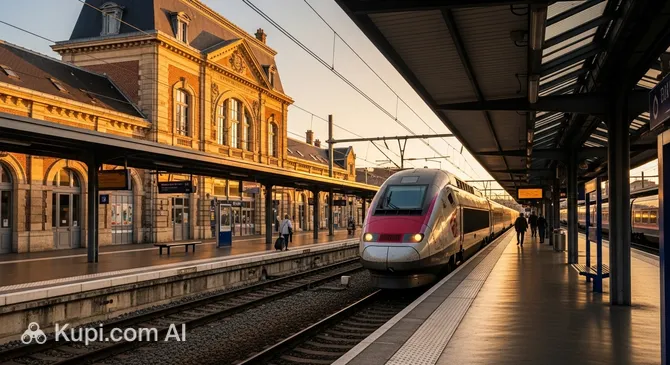
Douai Station (Gare de Douai) is an important transport hub in the Hauts-de-France region, providing a railway link between Lille and Paris. The station building combines functionality with the understated elegance characteristic of French transport architecture. Both high-speed TGV trains and regional TER express trains arrive here, making it a convenient starting point for travels across the north of the country. The atmosphere here is usually calm, and navigation is intuitive even for those visiting France for the first time.
It is important for passengers to know that the station has several platforms connected by an underground passage, equipped for ease of movement with luggage. The main entrance is located on the side of Place de la Gare. Information screens in the main hall and on the platforms display departure track details. To transfer to city transport, simply exit the building: the bus station is located in the immediate vicinity.
Contact Information
Official website: garesetconnexions.sncf (Gare de Douai section)
Information phone: 3635 (single SNCF number for inquiries and booking)
Address: Place de la Gare, 59500 Douai, France
Opening hours: the station is open daily from 05:15 to 23:00 (schedule may change on public holidays)
Luggage storage: availability of automatic lockers depends on the current security level (Vigipirate), it is recommended to check on site
Accessibility: the Accès Plus service operates to assist passengers with reduced mobility (advance booking 48 hours prior is desirable)
How to Get There
Getting to Douai station is effortless, as it is conveniently located relative to main city routes. If you are in the historic centre, for example, near the famous belfry, a walk will take about 10–15 minutes. Follow the signs for Gare SNCF, moving along the straight streets of the city.
For those who prefer public transport, a major transfer hub of the Évéole network is located in front of the station building. Main bus lines arrive here (including Line A), connecting the station with various districts of the city and suburbs. Also, city taxis are always on duty at the exit, ready to take you to any point in 5–10 minutes depending on traffic.
Services and Amenities
Douai Station offers passengers a necessary set of services for a comfortable wait for the train. The main hall houses ticket counters for consultations and automatic terminals for quickly purchasing travel documents by card or cash. For rest, there is a spacious waiting area with seats where you can pass the time before departure.
Free Wi-Fi operates throughout the station, allowing you to stay connected. Clean restrooms, a photo booth, and a mailbox are also available. Special attention is paid to passengers with limited mobility: the station is equipped with ramps, elevators for platform access, and special tactile paving. Convenience and accessibility are service priorities in Douai.
Where to Eat
If you need a quick snack before your journey, a kiosk of the Relay chain operates directly within the station building. Here you can buy fresh press, water, sandwiches, chocolate, and hot coffee. This is an ideal option for those rushing to catch a train who wish to take food with them. The average bill for a light snack will be around 5–8 euros.
For a more substantial meal, it is worth stepping out onto the station square. Next to the station, there are several typical French brasseries and cafes serving full breakfasts and lunches. Here you can calmly enjoy a cup of coffee with a croissant or order a hearty dish of local cuisine, provided you have 30–40 minutes to spare before the train departs.
Station History
The history of railway communication in Douai dates back to the mid-19th century. The first trains arrived here in 1846, when the strategically important Paris — Lille line was opened. Since then, the station became a crucial element of the region's industrial development, ensuring the transportation of coal and steel, for which the north of France was famous.
The station building and infrastructure were rebuilt and modernised repeatedly, especially after serious destruction caused by two world wars. The modern appearance of the station reflects post-war reconstruction with elements of functionalism. Today, it plays the role of a key hub for high-speed TGV trains, connecting the city's rich historical heritage with modern travel technologies.
Travel Tips
We recommend arriving at the station at least 20 minutes before the train departs, especially if you need to buy a ticket at the counter or find the correct platform. Boarding for TGV trains usually closes 2 minutes before departure, so punctuality is critically important here. The station closes at night, so plan your waiting time in advance.
Do not forget about safety: do not leave luggage unattended, as strict rules apply in France (Vigipirate plan). If you have an old-style paper ticket (without a QR code), be sure to validate it in the yellow machine before entering the platform. Travel light and keep your tickets at hand for inspection by the conductor.
Reached the bottom of the page?
Looks like you know this route inside out
Popular routes
Where travelers fly most — pick a route and check prices