Support

Rimatara

About the Airport

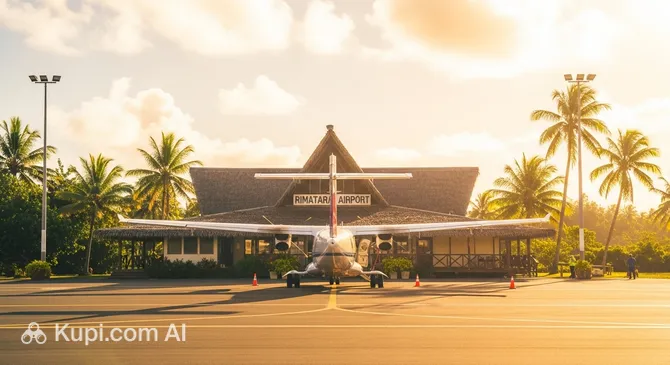
Rimatara. Illustration.
Source: Kupi.com AI

Rimatara Airport (RMT) is not merely a transport hub, but a long-awaited gateway to one of the most isolated corners of French Polynesia. Opened relatively recently, in 2006, this small airfield interrupted the centuries-old isolation of the island, making it accessible to travelers dreaming of seeing the pristine nature of the Austral archipelago. You will not find the hustle and bustle of megacities here: arriving here resembles a visit to old friends, where you are greeted right from the aircraft steps by a warm ocean breeze and the calm rhythm of island life.

PropertyValue
IATA CodeRMT
ICAO CodeNTAM
CityRimatara
CountryFrench Polynesia
TimezonePacific/Tahiti
Top AirlinesAir Tahiti
ScheduleOnline Timetable

Features and advantages of the airport:

The main and most unusual feature of the airport is its strict bio-control. Rimatara is one of the few places in the world inhabited by the endemic Kuhl's lorikeet (local name — 'Ura). To protect this rare bird from predators, all luggage and cargo undergo a thorough check upon arrival to prevent the introduction of rats and other pests to the island.

The terminal itself is a small and cozy building in the Polynesian style, harmoniously blended into the surrounding landscape. Thanks to its compact size, all procedures are quick and queue-free. Landing at Rimatara is considered one of the most picturesque: the plane descends over the turquoise lagoon and the ring of reefs, offering a stunning view of the green island even before touching the runway.

Contact Information

  • Official airport website: www.airtahiti.pf (Rimatara destination page on the main operator's site).
  • Inquiry service phone: +689 40 94 42 23 (Local Air Tahiti agency at the airport, hours limited to flight times: Tue, Thu 08:00–11:00).
  • Unified booking and information center: +689 40 86 42 42 (Air Tahiti Head Office, available daily).
  • Airport Address: Aéroport de Rimatara (RMT), Village de Amaru, 98752 Rimatara, Îles Australes, Polynésie française.
  • Email: reservation@airtahiti.pf (General inquiries and booking).
  • Social Media:
  • Lost Luggage Information: Contact the airline representative in the arrival area or call +689 40 86 42 42 (Service Bagages).
  • Passenger Support Contacts: For prompt communication, it is recommended to use the feedback form on the Air Tahiti website or call the central call center, as the local office is open only during flight handling.

How to Get to the Airport

Transport logistics on Rimatara differ significantly from what residents of major cities are accustomed to. There is no complex public transport system or taxi services with apps here. The island is very compact, and the atmosphere is incredibly friendly, so getting from the airport to your accommodation is a simple and pleasant procedure that often becomes the first step in experiencing local hospitality.

Transfer from Guesthouses (Pensions)

This is the main and most reliable way of getting around for tourists. There are no large chain hotels on Rimatara; travelers stay in cozy family pensions (pensions de famille). In 99% of cases, the "airport — hotel — airport" transfer is organized by the hosts themselves.

When booking accommodation, be sure to provide your flight number. Hosts will meet you at the terminal exit, often with traditional flower necklaces, and take you by car. The cost of this service is often included in the stay or amounts to a symbolic sum (about 1000–1500 Pacific Francs, XPF).

Public Transport and Taxi

Public transport is completely absent on the island: there are no buses, shuttles, or trains. You will not find classic taxi services with meters here either. If you have not booked a transfer in advance, you can ask for help from airport staff or local residents meeting the flight — everyone knows each other on the island, and you will surely be given a lift to the necessary village for a small fee.

Car and Bicycle Rental

Renting a car directly inside the terminal building is not possible — there are no international rental agency desks here. However, you can arrange a car rental through your guesthouse. Considering that the perimeter of the island is only about 14 km, the most popular transport among tourists is bicycles. Their rental is often provided by pensions for free or for a small fee. This is the ideal way to leisurely explore the island while enjoying the views.

Parking at the Airport

A small open parking area is equipped in front of the terminal. It is free and used mainly by local residents meeting or seeing off relatives. There is always enough space, and safety is guaranteed by the general tranquility of the island.

Travel Time and Distances

The main villages of the island — Amaru, Anapoto, and Mutuaura — are located very close to each other. The journey from the airport to any settlement will take very little time:

  • To the administrative center of Amaru: 2–5 minutes.
  • To the most remote guesthouses on the island: no more than 15–20 minutes.

Neighboring Airports and Air Connections

A trip to Rimatara is often part of a tour of the Austral (Tubuai) archipelago. Flights here are usually operated with stops on other islands, allowing tourists to plan interesting "island hopping" routes.

The nearest neighbor is the picturesque island of Rurutu, known for its caves and whale watching opportunities. It is located just 150 km away, which is quite close by Pacific Ocean standards.

The route network also connects Rimatara with the island of Tubuai, the administrative center of the archipelago, where you can see the historic Fort George. Slightly further lies the secluded Raivavae, often called the "Bora Bora of the past" for its incredible lagoon.

The main international hub, from where most journeys to French Polynesia begin, is Faa'a Airport on Tahiti. It is from there that the main flights to Rimatara depart. You can also reach the capital or other islands via transit through Temae Airport on the island of Moorea, although direct flights between Moorea and Rimatara may not be available in the seasonal schedule.

Terminals and Map

Structure and Navigation

Rimatara Airport (RMT) is the embodiment of island minimalism. A single passenger terminal operates here, serving both domestic arrivals and departures. The building is a small structure in traditional Polynesian style with open elements providing natural ventilation. It is impossible to get confused here: navigation is intuitive, as all key zones are within direct line of sight.

Arrival and Departure Zones

The internal space of the terminal is compactly zoned:

  • Check-in Zone: Located immediately at the entrance to the terminal. Here you will find the Air Tahiti counters where passengers check in luggage and receive boarding passes.
  • Waiting Hall: A small space with seats where passengers await boarding. Due to the absence of glass partitions and airbridges, a view of the runway opens up from here.
  • Baggage Claim Zone: There are no conveyor belts in Rimatara. Luggage is unloaded manually onto special racks or carts in the arrival area, which is located in close proximity to the exit to the parking lot.

Features of Procedures

Despite the relaxed atmosphere, procedures at the airport are strictly regulated, especially regarding bio-security. The Arrival Zone is equipped with a screening point where staff check the hand luggage and baggage of arrivals for prohibited items and biological materials (fruits, plants) to protect the island's unique ecosystem and parrot population.

Boarding is done on foot. Passengers walk from the terminal building to the aircraft across the apron. This is an excellent opportunity to take final photos against the backdrop of the plane and tropical greenery, however, airport staff ensure that passengers do not linger on the tarmac for safety reasons.

Check-in Time and Passenger Advice

The recommended arrival time at the airport is 1–1.5 hours before departure. Although queues are rare here, check-in for Air Tahiti flights closes strictly 20–30 minutes before departure. If you are late, the plane may leave without you, as the flight schedule between islands is very tight.

The terminal has restrooms, but there are no Duty Free shops, cafes, or ATMs. Travelers are advised to take care of water and snacks in advance, as well as to have cash on hand in case payment for excess baggage is required.

Airport History

The history of Rimatara Airport (RMT) is not a chronicle spanning a century, but an exciting chapter in the modern history of French Polynesia, telling the story of emerging from great isolation. Until recently, this island remained one of the most inaccessible places in the Austral archipelago, and the construction of the air harbor became a turning point in the life of the local community.

The Pre-Aviation Era: Long Isolation

For centuries and up until the beginning of the 21st century, Rimatara could only be reached by sea. The island does not have a deep lagoon or a convenient port, so the cargo ship Tuhaa Pae was forced to anchor in the open ocean. Passengers and cargo were transferred to small whaleboats that maneuvered among dangerous reefs to reach the shore. This procedure was not only long and exhausting but also unsafe, especially in stormy weather, making the island practically closed to mass tourism.

Opening and Launch

The official opening of the airport took place in 2006. This event became a real national holiday for the residents of Rimatara, as they were the last in the Austral archipelago to receive an air link with Tahiti. Construction was carried out taking into account strict environmental standards to minimize the impact on the unique landscape of the flat island.

Key Stages of Development

Since its launch, the airport has not undergone radical reconstruction, as it was originally designed for the specific needs of regional aviation. The paved runway has a length sufficient to accommodate turboprop aircraft such as the ATR 42 and ATR 72, which form the backbone of the Air Tahiti fleet. Major works over the past years have concerned:

  • Strengthening the runway surface to protect against erosion in the tropical climate.
  • Improving navigation equipment to ensure flight safety over the ocean.
  • Updating the terminal to improve passenger comfort while maintaining its traditional Polynesian appearance.

Ecological Record and Uniqueness

An interesting fact from the airport's history is related to bio-security. Rimatara is one of the last refuges of the rarest parrot — the Kuhl's lorikeet ('Ura). From the very first day of the airport's operation, perhaps the strictest quarantine control in Polynesia was introduced here. The history of the airport is inextricably linked with the history of saving this species: opening the air gates carried the risk of black rats (the main enemies of the parrot) entering the island. Therefore, the launch of flights was accompanied by an unprecedented campaign to train staff and introduce luggage inspection by specially trained dogs, which is successfully practiced to this day.

Today, Rimatara Airport remains a symbol of the balance between progress and the preservation of traditions, providing a vital link for the island with the outside world and allowing tourists to discover this lost paradise in just an hour and a half flight from Tahiti.

Services and Facilities

Rimatara Airport (RMT) is a place where time flows at its own rhythm. It is important for travelers to understand that this is a very small regional airfield located on a remote island. Infrastructure here is reduced to the necessary minimum, and the level of service is defined not by technical novelties, but by the warmth and responsiveness of the staff. Expecting the set of services customary for international hubs here, you may be disappointed, so it is better to prepare in advance.

Restaurants, Cafes, and Shops

The airport terminal lacks cafes, restaurants, and Duty Free shops. There are not even vending machines with snacks or coffee. In this regard, passengers are strongly advised to:

  • Take care of drinking water and a light snack in advance, before arriving at the airport (especially if you are traveling with children).
  • Purchase souvenirs at craft centers in the villages, as there are no shops in the departure zone.

Sometimes, during the arrival or departure of flights, local residents may sell traditional flower necklaces (leis) or small crafts at the entrance to the terminal, but this is not a permanent service.

Banking Services and Currency Exchange

This is one of the most critical points for trip planning. At Rimatara Airport, there are no ATMs and currency exchange points. Moreover, banking infrastructure on the island itself is extremely limited.

Tourists need to withdraw a sufficient amount of cash (Pacific Francs — XPF) while still on Tahiti or Moorea before departure. Cash will be required to pay for transfers, excursions, purchases in small shops, and payment for excess baggage at the check-in counter.

Communication and Electronics

The airport can be called a "digital detox" zone. Public Wi-Fi is absent. Mobile internet from local operators (Vini, Vodafone) may work in the airfield area, but the signal is not always stable. There are no charging stands for mobile devices or generally accessible power outlets in the waiting hall, so it is recommended to fully charge gadgets before leaving the guesthouse.

Lounges and VIP Services

The terminal consists of one general hall, which serves as a zone for both check-in and waiting. Separate business lounges, VIP lounges, or meeting rooms are not provided here. The space is open, well-ventilated, with simple benches. The main "VIP bonus" for all passengers is the panoramic view of the runway and tropical greenery.

Services for Passengers with Children

There is no specialized mother-and-child room or play areas in the terminal. However, thanks to the compactness of the building and the friendly attitude of the staff, traveling with children is relatively easy. Families with small children are usually invited to board first. It is recommended to have everything necessary with you (food, diapers), as there will be nowhere to buy this on-site.

Services for Passengers with Reduced Mobility

Rimatara Airport is single-story, which facilitates movement:

  • The entrance to the terminal and the exit to boarding are equipped at ground level; there are no steps inside the building.
  • Boarding the aircraft (usually ATR-72 or ATR-42) is carried out via a built-in ramp. Air Tahiti provides assistance with boarding and disembarking for passengers with limited mobility, but the carrier must be notified at least 48 hours before departure.
  • The terminal has a toilet accessible to people with disabilities.

Medical Services

There is no full-fledged medical center or pharmacy in the airport building. Security and airline staff are trained in first aid and have basic first aid kits. In case of serious health problems, help can only be obtained at the medical center (infirmerie) in the main village of Amaru. In emergency situations, medical evacuation by helicopter or special flight to Tahiti is organized.

Hotels and Accommodation

There are no hotels on the airport territory or within walking distance of it. Rimatara is an island of family pensions (pensions de famille). The nearest guesthouses are located in the villages of Amaru, Anapoto, and Mutuaura (10–20 minutes drive). As a rule, pension hosts come to the airport themselves for the flight arrival to meet their guests. If you have not booked accommodation in advance, finding a place to sleep upon arrival can be problematic, as the number of places on the island is limited.
Dining

Travelers flying from Rimatara Airport (RMT) should prepare for a complete lack of familiar gastronomic infrastructure. This is a tiny regional airfield where the concept of "airport dining" is not applicable in the classical sense. There are no restaurants, cafes, bars, coffee shops, or even vending machines with chocolate or water here.

Restaurants and Cafes: Current Situation

Since the terminal consists of one common zone and opens only for specific flights, maintaining a permanent food outlet here is economically unfeasible. You will not find chain establishments or local eateries in either the "landside" or "airside" zones. Passengers should not count on the opportunity to drink a cup of coffee before departure or have lunch while waiting for the plane.

Dining Recommendations: How to Prepare

Given the lack of service, the best strategy is self-catering. Here are a few tips for comfortable flight waiting:

  • Full Meal: It is strongly recommended to eat a hearty meal before leaving for the airport. In family pensions (where most tourists stay), hosts usually know the flight schedule and can serve you breakfast or lunch a little earlier than usual so that you do not fly on an empty stomach.
  • Take-away: If you realize you will get hungry, ask at your place of accommodation to prepare a "lunch box" or sandwich to take with you (usually for a small additional fee). This is the most reliable way to taste local products even on the way.
  • Buying Groceries in Advance: In the villages of Amaru, Anapoto, or Mutuaura, there are small grocery stores (magasins). Buy cookies, crackers, or local fruits there before the transfer takes you to the airport.

Drinks and Water

This is a critically important point: there is nowhere to buy water in the terminal. Drinking fountains are also not provided. Be sure to take a bottle of water with you. Since strict restrictions on carrying liquids (as in international hubs) are often absent on internal flights between islands with small airports (or screening is more lenient towards a bottle of water for personal use), having your own water will save you from thirst in the tropical climate.

Specialized Nutrition (Halal, Vegetarian, Gluten-Free)

Since catering is absent, diet control is entirely in your hands. The airport cannot offer any options. If you have strict dietary restrictions, such as requiring Halal food, the only option is to bring suitable food with you from your guesthouse.

Local Delicacies "Hand-sold"

In exceptional cases, during major holidays or the arrival of particularly busy flights, local residents may sell fresh fruits (bananas, papaya) or homemade pastries (for example, "brioche" or coconut bread) at the entrance to the terminal. However, this happens spontaneously, and one should not count on it as a guaranteed dining option.

Summary

Rimatara Airport is a place for rapid transit, not for gastronomic pleasures. Your "menu" at the airport will consist exactly of what you bring with you in your backpack. The average bill here is zero, and the "restaurant" opening hours depend only on when you decide to open your own food container.

Travel Tips

Traveling through Rimatara Airport is a unique experience that differs greatly from flights through major international hubs. To ensure your trip goes smoothly and leaves only pleasant impressions, it is worth considering the specifics of how small island airfields work and the features of local aviation.

Optimal Arrival Time

Although the airport is very small and it is impossible to get lost in it, being late is not accepted here. It is recommended to arrive at the terminal 1–1.5 hours before departure. Air Tahiti check-in counters close strictly 20 minutes before the flight departure. Considering that planes fly in a chain between islands, the delay of one passenger can disrupt the schedule for the whole day, so staff do not make exceptions for latecomers.

Check-in and Screening Features

The check-in procedure here takes place in a calm, "home-like" mode. There are no electronic self-service kiosks; everything is done manually by staff behind the counter. Prepare your passports and tickets in advance.
Security service works as standard, but with an emphasis on bio-control. When departing from Rimatara (or arriving), you may be asked to open bags to check for fruits, plants, or seeds. This is necessary to protect the island's ecosystem and prevent the spread of pests.

Seat Selection on the Plane

Flights are operated on turboprop aircraft ATR-72 or ATR-42. These liners have their own features to consider when choosing a seat:

  • View: Since the wing on the ATR is located on top of the fuselage, it does not block the view of the ground. However, if you sit directly under the wing (rows 7 to 14), the view may be partially blocked by the engine and landing gear. For the best photos, choose seats in the tail or at the very beginning of the cabin.
  • Free Seating: On many inter-island Air Tahiti flights, a "free seating" system or zone distribution operates. To occupy a window seat (which is worth its weight in gold here due to lagoon views), try to proceed to boarding among the first.
  • Side of the Aircraft: When departing from Rimatara towards Tahiti, beautiful views of the island usually open up from the left side of the aircraft, but this depends on wind direction and takeoff.

Hand Luggage: What is Important to Know

Requirements for hand luggage on Air Tahiti flights are stricter than on international lines.
Dimensions: The overhead bins in ATR aircraft are very small and narrow. A standard "cabin size" suitcase on wheels simply won't fit there. Use soft bags or backpacks.
Weight: The hand luggage limit is usually 5 kg (for some fares — 3 kg). Bags are weighed strictly.
Liquids: On domestic flights, rules for carrying water and liquids are often less strict than on international ones, but it is better to clarify this with staff at screening. However, sharp objects (scissors, corkscrews) will be confiscated permanently.

Advice for Transit Passengers

Rimatara is often an intermediate stop on routes through the Austral archipelago (for example, the Papeete — Rimatara — Rurutu flight).
If your plane lands here, but you are flying further, listen carefully to the crew's announcements. Usually, transit passengers are asked to remain in their seats while those who arrived at Rimatara disembark. Do not mix up the stop: airport buildings on the islands look similar to each other.

Saving Time and Money

  • Excess Baggage: If you are carrying souvenirs or diving equipment, and the baggage weight exceeds the norm (usually 10 or 23 kg depending on the fare), pay for the excess in advance at an Air Tahiti agency. Payment at the airport may take time, and rates will be higher.
  • Food: As already mentioned, there is no food at the airport. Save your nerves and money by taking sandwiches from the guesthouse. Buying food on the plane on short flights is not offered (only juice/water, and even then not always).
  • Transfer: Always arrange a transfer with the hosts of your accommodation. Taxi "from the curb" does not exist here, and finding a car on the spot can be a problem.

What to Do in Case of Flight Delay

Weather in the South Pacific is changeable, and flights to Rimatara may be delayed or canceled due to strong winds or poor visibility.
If the flight is delayed:
1. Stay calm: Staff do everything for safety. Shouting and demanding departure is useless.
2. Keep in touch with accommodation: If you have arrived, but the plane could not land and went to an alternate airfield (or returned to Tahiti), or if your departure is postponed — be sure to call the hosts of your pension. They are waiting for you at the airport and need to know that plans have changed.
3. Entertainment: There is no Wi-Fi or entertainment in the terminal. Be sure to have a paper book, downloaded movies, or music on your phone (and a power bank) to pass the waiting time.

Reached the end of the page?

That means the route is fully explored