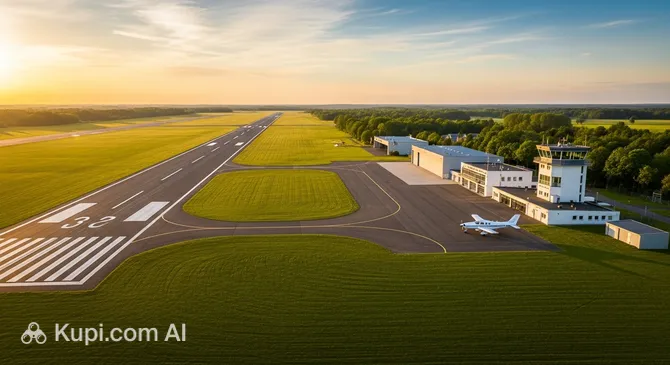
Source: Kupi.com AI
| Characteristic | Value |
|---|---|
| IATA code | QGW |
| ICAO code | EDAN |
| City | Ludwigslust |
| Country | Germany |
| Time zone | Europe/Berlin |
| Schedule | Online timetable |
| Characteristic | Value |
|---|---|
| IATA code | QGW |
| ICAO code | EDAN |
| City | Ludwigslust |
| Country | Germany |
| Time zone | Europe/Berlin |
| Schedule | Online timetable |
Since Neustadt-Glewe Airfield (QGW/EDAN) is a general aviation facility used primarily for sports and private flights, there are no 24-hour services typical of major international hubs. The main contact details refer to the airfield administration and the flying clubs based here.
As Neustadt-Glewe Airfield is a facility for small and sports aviation, there are no scheduled shuttle buses or express trains typical of large international hubs. Most visitors — skydivers, pilots, and festival guests — arrive here by private transport or combine a train journey with a short transfer. Logistics here are simple and pleasant, allowing you to enjoy the views of the German countryside.
By Car and Parking
A car is the most convenient way to reach the airfield. The site is located in immediate proximity to the A24 motorway (Hamburg — Berlin), making it easily accessible from both metropolises. You need to take the "Neustadt-Glewe" exit and follow signs for Flugplatz. The drive from Neustadt-Glewe city centre takes just 5–7 minutes (distance is about 2–3 km).
Unlike major airports, there are no complex multi-level car parks with high tariffs here. A spacious surface car park is provided for guests and flying club members. Typically, parking is free or costs a nominal amount during major events such as the Airbeat One festival. There is usually ample space even on weekends.
Public Transport: Train and Bus
There is no direct bus service to the airfield terminal, but the German railway network allows you to get very close:
Taxi and Transfer
A taxi is the optimal option for those arriving by train with heavy luggage or skydiving equipment. It is better to book a car in advance by phone, as they are not always waiting at the station. A trip from Neustadt-Glewe station will cost approximately 10–15 Euros, and from Ludwigslust station — about 25–35 Euros. Applications like Uber do not work as reliably in this region as they do in Berlin, so it is safer to rely on local dispatch services.
Car Rental
It is not possible to rent a car directly at the airfield. If you need a vehicle for travelling around the Mecklenburg-Vorpommern region, we recommend arranging a rental upon arrival at major international airports or in the city of Schwerin. This will give you the freedom to move between the lakes, castles, and the airfield.
Nearest International Airports
For international tourists planning to visit this region, Neustadt-Glewe Airfield is the final destination of the route, not the point of entry into the country. Travellers usually fly into one of the large nearby airports and then reach Neustadt-Glewe by ground transport:
The closest is Laage Airport (about 75 km), which is convenient for those wishing to combine the trip with a holiday on the Baltic Sea. However, the undisputed leader in terms of flight frequency and connection convenience is Hamburg Airport (112 km). The journey from there by car takes just over an hour via the Autobahn. Another popular option is the capital's Berlin Brandenburg Airport (about 169 km), from where it is convenient to reach Ludwigslust by high-speed train.
You can also consider Hannover Airport or Bremen Airport if you are planning a grand road trip across Northern Germany, although they are located somewhat further away.
If you are accustomed to endless corridors, travelators, and multi-level terminals of international airports, Neustadt-Glewe Airfield will be a pleasant discovery for you. The structure of this aviation hub is extremely simple, logical, and human-oriented. There is no complex system of terminals here — all infrastructure is concentrated in a compact complex of buildings, creating a cosy, almost home-like atmosphere.
One Terminal — Many Possibilities
Essentially, the functions of a passenger terminal are performed by the main administrative building. This is the heart of the airfield, where the paths of pilots, skydivers, and guests cross. The building combines several key zones:
Layout and Navigation
It is impossible to get lost in Neustadt-Glewe. Navigation is intuitive: from the car park, you go straight to the main building or the spectator area. The absence of strict "sterile zone" boundaries (as in large airports) allows guests to feel like direct participants in aviation life. However, it is important to remember that access to the apron (aircraft parking area) is permitted only when accompanied by staff or a pilot.
Departure and Arrival Zones
The concepts of "departure zone" and "arrival zone" are quite nominal here. Access to aircraft is through special gates directly from the administrative area or hangars.
Time for Procedures
The main advantage of general aviation is the absence of queues. Registration and pre-flight briefing procedures take minimal time:
There are no shoe scanners or restrictions on carrying liquids typical of commercial flights here, making the flight preparation process as comfortable as possible.
Navigation Recommendations
Upon arrival at the airfield, look for the sign "Flugleitung" (Flight Administration) or signs with the names of specific clubs (e.g., the parachute centre). If you have arrived as a spectator or companion, the best waiting point is the open terrace of the café: all flight activity is perfectly visible from there, and you will not miss the moment of take-off or landing of your friends.
The history of Neustadt-Glewe Airfield (QGW) mirrors German aviation of the 20th century. Over nearly a century of existence, this facility has transformed from a secret industrial testing ground to one of the most democratic and popular centres for sports aviation in Mecklenburg. Today, a spirit of freedom and celebration reigns here, but the pages of the past hold many austere and significant chapters.
Foundation and the Era of Aircraft Manufacturing (1930s)
The history of the airfield began in the mid-1930s. Its emergence was dictated by the rapid development of Germany's aviation industry at that time. A branch of the famous Dornier-Werke concern, specialising in the construction of bombers and flying boats, was opened in Neustadt-Glewe. For the factory's needs — equipment testing and transport logistics — its own runway was required. Thus, the airfield emerged, initially as a closed facility serving industrial and military interests.
"Forge of Wings": The Post-War Period and the GDR
After World War II and the formation of the GDR, the purpose of the airfield changed radically. Its industrial past gave way to a sporting future. The facility came under the management of the "Society for Sport and Technology" (GST) — a paramilitary sports organisation of East Germany.
During this period, Neustadt-Glewe became a true school for hundreds of future pilots. Gliding developed actively here: young people mastered the art of unpowered flight, and the airfield infrastructure was adapted for training tasks. New hangars and classrooms were built, and a strong tradition of flying club life was formed, which is still alive today.
Modernisation and Present Day
A new chapter opened after the reunification of Germany in 1990. The airfield received the status of Verkehrslandeplatz (commercial general aviation airfield), which allowed it to receive private aircraft and develop tourism. In the 1990s and 2000s, large-scale reconstruction took place: the ground surface of the runways was renewed, communication and navigation aids were modernised, and the passenger and pilot service area was improved.
Today, the airfield is a key hub for skydiving in Northern Germany. Thanks to the constant renewal of the fleet and infrastructure, it attracts skydivers from all over Europe.
Events and Interesting Facts
The infrastructure of Neustadt-Glewe Airfield (QGW) fully corresponds to its status as a cosy haven for general aviation. You will not find multi-storey shopping galleries or futuristic sleep pods here, but the special charm lies precisely in this simplicity and intimacy. All services are located compactly, and the staff treat every guest like an old acquaintance.
Restaurants and Gastronomy
The main attraction point for all visitors is the local bistro-café (Fliegerklause). It is not just a place to have a snack, but a true club for enthusiasts. It offers traditional German dishes, homemade pastries, coffee, and refreshments. The main feature of the establishment is the open terrace with a direct view of the airfield. While waiting for your flight or watching skydivers jump, you can enjoy lunch literally a few metres from taxiing aircraft.
Shops and Souvenirs
There is no customary Duty-Free zone or branded clothing boutiques here. Shopping opportunities are limited to small counters at the flying clubs. At the skydiving centre office, you can often purchase themed souvenirs: t-shirts, caps, or stickers with aviation symbols, which will be a great reminder of the jump you performed. For full-scale shopping or groceries, it is worth heading to the town of Neustadt-Glewe, located just a couple of kilometres away.
Communication and Finance
Comfort and Business Services
There are no specialised VIP lounges or airline business lounges at the airfield, as regular commercial flights do not operate here. The role of a relaxation zone is played by the common space in the club or on the terrace. For pre-flight briefings or small meetings, the flying club's classrooms can be used — by prior arrangement with the administration.
Medical Services and Safety
Due to the specific nature of the airfield (active skydiving), increased attention is always paid to safety here. Instructors trained in first aid are present on-site, and first aid kits are available for emergencies. There is no full-scale medical centre or pharmacy; in case of serious necessity, assistance will be provided by the city services of Neustadt-Glewe.
Services for Passengers with Children
The airfield is a great place for a family visit. Children will be interested in watching the take-offs and landings of light aircraft from a safe distance. There are no special playrooms inside the buildings, but the spacious green territory allows children to spend time actively in the fresh air. Parents should watch their children carefully to ensure they do not go beyond the barriers of the flight zone.
Accessible Environment
The main public areas (car park, café, administration) are located on the ground floor, facilitating access for passengers with reduced mobility and wheelchair users. Airfield staff are always ready to provide individual assistance with boarding the aircraft, if the aircraft design allows it.
Hotels and Accommodation
There are no hotels directly on the airfield territory, however, in the warm season (especially during festivals), a campsite is often organised here for guests and participants.
For comfortable accommodation, we recommend considering options in the town of Neustadt-Glewe (5 minutes by taxi):
The gastronomic map of Neustadt-Glewe Airfield differs significantly from what passengers of major international hubs are used to. Here you will not encounter chain coffee shops, fast-food giants, or fine dining restaurants. Catering at the airfield is organised on the principle of "cosy, hearty, and home-style," which fits perfectly into the overall democratic atmosphere of this place.
Main Establishment: Bistro and Terrace
The only and main place where you can satisfy your hunger is the local airfield café (often called Fliegerklause or Fliegerbistro). It is located in the main administrative building and is accessible to all visitors — both pilots and guests, seeing-off parties, or simply spectators. There is no division into "airside" and "landside" zones: entrance to the café is free from the street.
The main highlight of the establishment is the sunny open terrace. This is an ideal location for lunch: you can enjoy your meal while watching the preparation of skydivers and aircraft take-offs literally a few dozen metres away from you.
Menu and Specialities
The cuisine here is simple but honest — what is called Gutbürgerliche Küche (hearty home-style cuisine) in Germany. If you want to feel the local flavour, pay attention to the following offers:
Dietary Requirements
Travellers with strict dietary preferences should be prepared for a limited selection:
Prices and Opening Hours
The pricing policy at the airfield will pleasantly surprise you compared to city airports. The average bill for a full lunch with a drink will be about 10–15 Euros. Coffee and a piece of cake will cost 5–7 Euros.
The opening hours of the bistro depend directly on flight activity:
Recommendations
For a quick snack before a parachute jump, a "Bockwurst" (boiled sausage) with a bread roll and mustard is ideal — it is filling and does not require a long wait. If you have time, order a full lunch on the terrace. In case you require a more refined menu or a wide selection of vegetarian dishes, we recommend heading to the town of Neustadt-Glewe (just 5–7 minutes by taxi), where restaurants at the castle hotel and cosy town pizzerias are located.
Travelling through a small aviation airfield like Neustadt-Glewe differs radically from the experience in major international hubs. There is no hustle, long queues, or rigid regulations here, but there are specific rules dictated by the safety of private and sports flights. Here are some useful tips that will make your visit as comfortable as possible.
Arrival Time: No Rush, but On Time
Forget the rule of "arriving 2–3 hours in advance." In Neustadt-Glewe, everything happens much faster.
Check-in and Screening: Trust and Common Sense
There are no classic check-in counters or metal detector frames here. The "check-in" procedure is usually a personal meeting with the pilot or flying club manager in the main building (Flugleitung).
Seat Selection in the Aircraft
In general aviation, seating is determined not by a ticket, but by the aircraft's centre of gravity (weight distribution).
Hand Luggage and Baggage
The main limitation of small aviation is weight and dimensions.
Connections and Transfers
Neustadt-Glewe is not designed for transit transfers in the classical sense. If your route involves further travel:
Customs and Passport Control
The airfield operates primarily within the Schengen Area.
Saving Time and Money
What to Do in Case of Flight Delay
Delays in small aviation are most often caused not by technical failures, but by weather (fog, strong crosswind, low cloud cover).
Have you reached the end of the page?
So the route has been studied inside and out