Support

Milos Airport

About the Airport

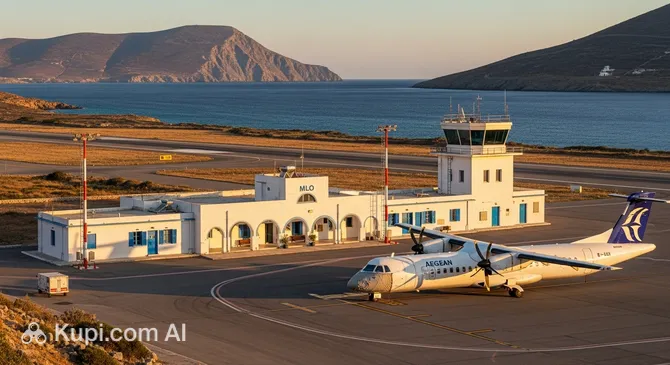
Milos Airport. Source: Kupi.com Binoculars

Milos Airport is not merely a transit point, but a welcoming gateway to the world of white cliffs and turquoise lagoons of this famous volcanic island. Unlike noisy international hubs, this air harbour greets travellers with an intimate atmosphere and the unhurried rhythm of a true Greek holiday. Immediately after landing, you will feel the warm breeze of the Aegean Sea, as the terminal is located literally a stone's throw from the runway, setting the mood for relaxation from the very first minutes.

IATA Code MLO
ICAO Code LGML
City Milos (near the port of Adamas)
Distance to Centre 5 km
Status National (Domestic)
Annual Passengers About 90,000
Schedule Seasonal and regular flights

Airport Features and Advantages:

  • Compactness and Speed: Thanks to the terminal's small size, all procedures — from check-in to baggage claim — are completed as quickly as possible, allowing you to save time for your holiday.
  • Scenic Approach: Flights to the island are primarily operated by smaller aircraft that fly lower than standard airliners, offering passengers stunning panoramic views of the Cycladic archipelago.
  • Convenient Logistics: The airport is located practically in the centre of the island, making the transfer to any resort or beach short and untiring.
  • Tranquil Atmosphere: It is rarely crowded here, which eliminates the stress and bustle usually associated with air travel.

Contact Information

For your convenience, we have compiled the main contact information for the Milos Island National Airport (MLO).

  • Official Website: www.mlo-airport.gr
  • Information Desk Phone: +30 22870 28410
  • Address: Milos Airport, Milos 848 00, Greece
  • Email: A direct email address is not published. It is recommended to use the contact form on the airport's official website for communication.
  • Social Media: The airport is represented on the official pages of the management company, Fraport Greece, on Facebook, X (formerly Twitter), Instagram, and YouTube, where general news and updates are published.
  • Lost Luggage Information: For issues related to lost or damaged luggage, you must contact your airline's representative directly or the ground handling service that processed your flight.
  • Passenger Support Service: For enquiries and assistance, you can use the information desk phone or the feedback form on the official website.

How to Get to the Airport

The National Airport of Milos (MLO) is located just 5 kilometres from Adamas, the island's main port, making it easily accessible from any point in this picturesque corner of Greece. There are several convenient ways to get to or from the airport to your hotel, depending on your budget and preferences.

The most economical way to travel is the municipal bus (KTEL). Routes connect the airport with Adamas, Plaka, Pollonia, and other key villages. The bus schedule is usually coordinated with flight arrival and departure times, especially during the high season (from June to September). At other times of the year, there may be fewer trips. The journey to Adamas takes about 15-20 minutes, and the ticket cost is just a few euros.

A more comfortable and faster option is a taxi. The taxi stand can be found right outside the arrivals terminal exit. Cars usually await passengers after every flight. The trip to Adamas will take 10-15 minutes, and the cost will be approximately 15-25 euros, depending on the destination and time of day. For greater convenience, especially if you are travelling with family or large luggage, you can book a private transfer in advance.

For those who wish to explore the numerous beaches and attractions of Milos with complete freedom, the best solution is to rent a car, scooter, or quad bike. Both local and international rental companies are represented at the airport. It is highly recommended to book transport in advance, especially during peak months (July and August), when demand is very high and on-site selection may be limited.

Next to the airport terminal, there is a small car park. It is usually free and convenient for both short stops to drop off or pick up passengers, and for leaving a rental car before departure.

Terminals and Map

Milos Airport (MLO) is distinguished by an extremely simple and clear structure, making it very convenient for travellers. There is only one small terminal operating here, which handles all flights without exception — both domestic and rare seasonal charters. Thanks to its compactness, the airport is ideal for those who value tranquillity and dislike the bustle of major aviation hubs.

The terminal layout is intuitive. Immediately upon entering, you find yourself in the general area with check-in counters. The departure and arrival zones are located in the same building, in close proximity to each other. After passing security control, passengers enter a small but cosy waiting lounge with a boarding gate. The arrival zone consists of a compact hall with a single baggage claim belt. Transfers between terminals are non-existent as they are unnecessary — everything is under one roof.

Check-in and security procedures at Milos Airport usually proceed very quickly thanks to the low passenger flow. On average, all formalities take no more than 20-30 minutes. However, during the peak tourist season, especially in July and August, it is recommended to arrive at the airport with time to spare — approximately 1.5–2 hours before departure, as the schedule may be busier.

The main advice for navigation is simple: follow the signs. However, getting lost here is practically impossible. All key points — from the building entrance to the boarding gate — are located within a few steps of each other. Such simple and logical organisation makes the stay at MLO airport maximally comfortable and eliminates the stress often associated with moving through large airport terminals.

Airport History

The history of Milos Island National Airport (MLO) began on 17 January 1973, when it was officially opened for passenger service. In its early years, it was a modest airfield created to improve the island's transport accessibility and connection with mainland Greece, primarily with Athens. Initially, the infrastructure was minimal and intended mainly for the needs of local residents and a small number of tourists.

As the unique volcanic landscapes and picturesque beaches of Milos attracted more travellers, an urgent need arose to modernize the airport. A key moment in its development was the construction of a new passenger terminal, which began operating in 1995. This event marked a new era for the island's air gates, allowing for a significant increase in passenger flow and improved service quality. The new terminal was designed for a more comfortable stay and efficient flight processing during the peak summer season.

Over the years of its existence, the airport has not witnessed loud historical events of a global scale, but its history is inextricably linked with the transformation of Milos into one of the most desirable tourist destinations in the Cyclades. Although the airport has not set significant records, its main achievement is the stable and reliable provision of air connections, which became a catalyst for the island's economic prosperity.

An interesting fact: unlike many other regional airports in Greece that were transferred to private management, Milos Airport is still under the jurisdiction of the Hellenic Civil Aviation Authority (HCAA). Its runway is relatively short, so it can accept mainly turboprop aircraft, such as the ATR 42/72, which adds a certain charm to the journey to this amazing island. Today, Milos Airport serves as a modern and functional air gateway that continues to play a vital role in the region's tourism industry.

Services and Amenities

Milos Airport (MLO) is a small and cosy airport serving one of the most picturesque islands of the Cyclades. Given its compact size, the range of services is focused on providing basic comfort for passengers waiting for their flight. Here you will find everything necessary for a convenient start or end to your journey through Greece.

Before departure, you can relax in a small café located within the terminal building. Here, you will be offered refreshments, coffee, light snacks, sandwiches, and local pastries. It is an excellent place to have a bite while waiting for boarding. There is also a small shop at the airport where you can purchase souvenirs to remember Milos island, press, and travel essentials.

Passengers have access to free Wi-Fi, allowing them to stay connected. Although the number of charging stations for electronic devices may be limited, they are available in the waiting lounge. Specialized VIP lounges or business centres are absent at the airport, as it is oriented towards the quick and efficient dispatch of tourists. An ATM is installed in the terminal for withdrawing cash. Passengers with reduced mobility are provided with all necessary assistance during boarding and disembarking; it is recommended to notify your airline in advance for this.

For travellers with small children, changing tables are provided in the restrooms. Since the airport is located just a few kilometres from the main tourist centres, such as Adamas, there are no hotels directly on its territory. However, you will easily find many accommodation options to suit any taste and budget just a 10-15 minute drive away by taxi or rental car.

Where to Eat

The airport of Milos island (MLO) is a small and compact regional airport, so the choice of establishments here corresponds to its size. Do not expect a large variety of restaurants, but you will certainly be able to have a snack and a coffee before departure.

In the airport's single terminal, there is one café-snack bar. It is located in the general departure area, before passing security control (landside). Here, travellers can purchase a basic set for a light snack: sandwiches, pastries, soft drinks, water, and, of course, coffee. This is the main and practically the only option for dining on the airport territory.

If you want to try something with local flair, pay attention to the traditional Greek pies that are often in the assortment: tiropita (with feta cheese filling) or spanakopita (with spinach). This is an excellent choice for a quick and filling snack. There are no facilities for a full lunch or dinner at the airport, so it is better to eat in advance at one of the numerous cafés or tavernas on the island itself.

Passengers with specific dietary requirements should be prepared for a limited selection. Vegetarians will likely be able to find a cheese or spinach pie. However, specialized vegan, gluten-free, or Halal dishes are not featured here. If you have strict dietary restrictions, your best bet is to bring food with you.

Prices in the café are standard for small island airports in Greece — slightly higher than in the city. Opening hours depend directly on the flight schedule: the café opens for the first departure and closes after the last plane of the day leaves.

Travel Tips

To ensure your journey through Milos Island Airport goes as smoothly as possible, take advantage of these tips. Despite its modest size, the airport can be quite busy during the height of the tourist season. It is recommended to arrive at the airport at least 2–2.5 hours before departure, especially if you need to check in luggage. This time will be enough to complete all formalities without haste.

To save time, use online check-in if your airline provides this option. There is only one security control point here, and queues can form during peak hours. Prepare liquids in advance (in containers up to 100 ml, packed in a transparent bag) and electronic devices to speed up the screening process. When flying on small aircraft plying between the islands of Greece, hand luggage rules may be stricter — be sure to check the allowable dimensions and weight with your carrier.

When choosing a seat on the plane, note that window seats offer stunning views of the Aegean Sea and the Cycladic islands. Since most flights from Milos are domestic, there are no serious customs procedures. However, if you are flying with a connection in Athens to a country outside the Schengen zone, you will have to pass passport control at Athens airport. Allow enough time for the connection, especially if tickets were purchased from different airlines.

To save money, book a taxi or transfer from the airport in advance, as prices on the spot may be higher. Also, take an empty water bottle with you, which can be filled after passing security control. The choice of cafés and shops in the airport itself is limited, so it is better to take care of a light snack in advance as well.

In case of flight delay or cancellation, first contact your airline representative for information. Remember that flights departing from the EU are covered by the EU261 regulation, which protects passenger rights and provides for compensation, as well as the provision of meals and accommodation during long delays. Sometimes delays can be caused by weather conditions, for example, the strong Meltemi wind, which is characteristic of this region in summer.

Reached the end of the page?

That means the route is fully explored