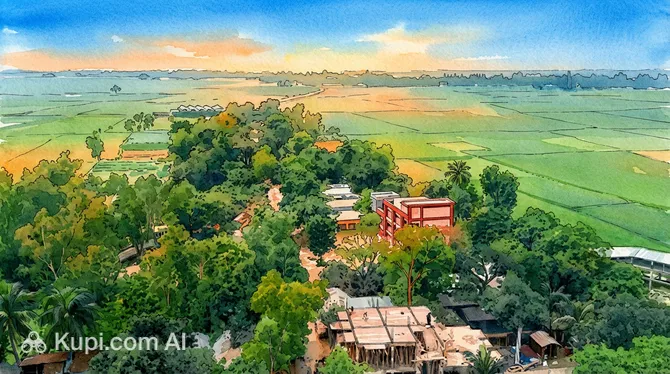
Bada Barabil is the heart of the industrial power of the state of Odisha in India. Often referred to as part of Barbil's "Iron City," it is a unique industrial hub nestled among the scenic hills of the Kendujhar district. While not a traditional tourist destination, it possesses a distinct working energy and the authentic atmosphere of one of the world's largest iron and manganese ore mining centers.
Bada Barabil. Illustration.
Source: Kupi.com AI
The city's geographical location at an altitude of about 477 meters above sea level defines its climate and terrain. The district's population is around 300,000, including a significant proportion of indigenous tribes, which gives the local cultural landscape a unique character. Exploring the history of Bada Barabil's development helps one understand how a small settlement transformed into a strategically important economic center that supplies steel to the entire country.
Although the city's architectural appearance is dictated by the needs of the mining industry, the surrounding areas hide natural gems, such as the Murga Mahadev temple near a waterfall. Visiting Bada Barabil is an opportunity to see the "inner side" of India, get acquainted with the life of mining communities, and appreciate the scale of the region's industrial heritage. It is an invitation for those seeking off-the-beaten-path routes who want to feel the pulse of an industrial giant.
Weather Overview
The climate in Bada Barabil belongs to the tropical savanna type, which means a clear division of seasons. When planning a visit, it is worth carefully checking the weather in Bada Barabil to avoid extreme heat or torrential rains that can paralyze traffic on dirt roads near the mines.
The summer months, especially April and May, are characterized by high temperatures reaching +36°C and high humidity. During this period, the dry air is often filled with dust from the mines. Winter (from November to February), in contrast, brings mild and comfortable warmth with average temperatures around +19°C...+22°C, making this the most suitable time for travel.
The monsoon season begins in June and lasts until September, bringing heavy rainfall. July and August are the wettest months, with up to 360 mm of precipitation, and air humidity reaches its peak. At this time, the surrounding hills are covered with lush greenery, but the transport accessibility of the region may deteriorate due to washed-out roads.
Average monthly temperature
Average monthly precipitation
Interesting Facts
World Treasury: The Barbil-Bada Barabil region possesses some of the world's richest reserves of iron and manganese ore, which supply industrial giants like Tata Steel.
High-altitude Status: The city is located at an altitude of about 477 meters above sea level, creating specific climatic conditions and a unique mountain relief in its surroundings.
Tribal Heritage: About 45–48% of the population consists of representatives of indigenous tribes and castes, placing the city in a special protected zone under the Constitution of India.
Industrial Giant: Bada Barabil's economy is almost 100% dependent on the mining and steel industries, making it one of the most important budget contributors to the state of Odisha.
Literacy and Youth: Despite its industrial character, the literacy rate here is over 72%, and a significant portion of the residents (about 16%) are children under the age of 6.
How to Get There
Bada Barabil is located in a remote industrial district of Odisha, making the journey there a true adventure. The primary ways to reach the city are by rail and road, which are actively used for transporting ore. Travelers should be prepared for logistics that require time and careful planning. Detailed information on routes is available on the how to get to Bada Barabil page.
The nearest major air hubs are located quite far away. Travelers most often fly into airports in neighboring states or the capital of Odisha, from where the overland portion of the journey begins.
The railway is the most reliable means of communication. Barbil station is connected by direct lines to major cities, including Bhubaneswar and Puri. Trains pass through picturesque mountain areas, and the travel time from Bhubaneswar averages between 6 and 8 hours.
Bus services connect the city with the administrative center of Keonjhar (about 100 km) and the industrial hub of Jamshedpur. The roads pass through mountains, and while traffic jams are rare here, the condition of the road surface can be variable, and movement is often slowed by convoys of ore trucks.
Main Attractions
Bada Barabil is primarily known for its industrial focus, so there are few classic tourist sites here. The main interest for the city's rare guests lies in the surroundings, where nature contrasts with giant quarries. The Murga Mahadev temple is considered the primary place of pilgrimage and relaxation. Located at the foot of a picturesque waterfall and dedicated to Lord Shiva, this site attracts visitors with its peaceful atmosphere and natural beauty, providing a sharp contrast to the dusty roads of the industrial zone.
For those interested in industrial tourism, the region's landscape itself is an attraction. Huge open-pit mines and manganese quarries are an impressive sight. Occasionally, for specialists or by special arrangement, introductory tours of the mining sites are conducted, where one can witness the large-scale technical processes that supply raw materials to the country's largest steel plants.
In the city itself, the local markets and squares of Barbil serve as the center of social life. Although they lack historical polish, here you can feel the true rhythm of working-class India. The absence of tourist crowds makes visiting these places as authentic as possible, allowing for observations of the daily lives of mining families and the traditions of local tribal communities.
Local Cuisine
The culinary traditions of Bada Barabil are closely intertwined with those of the state of Odisha and the lifestyle of mining communities. The staple of the diet is rice, served with various types of dal (lentils), vegetable curries, and fresh fish from local rivers. Simplicity and heartiness are the main characteristics of a local meal, designed to restore strength after a day's work.
You should definitely try the traditional Odisha pithas (a type of pancake/rice cake) and fragrant curries such as machha besara, prepared with prawns or chicken and local spices. The influence of tribal communities brings unique ingredients to the menu; you may find dishes using forest herbs and roots, adding wild, primeval notes to the gastronomic experience.
The food culture in the city is represented by modest diners (dhabas) near markets and roads, where workers usually eat. These are the best places to sample authentic street food. Among drinks, scorching masala chai and refreshing palm juice (toddy) collected by locals are particularly popular. Despite the lack of fine-dining restaurants, the city's food scene wins you over with its honesty and the bright, rich flavors of the traditional Indian hinterland.
Travel Tips
Bada Barabil is a specific destination requiring certain preparation and an understanding of the local context. These tips will help you make your visit to the industrial heart of Odisha as comfortable and safe as possible.
Clothing and Essentials: Choose practical and non-staining clothes that you don't mind getting dirty with red dust from the mines. Be sure to bring a protective mask or respirator—during the dry season, dust from trucks can be an issue. Modest clothing is required for visiting temples.
Transport: Rely on taxis or auto-rickshaws, but be prepared for traffic jams caused by ore trucks. If you plan to travel by train, book tickets to Barbil station 2-3 weeks in advance.
Finances: There are few ATMs in the city that accept international cards, so have a sufficient supply of cash rupees. Cards practically do not work in local shops.
Health and Safety: Drink only bottled water. Avoid walking through mine areas unaccompanied and try not to be near roads with heavy truck traffic after dark.
Communication: The main languages are Odia and Hindi. Only a few hotel staff and mine managers understand English. It is useful to learn a couple of basic phrases in Hindi or have an offline translator.
Local Etiquette: Always remove your shoes when entering homes or temples. Mining communities are friendly, but respect their privacy and do not photograph industrial sites without permission.
What to Avoid: Do not plan trips during the height of the monsoon season (July-August), as dirt roads can become impassable and mining operations slow down.
Extra Tip: Visit the weekly local bazaar—it's the best chance to see the culture of local tribes without tourist embellishments.
Despite its ruggedness, Bada Barabil will show you a new side of India—hardworking, massive, and majestic in its own way.
Entertainment & Nightlife
The entertainment infrastructure in Bada Barabil is almost entirely geared toward local residents and workers, so you won't find the typical tourist nightlife with clubs and bars here. Evening activity centers around the lively markets and tea stalls in the Barbil area, where people gather to discuss news over a cup of hot masala chai. This is the best time to experience the flavor of a working city and try local street food.
The main cultural events in the city are traditional holidays and festivals, such as Ratha Yatra or Durga Puja. During these days, the streets are transformed with festive processions and folk celebrations, which become the main entertainment for the entire region. At other times, residents prefer relaxing at home or engaging in outdoor sports activities, which is typical for industrial settlements.
To find more modern forms of leisure, such as cinemas or shopping centers, the local population usually travels to neighboring Keonjhar or larger cities. Safety in Bada Barabil during the evening is at an acceptable level; however, tourists are advised to avoid walking on the outskirts near the mines due to heavy machinery traffic and insufficient lighting. For night-time travel, it is better to arrange a local taxi driver in advance.
Parks & Museums
In Bada Barabil itself, you won't find classic museums or extensive manicured parks—the city's industrial status dictates its own rules. Greenery here is localized, mostly around residential townships for mining company employees. Nevertheless, for those looking for a place to walk, locals often use the slopes of the surrounding hills, which offer spectacular panoramic views of the quarries and mines.
The environmental situation in the region is challenging due to constant mining, so park areas cannot always compensate for the abundance of dust. However, small green zones near company administrative buildings serve as islands of tranquility in this industrial sea. Museum exhibits dedicated to the history of mine development and the region's geology should be sought in the administrative center of Keonjhar, where the state's cultural component is better represented.
The landscape itself can be called a natural open-air "museum" here: the combination of red ore earth and tropical vegetation creates surreal images. Travelers who appreciate landscape photography will find it interesting to explore the surrounding heights, where nature still retains its original state despite the proximity to giant excavators and conveyor belts.
Getting Around
The public transport system in Bada Barabil is adapted to the needs of miners and local residents. The main means of travel between residential areas and industrial sites are buses and auto-rickshaws. Bus services connect the city with neighboring Barbil and the larger Keonjhar; however, keep in mind that transport can be very crowded during shift changes at the mines.
For short trips within the city, auto-rickshaws are ideal. It is best to agree on the fare in advance, as meters are rarely used. Private taxis are an alternative and are convenient for trips to distant attractions, such as waterfalls or temples in the vicinity. Due to the abundance of ore trucks, the roads are often dusty, so many locals prefer to get around on motorbikes.
Payment by card or through apps virtually does not exist in public transport, so tourists should always carry a supply of cash. Transport operating hours are limited by daylight and the mine working schedules. The main feature of local traffic is the priority given to heavy machinery: convoys of trucks can cause significant delays, so travel time should be planned with a buffer of 20–30 minutes.
Accommodation
Accommodation in Bada Barabil is primarily oriented toward business travelers, mining company managers, and engineers. There are virtually no luxury resorts here, but there is a selection of functional mid-range hotels and guesthouses offering basic comfort for short-term stays.
Most lodging options are concentrated in the center of Barbil. These are the most convenient areas as they provide access to transport hubs and local infrastructure. For those planning a long-term work visit, apartment rental offers are common, allowing one to feel more autonomous in an industrial settlement.
When planning a trip, it is recommended to book accommodation in advance through popular international services, as the number of quality rooms is limited. The price range here is quite affordable, and the service in guesthouses is characterized by typical Indian hospitality, albeit without frills. The main focus when choosing should be on the availability of air conditioning and reliable Wi-Fi, which are critical in the local climate.
Nearby Cities
Bada Barabil serves as a kind of gateway to the industrial and natural heart of Odisha, being an excellent starting point for exploring nearby cities and ore centers. The city's surroundings offer travelers the chance to see a unique symbiosis of untouched nature and the massive human impact on the landscape.
The most significant neighbor is the city of Keonjhar (Kendujhar), located about 57 kilometers away. This is the district's administrative center, where you can find museums dedicated to the region's history and more developed infrastructure. Also worth noting is Noamundi, located just 14 kilometers away, which is also closely linked to the mining industry and offers a similar industrial landscape.
Exploring these destinations will help you better understand the scale of India's industrial development and see how people live in one of the country's most resource-rich corners. Short trips to places like Champua or Manoharpur will complement your understanding of the diverse and hardworking Odisha.
Shopping & Souvenirs
Shopping in Bada Barabil is primarily an immersion into the atmosphere of traditional Indian bazaars. There are no shiny shopping centers with global brands; instead, there is an abundance of local markets where you can find everything you need, from everyday work clothes to fresh tropical fruits and spices. The main shopping points are concentrated in the Barbil area, where life is in full swing from early morning.
The main treasure for a tourist here can be products from local tribal communities. Be sure to look for handmade fabrics and traditional jewelry. Since the region is rich in manganese and iron, you can sometimes find mining-related souvenirs or authentic household items created by local artisans in the markets.
Shops in the city usually operate from early morning until late evening with a lunch break. Payments are primarily made in cash (Indian Rupees); cards are accepted only in the largest retail outlets. Visiting the weekly markets is the best way to purchase unique souvenirs and see how goods from all around the area converge at this important industrial hub.