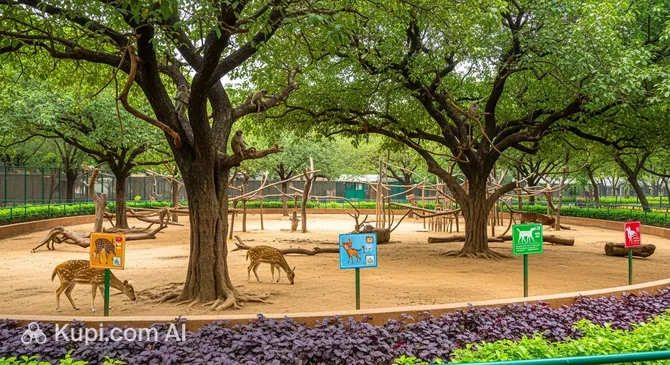
Guindy Children's Park is a stunning green oasis and a cozy corner of wildlife located in the heart of the bustling metropolis of Chennai. Part of the larger Guindy National Park in India, this park is a dedicated zone for family recreation where young explorers can get up close with the region's rich fauna.
Guindy Children's Park. Illustration.
Source: Kupi.com AI
Traveler photos:
A real mini-zoo spans across a territory of about 9 hectares. It is home to graceful blackbucks, spotted deer, sambars, and even clever jackals. Bird lovers will appreciate the variety of local residents: from majestic grey pelicans and night herons to vibrant cockatoos and common peacocks roaming freely among the tropical greenery.
A special point of pride for the park and a unique attraction is the fossilized tree trunk, which is estimated to be 20 million years old. This rare open-air exhibit allows you to literally touch the planet's prehistoric past, making a walk not only pleasant but also very educational.
Contacts
When planning your visit to Guindy Children's Park, it is helpful to have the administration's current contact details on hand. You can check for information about special events or visiting rules in advance by phone or via the official website.
A visit to Guindy Children's Park promises to be a real adventure for the whole family. The main activity here is leisurely strolls along shady, well-maintained paths lined with spacious enclosures. Children will be delighted by the opportunity to observe the habits of spotted deer and funny mongooses in almost their natural habitat.
For active recreation, the park features a modern playground with swings and slides. One of the most popular attractions is a ride on the miniature railway, which cheerfully winds through the trees. Young visitors can also try their hand at riding by taking a pony or even an elephant ride, which leaves an unforgettable impression.
Photography enthusiasts should keep their cameras ready: the local inhabitants, especially the colorful birds and langurs, often make excellent models. A walk through the park is also a great chance to study India's nature in a calm and safe environment, away from the city noise and bustle.
Getting There
Guindy Children's Park is conveniently located within the city limits and is easily accessible from anywhere in Chennai, India. If you prefer the metro, the nearest station is Government Estate (Blue Line/MRTS). The park entrance is about 2–3 kilometers from the station, which can be covered on foot or by using an auto-rickshaw or taxi.
The well-developed public transport network also offers many options. Bus routes 21G, 27B, and 47A lead to the park, stopping nearby in the Anna Salai or Guindy areas. A taxi ride from the city center takes little time and is the most comfortable way to reach the gates of the national park directly.
Nearest city: Chennai
History & Facts
The history of Guindy Children's Park is closely intertwined with the past of the entire Guindy National Park, which once served as a vast hunting reserve. This territory is one of the last remaining patches of the unique tropical dry evergreen forests of the Coromandel Coast, giving it significant ecological value.
The development of these lands began back in the 17th century. Between 1672 and 1678, British Governor William Langhorne built Guindy Lodge here—a picturesque residence with a luxurious garden intended for relaxation. Later, in 1821, the Madras Government purchased the remaining forest land from a Briton named Gilbert Rodericks for the then-impressive sum of 35,000 rupees.
A turning point came in 1910 when more than 500 hectares of the territory were officially granted reserved forest status. The modern Children's Park was carved out of the national park as a specialized space designed to instill a love for nature from an early age while preserving the region's historical heritage.
Time Needed
To explore every corner of the park without rushing, see the inhabitants of the mini-zoo, and give children enough time to play on the playground, it is recommended to set aside 2 to 3 hours for your visit. This is enough time to take a ride on the miniature railway and examine the unique fossilized tree trunk.
If you plan to have a small family picnic or linger by the rare bird enclosures for more detailed observation, it is worth budgeting half a day. Morning hours or time closer to evening are considered the most favorable, as animals are more active and the air temperature becomes more comfortable for walking.
Working Hours
Guindy Children's Park is open to visitors daily from 09:30 to 17:30. It is important to remember that Tuesday is the official day off when the park is closed for maintenance and animal rest. It is recommended to check the information on the official website before your trip, as the schedule may change on public holidays.
The entrance fee is very affordable: a visit for adults will cost approximately 60 rupees, and a discounted rate of just 10 rupees is available for children aged 5 to 12.
Day
Working hours
Monday
09:00–17:30
Tuesday
Закрыто
Wednesday
09:00–17:30
Thursday
09:00–17:30
Friday
09:00–17:30
Saturday
09:00–17:30
Sunday
09:00–17:30
Nearby
Exploring the surroundings of Guindy Children's Park can significantly enrich your trip. The Guindy district and its adjacent neighborhoods are famous for their entertainment complexes and shopping centers, where you can relax after an active day in nature.
For those looking to continue the family fun, nearby you will find modern trampoline centers, beach resorts, and large-scale theme parks offering entertainment for every taste.