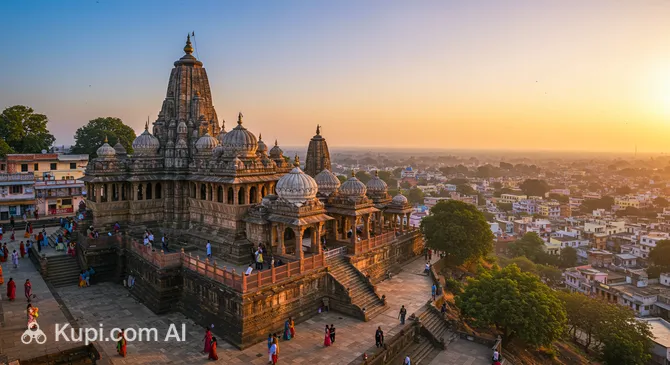
Dewas is a dynamic industrial center located in the picturesque Malwa region of the Indian state of Madhya Pradesh. Despite its industrial status, the city possesses a unique atmosphere where modern development is closely intertwined with the rich spiritual heritage of India.
Dewas. Illustration.
Source: Kupi.com AI
Geographically, the city stretches across the Malwa Plateau, right at the foot of Chamunda Hill, which serves as its main natural and spiritual landmark. With a population of about 290,000, Dewas plays an important administrative and economic role, being widely known for the government's Bank Note Press. Delving into the city's historical heritage, one can learn that it once served as the capital of two princely states simultaneously under the rule of the Maratha Puar clan.
For travelers, the city is primarily interesting for its temples and the opportunity to witness the daily life of a developing hub in Central India. A visit to Dewas is an excellent addition to a Madhya Pradesh itinerary, offering a calm atmosphere and the warm hospitality of the locals.
Weather Overview
Climatic conditions in Dewas are typical for the central part of the country and are characterized by distinct seasonality. Hot summer begins in March and reaches its peak in May, when daytime temperatures often exceed +39°C. Winter months, by contrast, bring long-awaited coolness with comfortable average values around +18...+20°C. Detailed weather in Dewas will help you better plan your visit dates.
Special attention should be paid to the monsoon season, which lasts from June to September. During this time, the city is covered by heavy rains—in July and August, more than 300 mm of precipitation falls, and humidity increases significantly. The dry and sunny winter with clear days is considered the most suitable time to visit the region, when you can enjoy walks without the exhausting heat.
Average monthly temperature
Average monthly precipitation
Interesting Facts
Dewas hides many interesting details that help to better understand its character and significance for the region.
The city's name comes from the phrase "Dev-vas", which translates to "Abode of the Goddess," indicating the settlement's deep connection to the temple on Chamunda Hill.
The uniqueness of the city's history lies in the fact that from 1728 it was divided between two brothers of the Panwar Maratha clan, becoming the capital of two independent princely states at once.
Dewas plays a critical role in the country's financial system, as it is home to one of the largest state printing presses that prints Indian banknotes.
In everyday communication, local residents use not only Hindi but also the colorful Malvi dialect, reflecting the cultural identity of this part of Madhya Pradesh.
How to Get There
The transport accessibility of Dewas is due to its advantageous location on the NH52 national highway, which connects the key cities of the region. For those planning a trip, it is important to study the routes to Dewas in advance to choose the most comfortable travel option.
The nearest aviation hub is Indore International Airport (IDR), located about 35 kilometers away. From there, the city center can be reached by taxi or regular bus in about one hour. The airport accepts flights from all major metropolises in the country, including Delhi and Mumbai.
Railway communication is represented by Dewas Junction station. This is an important hub through which long-distance trains pass. Direct trains, such as the Malwa Express or Avantika Express, connect the city with Delhi and Mumbai. A train ride from neighboring Indore takes only about one hour.
Station
Passenger traffic
Distance
Indore Junction railway station
7
34 km
Bhopal Junction railway station
9
143 km
Rani Kamalapati railway station
10
145 km
Jalgaon railway station
6
222 km
Udaipur City railway station
5
298 km
Main Attractions
The main spiritual center and symbol of the city is the majestic Dewas Mata Temple, located atop Chamunda Hill. This site attracts not only pilgrims but also lovers of panoramic views: the hilltop offers an impressive vantage point over the Malwa Plateau and city quarters. A convenient staircase leads to the temple, and the ascent is accompanied by an atmosphere of peace.
In addition to the main sanctuary, the Devi Vaishini Shrine is also located on the hill, making this a unique religious complex where two incarnations of the goddess are worshipped. The history of the Maratha princely states has left its mark on the city's architecture: you can find ancient gates and building fragments that recall the former grandeur of the Puar clan rulers.
Although Dewas is not a mass tourist destination, its authenticity and the absence of crowds allow for a genuine feel of the spirit of Central India. For those interested in Maratha culture, the city offers a quiet introduction to history without the hustle and bustle of neighboring metropolises.
Local Cuisine
The gastronomic profile of Dewas is inextricably linked to the culinary traditions of the Malwa region, where the diet is based on wheat, dairy products, and aromatic spices. One of the most popular dishes here is dal bafla—baked wheat dough balls served with a rich lentil gravy. For breakfast, locals prefer poha—light flattened rice seasoned with turmeric and mustard seeds.
Among the city's establishments, The South Ishq is notable for exploring South Indian flavors, and God Gift Hotel & Resort offers a wide selection of dishes in a comfortable setting. Street food also deserves attention: at the markets, be sure to try sabudana khichdi (a tapioca dish) and sweet malpua pancakes, which are especially good when paired with hot masala chai.
Dining culture in Dewas is quite traditional: in the evenings, residents often gather in small family restaurants or at street food stalls. The city's gastronomic scene is predominantly vegetarian, reflecting the religious and cultural characteristics of this region of Central India.
Travel Tips
To ensure your trip to Dewas is as comfortable as possible and leaves only pleasant impressions, we have prepared a few practical recommendations.
Clothing and Dress Code: Choose light clothing made of natural fabrics, but remember modesty when visiting temples—shoulders and knees should be covered. In the winter months (December-January), it can be cool in the evenings, so bring a light sweater.
Getting Around: The most convenient way to move around the city is by auto-rickshaw. Always agree on the price in advance. For trips to neighboring Indore, it is better to use taxis or comfortable intercity buses.
Finances: The local currency is the Indian Rupee. Major hotels and chain stores accept cards, but always keep cash on hand for markets and rickshaws.
Health: Drink only bottled water and avoid ice in drinks on the street. Pharmacies are easy to find on the city's main shopping streets.
Communication: The main language is Hindi. English is understood by hotel staff and young people, but a learned "Namaste" greeting will always help win over the locals.
Local Etiquette: Be sure to remove your shoes when entering temples and private homes. When passing money or food, try to use your right hand.
What to Avoid: Do not plan walks through remote industrial zones after dark. It is also worth avoiding noisy behavior in sacred places.
Connectivity: You can buy a SIM card at specialized centers in the city center; tourists will need a passport for registration.
Following these simple rules will help you dive deeper into the local culture and make your visit to this industrial center truly interesting.
Entertainment & Nightlife
Dewas is primarily a city of work and prayer, so classic nightlife in the form of clubs and discos is virtually non-existent here. Local entertainment mainly revolves around watching new movie releases in city cinemas and visiting modern shopping spaces like Pakeeza Dewas. If you are looking for vibrant parties and bars, it is better to head to neighboring Indore, which can be quickly reached by taxi.
Evenings in the city are best spent strolling past historical sites such as Lal Gate or Sayaji Gate, which look particularly monumental in the rays of the setting sun. During major festivals like Diwali or Navratri, the city is transformed: the streets fill with music, dancing, and bright illuminations, turning Dewas into a single festive venue in the Malwa style.
For a quiet family evening, dining at hotel restaurants like the one at God Gift Hotel & Resort is a good choice. Daytime leisure can be varied with walks through local markets or visits to spiritual shrines, which remain the main centers of attraction for both residents and the city's few guests.
Parks & Museums
As a major industrial center, Dewas does not boast an abundance of extensive park areas or classical museums. The main place for outdoor walks is the area around Chamunda Hill. At the foot of the hill and on the way to its summit, there are small green corners and well-kept terraces where you can take a break from the city bustle and the noise of the factories.
Historical enthusiasts will find interest in the architectural monuments that serve as unique open-air heritage sites. Notable among them are the majestic Sayaji Gate and the historic Lal Gate. These structures are silent witnesses to the era of the Maratha princes' rule and allow one to imagine the scale of the city's former administrative significance.
While there are no specialized art galleries in the city, the cultural layer of Dewas is vividly manifested in its temple architecture. Many shrines are decorated with intricate carvings and paintings that tell the stories of Malwa's mythology and traditions just as well as museum exhibits.
Getting Around
The public transport system in Dewas is oriented towards the needs of the local population and the workers of numerous factories. The basis of intra-city communication is auto-rickshaws and cycle-rickshaws. This is the most accessible and maneuverable way to move through busy streets and the market area. Fixed fares are not standard here, so tourists are advised to clarify the price of the trip with the driver in advance.
Intercity communication is much better developed. Regular bus services connect Dewas with Indore, Bhopal, and other parts of the state. Buses depart from the central bus station quite frequently, offering both budget options and more comfortable expresses. The Dewas Junction railway station is also a key infrastructure element, providing connections to major cities across India.
Walking is possible in the central quarters and at the foot of Chamunda Hill, though one should consider the intense traffic and the hot climate. Car rentals are practically non-existent in the city, so for long-distance travel, it is most convenient to call a taxi through specialized services or mobile apps.
Accommodation
The choice of accommodation in Dewas mainly consists of budget hotels and guesthouses catering to business travelers and pilgrims. The most convenient accommodation options are concentrated in the central part of the city, near the railway station and the main temples. For those seeking more modern infrastructure, God Gift Hotel & Resort is worth considering.
As the city is a major industrial hub, long-term apartment rentals are also popular, often used by specialists visiting local factories. The tourism sector is represented by 2-3 star hotels where you can find basic amenities at quite affordable prices. It is recommended to book accommodation in advance if your trip coincides with major religious holidays.
For those who prefer a wide selection of luxury hotels, staying in neighboring Indore can be a good solution. Due to the proximity of the cities and good transport links, many travelers prefer to stay in the larger metropolis and visit Dewas as a day trip.
Nearby Cities
The location of Dewas makes it an excellent starting point for exploring Madhya Pradesh. Just an hour's drive away is the region's largest metropolis—Indore, which impresses with its Holkar-era architectural heritage, modern shopping malls, and the gastronomic variety of the Sarafa Bazaar night market.
If you want to see the quieter province, it is worth visiting small neighboring settlements such as Sanwer or Tonk Khurd, the road to which will not take much time. Those interested in spiritual enlightenment will find it rewarding to travel to ancient Ujjain, one of the country's sacred cities, located about 100 kilometers from Dewas.
City
Population
Distance
Tonk Khurd
8,696
22 km
Sanwer
17,365
23 km
Sonkach
20,529
30 km
Chirak
10,855
30 km
Bhainsoda
16,818
30 km
Exploring the surroundings allows you to see the multifaceted nature of Indian life—from the bustling markets of Sonkatch to the peaceful agricultural landscapes of Chiraka. A well-developed network of roads and railways makes such day trips easy and untiring.
Shopping & Souvenirs
Shopping in Dewas is primarily an immersion into the atmosphere of traditional Indian bazaars. The main trading activity is concentrated in the city's central markets, where stalls are bright with colorful fabrics, piles of aromatic spices, and daily necessities. While there aren't many glittering malls, the Pakeeza Dewas complex is open for those seeking a modern shopping format.
As souvenirs from Dewas, people most often bring back religious attributes and figurines of deities purchased in the shops at the foot of Chamunda Hill. The region is also famous for its textile products featuring traditional Malwa patterns, which make excellent gifts. At the food markets, look out for local sweets that preserve the authentic taste of Madhya Pradesh.
Market stalls usually operate from early morning until late evening, closing only for a short break during the hottest part of the afternoon. Payment in most small shops is accepted in cash only, and the ability to haggle politely will help you make a purchase at a better price.