Support

Kaniyambadi

About

Kaniyambadi is a charming and authentic town nestled in the heart of the state of Tamil Nadu, in southern India. It is situated in a picturesque valley surrounded by green hills, just a few kilometers southwest of the larger city of Vellore. Thanks to this favorable location, Kaniyambadi has absorbed the tranquility of nature and the authentic rhythm of traditional South Indian life.

With a population of about 11,000 people, Kaniyambadi maintains the atmosphere of an intimate and friendly place where every guest feels comfortable. While the town is not a major administrative or industrial center, it plays an important role in the region's life due to its developed agriculture, crafts, and local trade, which gives it a special character.
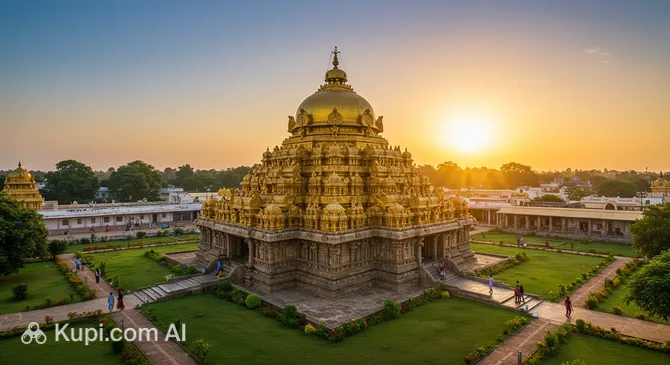
Kaniyambadi. Illustration.
Source: Kupi.com AI

The main appeal of Kaniyambadi lies in its leisurely and peaceful atmosphere. There is no city bustle here, but there is a wonderful opportunity to immerse yourself in the authentic culture of Tamil Nadu. Guests can enjoy strolls through quiet streets, observing the daily lives of locals, or admire magnificent sunsets against the backdrop of the hills. It is a place where you can truly relax your soul and get acquainted with the traditional way of life.

If you are looking for new experiences away from standard tourist routes and want to feel the true spirit of southern India, Kaniyambadi will be a real discovery for you, offering unforgettable moments of tranquility and harmony.

You can find more interesting facts on the Kaniyambadi city history page.

Weather Overview

The climate in Kaniyambadi is hot for most of the year. In general, travelers should expect a very sweltering summer with increasing rainfall towards June and a warm, predominantly dry winter. In more detail, the highest temperatures (averaging 30.5-31.4°C, peaking up to 36.5°C) are observed from April to June. The winter months, from December to February, are characterized by an average temperature of about 23-25°C and minimal rainfall. The most humid period lasts from June to November, peaking in rainfall (up to 7 mm) and rainy days (up to 20) in October and November. The driest months are February, March, and April. To better plan your trip, check the detailed forecast on the Kaniyambadi climate page.

Average monthly temperature

Average monthly precipitation

Interesting Facts

Beyond the well-known tourist routes, Kaniyambadi hides many amazing stories and features that make it a truly unique place. Here are just a few interesting facts that will help you look at this town from a new perspective:

  • Historically, Kaniyambadi was known as an important agricultural center. Even today, rice, millet, peanuts, and mangoes are grown here, and local farmers take pride in their harvests, considering them among the best in the district.

  • Kaniyambadi is home to one of the oldest markets in the Vellore district. It is a true fair of colors, flavors, and aromas, where you can experience the authentic atmosphere of a South Indian village and bargain with hospitable locals.

  • The town is famous for its colorful religious holidays and temple festivals. Every year, impressive processions dedicated to Hindu deities take place, during which the streets are filled with music, dancing, and the scent of incense.

  • Many legends are associated with Kaniyambadi. Locals say that sages and ascetics once sought solitude in the surrounding hills. It is said that ancient rock-cut images can still be found on one of the hills, which, according to tradition, bring good luck to travelers.

How to Get There

When planning a trip to this cozy corner of Tamil Nadu, it is worth thinking through your route in advance. Since the town is small, direct access may require transfers at larger transport hubs. You can learn more about how to get to Kaniyambadi by reviewing the main options below.

Kaniyambadi does not have its own airport, so the air route here lies through neighboring major cities. The most convenient option for most international and domestic tourists is Chennai Airport (IATA: MAA). It is located in Chennai, approximately 114 km from Kaniyambadi. This is one of the country's largest aviation hubs, receiving flights from all over the world. The journey by taxi or bus from the airport to the town takes about 3 hours and 10 minutes.

Another popular option, especially for those traveling through the state of Karnataka, is Kempegowda International Airport (IATA: BLR) in Bengaluru. It is located at a distance of about 161 km. The drive from there will be longer, approximately 4 hours and 20 minutes, but the wide range of flights often makes this route worthwhile.

It is also worth mentioning Tirupati Airport (IATA: TIR), located in Tirumala (Tirupati), just 102 km from Kaniyambadi. Although smaller and primarily serving domestic flights, the travel time from there is about 2 hours and 50 minutes, making it the closest gateway.

For clarity, here is summary information on the main airports used to reach the region:

AirportPassenger trafficDistance
Tirupati Airport995 640102 km
Chennai Airport22 mln114 km
Pondicherry Airport85 000118 km
Kempegowda International Airport41.9 mln161 km
Salem130 132162 km

Regarding rail connections, Kaniyambadi has a small railway station, but it serves only a limited number of local passenger trains. For tourists, it is much more convenient to use the major Katpadi Junction station, located in the neighboring city of Vellore, just 15–20 km from Kaniyambadi. Katpadi is an important railway hub where many express trains from Chennai, Bangalore, Mumbai, and Delhi stop. From the station, Kaniyambadi can be easily reached by local bus or auto-rickshaw in 30–40 minutes.

Road connections are also quite well-developed. Kaniyambadi is located on the highway connecting Vellore and Tiruvannamalai, so state and private buses from both cities run regularly. A bus ride from Vellore takes very little time and is the most budget-friendly way to reach your destination.

Main Attractions

Kaniyambadi, cozily situated in the state of Tamil Nadu, serves as an excellent starting point for exploring the region's rich cultural and historical heritage. Although the town itself may be small, its surroundings abound with iconic sites that attract travelers.

One of the main attractions easily accessible from Kaniyambadi is the majestic Vellore Fort. This 16th-century fort impresses with its monumental architecture and rich history. Its grounds house a temple, a mosque, and a church, testifying to the region's cultural diversity. A walk along its powerful walls and inner courtyards allows you to touch the past and appreciate the craftsmanship of ancient builders. The fort is of interest to both history buffs and architecture enthusiasts.

Nearby, in the village of Thirumalaikodi, lies the famous Sripuram Golden Temple, dedicated to the goddess Mahalakshmi. It is one of the most impressive modern religious structures in India. The temple and its surrounding buildings are covered in real gold, creating a dazzling spectacle, especially at sunrise or sunset. Pilgrims and tourists come here to admire its splendor and spiritual atmosphere.

Inside Vellore Fort itself is another significant site – the Jalakandeswarar Temple. Dedicated to Lord Shiva, this temple is a fine example of Dravidian architecture. It is famous for its exquisite stone carvings, detailed gopurams (entrance towers), and sacred pond. The temple attracts visitors with its beauty and peaceful atmosphere, offering an opportunity to immerse oneself in Hindu traditions.

Local Cuisine

The cuisine of Kaniyambadi is a true immersion into the gastronomic traditions of South India, specifically the state of Tamil Nadu. Travelers can expect authentic, aromatic, and incredibly tasty food that tells as much about the local culture as its landmarks. The diet is based on dishes made from rice, lentils, and fresh vegetables, generously seasoned with spices.

Be sure to try classic dishes like idli – tender steamed rice cakes, and dosa – crispy thin pancakes made from rice and lentil flour. These are often served with sambar, a thick and spicy lentil soup with vegetables, and various chutneys. Coconut plays a major role in local cooking – it is added to many sauces, curries, and even desserts. Don't miss the chance to enjoy "payasam" – a sweet milk and rice pudding with nuts, traditionally prepared for holidays.

As for drinks, refreshing beverages made from fresh tropical fruits are popular in Kaniyambadi and can be found everywhere. Traditional Indian Masala Chai is also an integral part of the meal. Among non-alcoholic drinks, it is also worth trying lassi – a yogurt-based drink that can be either sweet or salty. Information on local alcoholic beverages is less common, as the emphasis here is on the rich culture of non-alcoholic treats.

The food culture in Kaniyambadi is very lively and accessible. Street food here is not just a snack but an entire gastronomic experience: on every corner, you can find stalls with fried bananas, spicy samosas, and other local delicacies. Farmers' markets offer an abundance of the freshest fruits like mango and guava, as well as exotic spices. During gastronomic festivals, locals organize communal meals, creating an atmosphere of hospitality and togetherness where everyone can feel part of a big, friendly family and discover new facets of Tamil cuisine.

The Kaniyambadi food scene attracts tourists with its authenticity, use of fresh local products, and the opportunity to taste real South Indian flavors. Signature dishes that shouldn't be missed include idli, dosa, and aromatic sambar. The general character of the cuisine can be described as simple yet incredibly rich and welcoming, offering a unique culinary experience to every guest.

Travel Tips

Planning a trip to Kaniyambadi? Wonderful! To ensure your journey through this corner of India goes smoothly and leaves only pleasant impressions, we have prepared some practical tips.

  1. Clothing and Essentials: When packing for Kaniyambadi, opt for light, breathable clothing made of cotton or linen, especially during the hot months (usually March to May). Monsoon rains are possible from October to December, so a light waterproof jacket or umbrella will be very useful. Don't forget sunscreen, a hat for sun protection, comfortable shoes for walking, and a universal adapter for electronics. When visiting temples and other religious sites, choose modest clothing that covers your shoulders and knees.
  2. City Transport: Kaniyambadi is a small settlement, so the main transport here will likely be local buses connecting it with the surroundings and, of course, auto-rickshaws. Always agree on the fare for a rickshaw ride in advance, as meters may be absent or not used. A rental car is unlikely to be needed for moving around the town itself but could be an option for exploring the region if you feel confident on Indian roads.
  3. Finance and Currency: The official currency is the Indian Rupee (INR). We recommend exchanging money at banks or official exchange offices in larger cities before arriving in Kaniyambadi, as exchange opportunities here may be limited. Bank cards may be accepted in very few places, so having enough cash is mandatory. ATMs may also be scarce, so withdraw money in advance. Tipping is not strictly mandatory but is always appreciated for good service (usually 5-10% of the bill in restaurants or a small amount for drivers and porters).
  4. Health and Safety: Pharmacies with a basic set of medicines can likely be found in Kaniyambadi, but it is always better to have a personal first-aid kit with necessary medications. For serious medical help, you may need to visit medical facilities in the neighboring, larger city of Vellore. Be sure to take out travel medical insurance before your trip. Drink only bottled or boiled water. The town itself is generally safe, but always observe standard precautions: watch your belongings, especially in crowded places, and avoid walking alone in poorly lit or deserted areas after dark.
  5. Language and Connectivity: The main language in Kaniyambadi and the state of Tamil Nadu is Tamil. English may be understood in some tourist areas or among educated youth, but you should not count on it being spoken everywhere. It will be helpful to learn a few simple phrases in Tamil: "Vanakkam" (Hello/Hi), "Nandri" (Thank you), "Illai" (No), "Aama" (Yes), "Evalavu?" (How much?). It is best to purchase a SIM card with internet access (popular operators are Airtel, Jio, Vi) at the airport or at a mobile shop in a large city upon arrival in India (passport and visa required). Wi-Fi access may be available at your hotel or guest house.
  6. Local Etiquette and Traditions: When greeting locals, use the traditional Tamil greeting "Vanakkam," which can be accompanied by a slight nod of the head or a "namaste" gesture (palms joined together at chest level). In public places, try to behave discreetly and dress modestly, especially women. When passing money, food, or any objects, as well as while eating, try to use your right hand, as the left hand is traditionally considered "unclean." Before photographing people, especially women and children, politely ask for their permission.
  7. What to Avoid: Try not to point your feet at people, religious images, or toward a temple – this is considered extremely disrespectful. Also, avoid public displays of affection. Do not engage in loud arguments, especially over prices; if you bargain, do so with a smile and respect.
  8. Additional Useful Tip: Kaniyambadi is relatively close to the city of Vellore, which is famous for attractions like the historic Vellore Fort and the magnificent Sripuram Golden Temple. If you have the time and opportunity, consider them for a day trip. And, of course, don't miss the chance to try authentic Tamil cuisine in local small cafes and eateries – it is an unforgettable gastronomic experience!

We hope these tips help you better prepare for your trip and enjoy every moment of your stay in Kaniyambadi. Have a safe journey and wonderful impressions!

Entertainment & Nightlife

Kaniyambadi, a small and cozy town in the state of Tamil Nadu, offers its guests a unique opportunity to immerse themselves in the measured pace of Indian provincial life. Evening life here is far from the noise and bustle of megacities and has its own, more quiet and authentic character. It is important to understand that in Kaniyambadi, you will not find extensive districts with nightclubs or many specialized bars; evening entertainment here is focused on other aspects.

Nightlife in Kaniyambadi is mostly concentrated around local restaurants and eateries where you can taste traditional South Indian cuisine. Some of them stay open until late evening, allowing you to enjoy dinner in a calm setting. The atmosphere in such establishments is usually very local and friendly, without any strict dress code. Regarding specific names of famous bars or nightclubs, given the size and nature of Kaniyambadi, such information is generally absent from public tourist guides. It is best to find noteworthy restaurants that stay open late once you are on-site, based on recommendations from locals.

Evening activity in the town usually winds down after 10:00 PM - 11:00 PM. Prices for dinner or drinks in local establishments are generally quite affordable and consistent with the level of a small Indian town, making evening outings accessible. It is best to check exact price ranges on-site, but you can expect dinner to be significantly cheaper than in major tourist centers.

For getting around the town in the evening, auto-rickshaws are the most convenient transport. They can be found on busier streets, sometimes at makeshift stands near markets or bus stops, or simply hailed by hand. It is critically important to always agree on the fare with the driver in advance, especially late at night, to avoid misunderstandings. Although Kaniyambadi is generally considered a safe place, standard precautions should not be neglected: avoid poorly lit and deserted streets, especially if you are traveling alone.

Since Kaniyambadi is a small town, there are practically no specialized nightclubs or European-style bars here. Instead, for evening relaxation, we recommend exploring local restaurants and cafes on the main streets – that is where you can feel the true atmosphere of the town. Do not hesitate to ask your hotel staff or locals for advice – they can often suggest the best places for an evening dinner or a quiet pastime based on your preferences.

During the day, Kaniyambadi offers other opportunities to get to know the region. You can visit local temples, stroll through small markets to buy fresh fruit or souvenirs, or simply enjoy the leisurely atmosphere of the town. While there may not be large museums or amusement parks, its charm lies in its authenticity and the chance to see real life in India away from tourist hubs.

Parks & Museums

Kaniyambadi, a small town in the state of Tamil Nadu, offers its guests the opportunity to enjoy the tranquility of nature and get acquainted with the local culture, which distinguishes it from the bustle of major megacities. Although there may not be a large number of traditional parks and museums, the town and its surroundings possess their own unique charm.

For those seeking green spaces, Kaniyambadi and its environs offer several options. The town itself, located in a rural area, is surrounded by natural landscapes where you can enjoy silence and fresh air. The Christian Medical College (CMC) campus area in Kaniyambadi may also offer well-maintained green zones pleasant for walking. One of the most impressive examples of landscape design nearby is the gardens at the Sri Narayani Peedam (Golden Temple) complex in Sripuram. These extensive, meticulously maintained gardens with star shapes, fountains, and sculptures create an atmosphere of peace and spirituality, attracting many visitors.

Regarding museums and cultural heritage, as a small town, Kaniyambadi may not have many formal museum institutions. However, the cultural richness of the region can be felt by visiting local temples, which are often not just religious centers but also repositories of history and traditional art. These temples, with their characteristic Dravidian architecture and vibrant rituals, provide a glimpse into the spiritual life of South India. The Christian Medical College itself, being an important institution, also contributes to the town's character and may be of interest from the perspective of modern history and architecture.

For a deeper dive into the history and art of the Tamil Nadu region, travelers might consider visiting the larger city of Vellore nearby, which houses historical monuments such as Vellore Fort and several museums. However, even in Kaniyambadi itself, authentic experiences can be found. Try visiting the local market to see daily life or simply walk through the streets observing the locals' way of life – this will allow you to better feel the atmosphere of this corner of India.

Getting Around

When planning to get around Kaniyambadi, it is worth considering that this is a small town, and the public transport system here will differ from that of megacities. The basis of the transport network likely consists of local buses and the ubiquitous auto-rickshaws.

Buses are the most common and affordable type of public transport, connecting different parts of the town and nearby settlements. These are usually state or private buses with regular, though not always strictly followed, schedules. Fares are generally paid in cash to the conductor or driver upon entry. The cost depends on the distance. Information about routes is best obtained from locals or at bus stops, if they are equipped with information stands.

Auto-rickshaws (or "tuk-tuks") are a popular and flexible way to travel short and medium distances. They provide a "door-to-door" trip. It is important to agree on the fare with the driver in advance, before boarding, as meters may be absent or not used. In some cases, you can use ride-hailing apps for taxis and auto-rickshaws if they operate in the region, but the traditional way to order is to hail one on the street or find them at special stands.

For short distances in Kaniyambadi, moving on foot can be quite comfortable, especially if you want to get better acquainted with the town's atmosphere. Cycle rickshaws may be encountered, but auto-rickshaws are usually more common. As for taxis in the traditional sense, they may be less available compared to auto-rickshaws and generally cost more; it is better to order them in advance, for example, through your hotel.

The fare payment system in Kaniyambadi's public transport likely does not involve complex travel cards or tourist-oriented mobile apps. Prepare small change for the fare. Public transport usually operates most actively during daylight hours. Overall, navigating the town's transport system should not cause major difficulties, and locals are generally friendly and ready to help with directions.

Accommodation

In Kaniyambadi, travelers can find various accommodation options to suit both modest budgets and requirements for greater comfort. The main choices include small hotels, guest houses, and possibly room or apartment rentals from local residents. You can find simple and economical options as well as more well-equipped places to stay.

When choosing accommodation in Kaniyambadi, it is worth considering its location. The most convenient options are generally in the central part of the town or near main transport links, which will facilitate movement and access to local shops and eateries. Given that Kaniyambadi is a relatively small town, most interesting locations will likely be within reasonable reach.

While there may not be large international hotel chains in Kaniyambadi, local hotels and guest houses often offer a warm, hospitable atmosphere and an individual approach to every guest. Staying in such places allows for a deeper dive into the local culture and lifestyle. It is recommended to check reviews from other travelers beforehand to choose the most suitable option.

When planning your trip, especially if it falls during the peak tourist season or during local festivals, we advise booking your accommodation in advance. This not only guarantees availability but often allows you to secure better prices. Most options can be found on popular online booking platforms, though some small family-run guest houses may take bookings directly. Overall, the price range for accommodation in Kaniyambadi can be described as affordable and moderate, making it attractive to a wide range of tourists.

Nearby Cities

For those who want to explore the surrounding area, Kaniyambadi serves as an excellent starting point for day trips to several interesting nearby locations:

CityPopulationDistance
Kannamangalam9 6576 km
Vellore696 11013 km
Padavedu14 24116 km
Thimiri19 73718 km
Nandiyalam9 12219 km

These nearby destinations provide insight into the region's diverse culture and landscapes. Each of these towns offers its own unique attractions, whether historical forts, temples, or local markets, making them a wonderful choice for a short journey from Kaniyambadi.

Shopping & Souvenirs

Shopping in Kaniyambadi offers an immersion into the local trading culture typical of small towns in India. Here you won't find large shopping centers with global brands, but you can purchase authentic goods and observe daily life. The main focus should be on local shops and markets where everyday goods, handicrafts, and fresh produce are sold.

Generally, trading activity in Kaniyambadi is concentrated along the main streets or near the central market, if one exists. There are no specialized shopping districts here, but small shops offering clothing, household items, spices, and sweets can be found by strolling through busy parts of the town. This is an excellent opportunity to buy something truly local and interact with the sellers.

Modern large shopping centers should not be expected in Kaniyambadi. Shopping here is of a more traditional nature. Instead of malls, you will find many small family-run shops and stalls, each of which may offer something unique, from fabrics to local delicacies.

Markets play an important role in the commercial life of Kaniyambadi. Visiting a local market is a chance to see a bright variety of fresh vegetables and fruits, aromatic spices, flowers, and possibly handmade items. Even if you don't plan to buy anything, a walk through the market will provide colorful impressions and allow for a better understanding of the local way of life.

As souvenirs from Kaniyambadi and the Tamil Nadu region, you can bring back traditional textile products, such as cotton fabrics or small clothing items with local patterns. Small handicrafts, clay pottery, or wooden items are also popular. Don't forget about spices – India is famous for its variety, and fresh, fragrant options can be found at local markets.

Shops in Kaniyambadi are usually open from the morning (around 10:00 AM) and work until the evening (until 8:00 PM-9:00 PM); some may close for a lunch break. Cash is the main means of payment, especially in markets and small shops. Although digital payments (UPI) are actively developing in India, for tourists, the most convenient option will be to have enough rupees on hand. Credit cards may be accepted in a very limited number of places.

Regarding the Tax-Free system, although India has a Goods and Services Tax (GST), the possibility of tax refunds for tourists is in practice not very common and complicated to arrange, especially in small towns like Kaniyambadi. Therefore, you should not count on this option when making purchases here.

Nearby cities

Reached the end of the page?

That means the route is fully explored